





A Statistical Overview of 2012 First Half Trends in Korean Performing Arts
[Focus] Market Growth Increases Polarization between the Performing Arts Industry and the Creative Arts
Organized by the Research & Consulting Team of the Planning Department at KAMS
Forum Participants (in Korean alphabetical order):
Sangwon SON, Seonga AHN, Jonggyu LEE, Hyunggeun INN, Yoonwoo CHOI
Survey period: June 29, 2012 ~ July 20, 2012 (Survey cycle semi-annually)
Survey sampling: 178
- 63 Performing Arts Facilities (National, Culture and Art Center, Daehangno, other public and private facilities)
- 92 Performing Arts Organizations (Theatrical, Dance, Western Music, Korean Traditional Music, Multidisciplinary)
- 23 Performing Arts Production Companies (including high-profile as well as small to medium-sized companies)
Survey details: business result and outlook (overall business, number of audience, total sales, net profit), number of performance works, number of performances, operating days of performing arts facilities, key factors contributing to errors in operation.
Survey target period: business results Jan. 1 ~ June 30, 2012, outlook July 1 ~ Dec. 31, 2012
Survey method: online
※ Drafted major issues and issues by genre affecting trends in Korean Performing Arts businesses in the first and second half of 2012, through forums participated in by professionals
‘Trends in Korean Performing Arts’, published semi-annually since 2009, provides basic data necessary for establishing business plans for the Korean market. This data allows the Korean Government to understand the market trends and outlook when devising Performing Arts support policies.
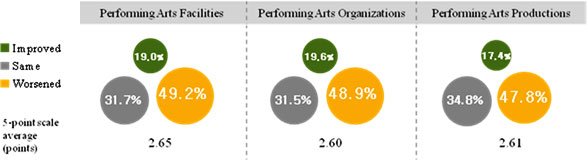
According to the survey, more respondents said that, in the first half of 2012, the business sentiment in the Korean Performing Arts sector had deteriorated since last year, despite slight differences depending on segments. Businesses in the performing arts facilities group aggravated by 49.2% and those in the performing arts organizations improved by 19.6%, year on year, respectively. A review of the data for specific types of establishment reveals that the public facilities, such as the Government sector and Culture and Art Center, deteriorated compared to the private facilities. In the case of the organizations, business improved by genre in the order of Western Music, Dance and Multidisciplinary. As for performing arts production companies, relatively more respondents saw improvement in larger companies.
|
|
|
Diagram 1. Overall Business Result of Respective Segment (by types of establishment) YOY (first half of 2011) |
| |||||||||||||||||||||||||||||||||||||||||||||||||||||||||||||||||||||||||||||
|
Chart 1. Overall Business Result of Respective Segment (by types of detailed establishments) YOY (first half of 2011) | |||||||||||||||||||||||||||||||||||||||||||||||||||||||||||||||||||||||||||||
However, according to Interpark statistics, the market took a favorable turn and increased by 9% to 1,370 performances in the first half of 2012. This was attributable to the huge success of large-scale musicals, with over 1,000 seats filled, and Dance, a relatively a minor genre, which more than doubled its popularity.
|
Survey Period: Jan.1 to June 30 of each year. | |||||||||||||||||||||||||||||||||||
| |||||||||||||||||||||||||||||||||||
| Chart 2. Number of Performances Comparison in First Half of 2009-2012 |
Data collected from Interpark, which indicate the market trend is improving, contradict the results of the survey, even when the concert genre, not included in the survey, is disregarded. In line with results from last year’s survey, market expansion was shown to be led by a few in the industry, and the business sentiment level, as well as its deviation, have increased this year. The results show that the volume of the market expanded in terms of contents supply, but also aggravated in terms of individual organizations or facilities.
Key Issues in the First Half of 2012
Key issues emerged from the changes to the internal and external environment of the Performing Arts sector, some of which were elaborations or intensifications of previous issues.
■ Increasing polarization between culture industry and the creative arts.
The recession in the Theater market has become apparent with a big fall in the number of audiences and oversupply, whereas the market share for big musicals has increased. In the first half of this year alone, the output of two to three musical works, with sales over 10 billion won, was a catalyst for market expansion. This led to the full-scale production and distribution of musical works and the opening of musical-exclusive theaters, such as D-Cube Arts Center and Blue Square, late last year. With the increased supply of such musicals, the production companies cited lack of actors and increase in production cost due to star castings as potential issues.
■ Economic stagnation and changes in customer outlook.
Among the economic variables, ’’overall domestic economic slump’’ topped the list of major causes for the aggravated business trend. However, unlike the economic recession back in 1998, the recent North American and European financial crisis didn’’t affect performing arts attendance. Younger audiences, who are indifferent to continuous economic stagnation, tended to enjoy the present rather than invest and save for the future. Amid such changes, audiences came to watch the same works over and over again and production companies tailored their marketing to repeat customers.
■ Change in the cultural policy direction of Seoul City
The central government hasn’’t made any big changes in the support system since 2010 and there hasn’t been a negative response to the support policy from the performing arts sector. After the election of the Seoul Mayor in October last year, the local government’’s policy changed to be more citizen-oriented. It will be interesting to see the impact this has on support for artists.
■ Emergence of various promotion marketing media, and widespread usage of SNS.
With the prominence of online and various other media, and the scope of the social network service (SNS), there is no such thing as off-season in promotion and marketing. Use of SNS also allows enhanced communication between creator, producer and audience. At the same time, the market has witnessed the byproduct of SNS-based social commerce: price policy imbalance in the performing arts market.
■ The Korean Wave (’’Hallyu’’) 3.0 is musicals
The Musicals Dream High, Thrill Me, Washing, Jack the Ripper, Goong, Street Life and Gwanghwamun Sonata are to be performed in the latter half of this year in Japan. It may be fair to say that this year is the first year of the Korean musicals’’ fully-fledged overseas expansion.
In the first half of this year, foreign bookings of Korean musicals through the Interpark global page more than doubled - an increase of 102%, year on year - and the reservation rate increased by 254%, year on year, through the online cultural guide site VisitSeoul. In the past, foreigners mainly watched non-verbal performances, such as Nanta and Jump. However, in recent years, more Hallyu fans are coming to watch musicals starring Korean musicians or actors.
Let’’s look into the key issues by genre:
Musical
• Premieres of large-scale musicals, and their success in Korea.
- The biggest attribute of the musical industry in the first half of 2012 was the box-office success of large-scale musicals. Long-running hit musicals from Broadway and the West End premiered in Korea and became box-office hits, increasing the volume of the musical market. The premiered works that sold over 1,000 seats include Zorro, Elizabeth, Dr. Zhivago, Catch Me If You Can, Wicked and Mozart Opera Rock.
• Small to mid-sized creative musicals presenting stronger stages.
- In 2012, small to mid-sized musical works were reproduced as newer versions. These works which were premiered, and well received, last year include Moby Dick, Finding Family and Sherlock Holmes. In particular, musical works developed by Creative Factory or CJ Creative Minds through step-by-step incubation programs produced notable results.
Theater
• Increase in open-run performances.
- As it became difficult to operate theater companies, production companies focused on making profit from open runs of Romantic Comedy performances that had been successful in the past.
• Reflecting on socio-political issues.
- Writers’ views extended to socio-political issues, and works dealing with such issues were well-received by the audience. Following a play handling the suicide of a middle school student in Daegu, similar plays dealing, directly or indirectly, with adolescents and their issues were performed on stage. Seensee Company’’s play I want to meet your parents dealt with issues of social isolation and suicide, and sent a strong message of the importance of parents and teachers. - As for plays, performances produced in national and public theaters, such as the National Theater Company of Korea, Myeongdong Art Center and Namsan Art Center, were critically acclaimed and were more successful than those in Daehangno. Plays that went on stage in the first half of 2012 recorded a high share of paid seats and Don Quixote, The Gift of the Gorgon, Hedda Gabler and Incendies, performed at Myeongdong Art Theater, were also well-received by the audience. Empazar and My Sweet Mind Seems Ill, played at Theater "Pan" of the National Theater Company of Korea, also garnered big attention. These facilities, celebrating the second to the fourth year of reopening, were able to secure a stable audience pool with high-quality repertories. As roles and functions of public theaters are growing, ongoing discussion of the identity of the private sector is needed.
Concert
• Concerts at a standstill.
- The growth rate of concerts, which increased tremendously until the end of 2011, decreased by about 7% in the first half of 2012. Last year, we witnessed a rich variety of cultural events, including nationwide tours by famous singers Cho Yong Pil, Lee Seung Chul and Lee Mun Sae, and the famous TV program I am a Singer. However, this year world-famous musicians, such as Lady Gaga and Jason Muraz, captured public interest by holding concerts in Korea. Performances by Korean idol groups, such as Shinwha, Beast and Infinite, saturated the rest of the concert market.
Dance
• Ballet at its best: the rise of the ‘Balletdols’.
- Performances from a range of repertories boosted the overall dance market. These repertories included The Lady of the Camillias with Stuttgart Ballet prima ballerina Kang Sue-jin, This is Modern3 from Universal Ballet, and Giselle and Spartacus from Korean National Ballet. As Ballet grew in popularity, star ballerinas and ballerinas, such as Kim Joowon, Kim Jiyoung, Lee Donghoon and Lee Eunwon, now as famous as Korean idols, became known as ‘Balletdols’.
Classical Music
• Continuous growth, year on year.
- The Classical Music sector expanded with annual festivals, such as Uijeongbu International Music Theatre Festival, Korean Orchestra Festival, Busan International Music Festival, Ditto Festival, and Korea Opera Festival, and with more than ten series of weekly performances planned in each facility, including Seoul Arts Center Artist Series, Kumho Art Hall Rising Star Series, Sejong Rising Artist Series, Youngsan Art Hall Concert, and Goyang Aram Nuri Matinee Concert. Ticket sales of small as well as big concerts and award ceremonies contributed to the growth in this sector.
- Cho Young-nam Concert, attracting attention by returning to the stage at Seoul Arts Center, as a pop singer, for the first time in years, and Yuki Kuramoto Concert ranked first and second in total sales in the Classical sector. The tickets for Chung Kyung-Wha’s Recital of Bach’s Sonatas and Partitas, held in Myeongdong Cathedral, were sold out in just a couple of days, showing exceptional ticket-selling power. While world-famous orchestral concerts topped last year’’s ranking, exclusive concerts by these popular musicians dominated the first half of this year’s market.
Key Issues in the Second Half of 2012
The outlook for each sector in the latter half of the year is much the same. By segment, business sentiment for Western music organizations and big production companies looks set to improve. It is predicted that the Daehangno facilities will deteriorate at the highest rate: 57%. In accordance with the first half-year’s results, the second half will also see an increasing polarization between the industry and the Creative Arts sector. The London Olympics haven’t affected the overall performing arts sector, and increased demands towards the end of the year, as well as the Presidential election, should have a positive impact on growth in the latter half. Interpark forecasts around a 15% growth rate in musicals and concerts, based on the growth trend from the first half of the year.
 PREV
PREV
.JPG)
.jpg)
.jpg)
.jpg)
.jpg)












.gif','This data allows the Korean Government to understa..');)


