





Spielart Festival Munich, Contemporary Performing Arts Festival of Germany
[FOCUS] Meet Artistic Director Tilmann Broszat
This winter, I met Tilmann Broszat at Daehangno. He is a figure who is amazingly operating 3 festivals (contemporary music, dance, and theater festivals), and is continuously getting fresh ideas through the festival network and putting them into a reality. Tilmann, who had much interest in theatre, though a sociology major, stepped into the cultural scene when he became the Administrative Director of the Munich Theatre Festival in 1983. He has since been going back and forth working as the managing director and producer for major festivals like the Theatre der Welt, and has stayed close with the theatre scene. In 1995, Tilmann founded the Spielart Festival Munich based on his know-hows and experiences from the prior years. One can feel the force of the programming with such list of names as Toshiki Okada, known as the rebel in Japanese contemporary theatre; Romeo Castellucci, an Italian director known as the master of contemporary performing arts; Forced Entertainment, one of the best experimental theatre groups in Britain. Along with Tilmann, only 7 staff members are operating the 3 festivals. When I asked him if it''s not too tough on the staff, he smiled and said "There aren''t too much problems because there aren''t many places where such things can be done."
|
|
| |
| Tilmann Broszat | ||
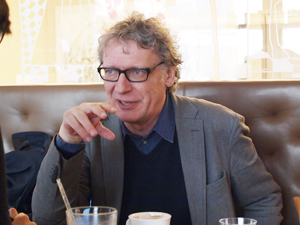
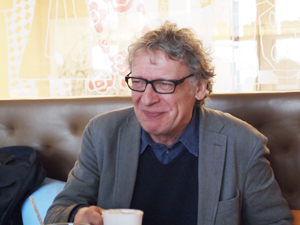
The Spielart Festival Munich was started in Munich, and it is a festival held every two years. Munich is the home of BMW and Goethe Institute, and it is one of the cities where the wealthy retirees make their home. With two universities, it is also a city with considerable number of poor student population. Though it is a beautiful and a nice city to live in, it didn''t always have audiences that come and watch performing arts, especially, contemporary. Even up until the mid-90s, German theatre centered on the state theater, and it was made up of safe repertoires and well-trained actors. So, it wasn''t easy to put up works from unknown artists in the beginning stages of the festival. Of course, the opposition from the critics was formidable as well. When I asked him how he was able to overcome such difficulties, he answered "We got people on our side one at a time. We asked writers who weren''t based on prior writings and asked them to write about their true feelings on our works, and had the writings sent out to people." There wasn''t a special secret or shortcut, but maybe his secret to success came as he consistently and strategically carried on his works with the people who believed in his way of performance as he did.
Festival Network for the Younger Generations
What are the advantages of festivals that open as biennale? Because most of the festivals in Korea must go through budget request and assessment every year to receive public support, I was curious to know the background to how it''s possible to get consistent support even for a festival that happens every other year. Interestingly, the Spielart Festival Munich gets half and half support from the Spielmotor Munich of the BMW Group and the city of Munich. The two sponsors who share the same goal of creating new arts with the festival are said to not interfere in the program or operation of the festival at all. For the year when the festival doesn''t open, the time is used to check and improve the structural issues such as getting new and different ideas.
|
|
| |
| Nursery _ Judith Huber | 1: Songs _ Nicole Beutler |
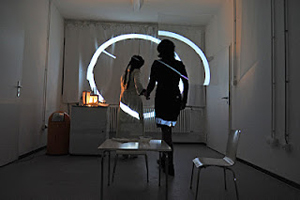
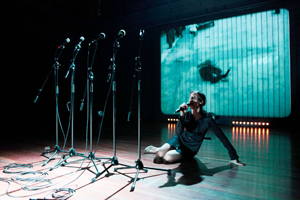
Among those, is a festival network called ''Festivals in Transition (FIT)''. FIT consists of staffs from 8 festivals, who travel to each festival since 2005 to meet with politicians in charge of festival support for lobbying, which is needed for festival operation, and also to meet other staff in order to co-produce or share programs. As most of the festival members are from Eastern Europe, I asked him how the 8 festivals came together. "Though the festivals were doing well they were less well-known than others, and I wanted to help by giving more support." Tilmann regarded other festivals as equal partners and saw them as people with the same dream. That''s how interesting ideas were able to come out naturally, and how he was able to consistently carry on the works. The festivals participating in the FIT are the following:
Festivals participating in FIT
Spielart Festival Munich (Germany)
London International Festival of Theatre: LIFT (UK)
Baltic Circle International Theatre Festival (Finland)
Exodos Festival (Slovenia)
Homo Novus Festival (Latvia)
Krakowskie Remiscenje Teatralne (Poland)
Oktoberdans and Meteor (Norway)
Festival POT (Estonia)
In 2005, the preparation process for the first meeting of these festivals was undoubtedly bold. They asked for support from Allianz Kulturstiftung and received 10 plane tickets. They built trust in each other as they were together through thick and thin, and they began operating an educational program for inspiring next generation of artistic directors by opening the Festival Lab in 2011. Festival Lab gets budget support from the European Commission, and the word educational program is an understatement considering the variety and depth of the topics the Festival Lab deals with. Because most of the recent EU funds are focused on encouraging international collaboration, it wasn''t a difficult task for them as they have been building up such networks. I asked him for the reason behind creating a program for the next generation of artistic directors when the terms aren''t limited for most of the artistic directors in Europe. Tilmann said, "The age group for many festival directors has increased. They might not be able to keep up with the concerns and reality of the younger generations in the future. I believe a generational change is coming."
Other than programs for the next generation artistic directors, a program for next generation artists is also being operated called ‘Connect Connect’. This program invites the next generation artists to the festivals and provides them with mentoring from established artists, and also supports production of new works. As they continuously created opportunities for discussions of works through the Festival Lab, the program for artists was developed from the curiosity as to what would happen if the established artists met with the next generation artists. Artists such as Belgian choreographer Alain Platel, German playwright and director Rene Pollesch, and Belgian choreographer Jan Fabre gets paired with unknown artists and they present their works. Other than production of works, I think this mentoring support from senior groups is a very desirable system of support in comparison to Korea''s support where it is moving towards limitless competition. This year, the Seoul Performing Arts Festival (SPAF) is planning to invite the work by Alain Platel and a Belgian artist, among other works.
|
|
| Connect Connect-Talks |
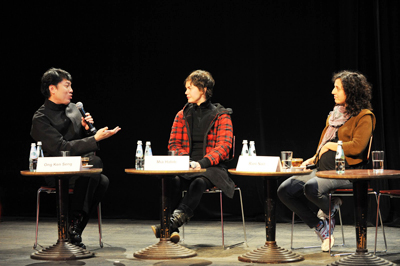
The Spielart Festival Munich has a lot of interest in collaborating with partners other than in Europe, especially, in Asia. Currently, ''Global City, Local City'' is being planned in collaboration with Canada''s Push Festival and Japan''s Festival/Tokyo.
As if he had already mastered the ''Asian behavior'' like the non-stop nodding in front of elders, Tilmann quickly stood up saying he needed to see more of the Korean streets even in the blistering winter wind. As I watched him become smaller in the distance, I realized my biggest expectation of the next Spielart Festival Munich that will open in the winter of 2013 is from the fact that I had just witnessed the wise artistic director who has led this festival for 15 years.
 PREV
PREV
.JPG)
.jpg)
.jpg)
.jpg)
.jpg)












.jpg','This winter, I met Tilmann Broszat at Daehangno. H..');)


