





A Forum for Communication and Research
[FOCUS] Changes and Growth of the Malta Festival Poznań
Why organise festivals in an age of too much content that is often difficult to select and skilfully evaluate? In a continuously changing social and political (as well as cultural) reality should a festival last for decades facing the threat of fossilisation and excessive institutionalisation? Will it not lose its ability to actively follow the most recent and explorative cultural content? Or, perhaps, this is not the goal of a festival at all?
All these questions relate to the Malta Festival Poznań which, for over twenty years, has been trying to engage viewers in an encounter with and participation in a unique celebration that disrupts their daily routine. It all started in 1991, soon after the political transformations that took place in Poland in 1989, in concurrence with the first free elections since before World War II and the onset of the democratisation of political and public life. Polish people had to deal with a new reality on many planes: the free market and changes in authority structures, as well as the emergence of a multitude of discourses and views. During this period of reformulating the nation’s identity Malta Festival Poznań proposed a type of cultural event that had no precedent in Poland: a common and ludic artistic experience celebrated in public space that brought together people holding different outlooks on life and of various social stance. Every year Poznań was visited by a number of international street theatre, circus and music artists who in their spectacular albeit egalitarian projects reclaimed the urban space for culture. Year by year the Malta Festival Poznań grew whilst its network of international contacts continuously expanded.
After a decade it turned out that culture and the surrounding world had changed to an extent that demanded the reformulation of the festival’s actual programme structure. With this in mind, in 2005 we separated several disciplines within the programme, i.e. theatre, dance, music, film and the visual arts. As of then Malta Festival Poznań was no longer a festival of the performing arts only, albeit this lineage continues to significantly determine its programme to date. Another important decision regarding the inner structure transformation was taken after twenty years of the festival’s existence. This regarded the highlighting of a specific theme that engages in dialogue with the surrounding reality and the current cultural phenomena. As of 2010, in the Idiom we have been reflecting upon a selected topic and presenting artistic projects chosen by a curator within a more critical framework. Consequently, the Idiom has become a stage for the presentation of the most electrifying and important international theatre and dance artists, in addition to being a specific laboratory that provides for an in-depth exploration of a particular theme.
The latter decision to reform the festival stemmed also from our reflection on the necessity to avail of this large-scale event not only as an extraordinary urban celebration of the theatre, music and dance, but also as an important situation that draws the audience’s attention to how the world is changing and how artists relate to such change.
|
| ||
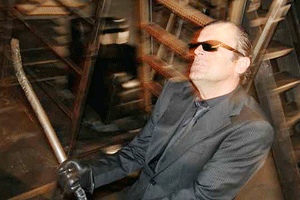
| La Menzogna |
The Co-production that Enables Sharing of Culture & Arts Assets
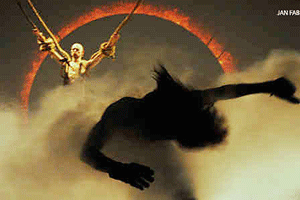
The Malta Festival Poznan programme strategy has been changing simultaneously to the transformations within its structure, albeit its core elements have been continuous in their nature and have, for all these years, been building the event’s identity and position. From the very beginning Malta Festival Poznań has been an international festival and has welcomed ensembles from all over the world. Several years ago this international collaboration also started to stretch beyond the framework of standard project presentation. We are now involved in being the co-creators of various valuable initiatives and have been co-producing them with some of the most renowned European festivals and institutions. In 2009 we co-produced Pippo Delbono’s show La Menzogna (with Theatre du Rond-Point/Paris and Maison de la Culture d''Amiens) and in 2011, the show of the brilliant Flemish artist Jan Fabre, Prometheus Landscape II (with Peak Performances@Montclair State University/Montclair, Théâtre de la Ville/Paris, Tanzhaus NRW / Düsseldorf and Zagreb Youth Theatre, Exodos Ljubljana). This was a very special collaboration which became to us the model of co-production activities. The Malta Festival Poznan was not simply one of the entities that assisted Fabre’s project financially. Our contribution also involved the organisation of master classes a year prior, as part of the Flanders Idiom (2010). To his weeklong master classes Fabre invited actors and dancers from Poland. This resulted in a collaboration with Katarzyna Makuch, a young Polish actress who was then cast in Prometheus Landscape II. Consequently, the co-production gained an added artistic dimension owing to both sides’ exchange of concepts and cultural assets.
|
| ||
| Prometheus Landscape II |
A Festival that Provides New Adventures for the Audience
The multifaceted programme presenting different areas of art, as well as its core, the Idiom, requires well-aimed and suitably motivated decisions concerning artist and project selection. The Malta Festival Poznan is always making an effort to meet the expectations of viewers towards a massive cultural event and this is not an easy task. Hence the individual programme sections are targeted at audiences with various needs and are arranged to provide the several-day-long happening with a dynamic that equally enables participation in large-scale concerts, intimate contemporary dance shows and progressive performances shown within the Idiom, as well as site-specific projects dedicated to particular public space in the city of Poznań. The festival dramaturgy and an appropriate balance of projects displaying various aesthetics and ‘weight’ is the key to a festival that is capable of communicating with viewers without overwhelming them with too much content or leaving them with a sense of separation from it due to its inaccessibility.
Thus Malta Festival Poznań supports the local theatre scene bearing in mind that it takes place in a specific town and region which boasts important artistic traditions, traditions which it has the responsibility to nurture. On the other hand it wishes to present to the Polish audience major artists of international renown. It is our duty to use the festival as an international platform for presenting the arts as well as to include the festival in the flow of significant events of this type in Europe. Only through such a combination can the festival be an inspiring situation for both the local audience and artists and, we hope, for the foreign ensembles that come to the Poznań.
Apart from presentations of local and international projects our focus has recently turned to publishing. With the subsequent Idioms Polish readers are presented with books about major contemporary artists and theatrical phenomena which, despite already being well-established, are not so well-known in Poland, for instance Jan Fabre, Christoph Schlingensief and Rimini Protokoll.
As the director and founder of the Malta Festival Poznań, in the creation of its subsequent editions I always try to find the time for self-reflection and the crystallisation of the goals, opportunities and threats which the project should deal with. I am certain that only the analysis of current activities combined with strategic thinking makes it possible to avoid the threat posed by routine and to preserve the condition of creative tension in the approach to one’s own work.
A successful festival resembles a dish comprising numerous ingredients. Its flavour may be complex and unfamiliar, but it does not leave any doubt as to the quality of the components or the skills of the chef. A festival is also a challenge, both to its creators and organisers, as well as the audience. Each edition invites viewers to take part in this adventure, to take risks and to find their own pathways in the situation proposed.
| Malta Festival Poznań 2011 |
 PREV
PREV
.JPG)
.jpg)
.jpg)
.jpg)
.jpg)












.gif','Why organise festivals in an age of too much conte..');)


