





One India, but Many Cultures
[FOCUS] Performing Arts Festivals that Seek Common Ground
“Must every state be a nation and every nation a state? Or should we look instead to the example of countries such as India, where one state holds together a congeries of “national” groups and cultures in a single and wisely conceived federal republic?”
– Abstract from the essay, ‘The Rise of “State-Nations”’ by Alfred Stepan, Juan J. Linz,
Yogendra Yadav in Journal of Democracy, Volume 21, Number 3, July 2010
There is a practical issue in reconciling the variety of performing arts of India with the idea of a single nation-state. The authors in the essay, while acknowledging that most nation-states will have cultural diversity, introduce the concept of a ‘state-nation’ which is not only multicultural, but even ‘multi-national.’ India, they find, is a good example: “Under Jawaharlal Nehru, India made significant gains in managing multinational tensions through skillful and consensual usage of numerous consociational practices. Through this process India became in the 1950s and the early 1960s a democratic state-nation.”, they say.
Whatever the early years of Independence achieved for political integrity with a founding model, the post-90s India – which has accepted liberalisation, privatisation and globalization – is resonating with the changed economic regime in the arts and culture (or rather, cultures). The states of India, divided culturally, linguistically and, sometimes, ethnically, are actually ‘cultural nations’ that have accepted ‘multiple and complementary identities.’
 |
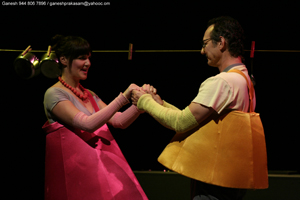 | |
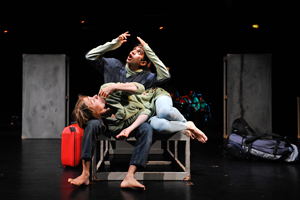
| Boy with a Suitcase | The Great Lalula |
Even looking at India from the city of Bangalore in the deep south, the urge for cultural expression in all of the 28 states up and across the country is evident. Funds for culture provided by the Karnataka government, of which Bangalore is the capital is one indicator: at 40 million USD for a population of 60 million, it challenges the 180-million USD budget for culture provided by the Union Government of India, covering a population of 1.21 billion.
This cultural quickening finds expression in performing arts’ festivals, many of them featuring artistes from other states of India and foreign nations. There is little private support for theatre, dance and music in India except some notable corporations which have established charitable trusts to promote the arts. This is curious because the many global billionaires that have emerged in the new economic regime are staring at skewed development which has made life harder for the poor both in urban and non-urban regions. Nearly 2.5 million farmers have committed suicide in India in the last 15 years, marking the same period that created the billionaires who, it may be argued, could benefit from the “we-ness” that cultural expression would provide.
Growth of Performing Arts Festivals for Local Promotion
The Union Government itself, while declaring India a trillion-dollar economy, is under pressure to deliver on basic issues like health and education, but the governments of the states are increasingly showing eagerness to institute national and international performing arts’ events that are seasonally timed around traditional festivals or local historical sites. This trend is yet to fully play out, but these traditional and historical site festivals have now become the major venues for the performing arts in India.
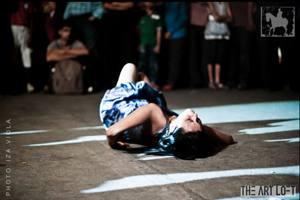
Among these are the 12-year-old Kala Ghoda Arts’ Festival in Mumbai featuring gallery and pavement shows, exhibitions of paintings and sculptures, literary events, film screenings, music concerts, dance performances, theatre shows, workshops, heritage walks and food fiesta. The festival is held usually during the month of February and the Hampi Festival in Karnataka, at the world heritage site and the Konark Dance and Music Festival, which are state-promoted events in Orissa in eastern India.
 |
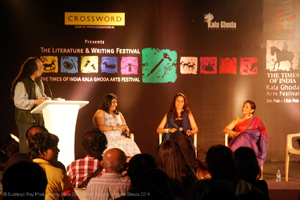 | |
| Kala Ghoda Arts Festival | ||
A unique event of the deep South is the annual ‘Season’ in the city of Chennai, featuring a month of music and dance performances between December and January, when the humid coastal city is coolest. The festival is held across many venues in the city, in performing spaces and temples, and hosted by organizations that call themselves ''sabhas''. The festival has survived with rigor over 70 years and has its roots in religious traditions. Over 2,000 artistes in 300 performances inform this amazing event that attracts dance and music buffs and scholars from around the world.
Similar religion-based performing arts’ events, featuring mainly the varieties of classical music and dances of India, are held during the festivals commemorating the birth of Lord Rama, hero of the epic Ramayana; Lord Ganesh, the guardian of the arts and preventer of evil and bad luck; Diwali, the festival of lights that symbolizes the Hindu creation myth and enlightenment; Navaratri, the nine-day festival that marks the victory of the forces of good against the forces of evil and is celebrated with performances in many parts of India, and some states have local festivals like Onam in Kerala, south India.
Among private supporters of the arts stands out the National Centre for Performing Arts (NCPA), Mumbai, founded in 1969, India’s first multi-venue, multi-purpose cultural centre showcasing a variety of traditions in music, dance and theatre. NCPA has five well-equipped performing spaces and is located in downtown Mumbai. It presents more than 500 events each year across all major art forms.
A good source of information on the performing arts in India is the website www.artindia.net of Art India, founded 1989 in New Delhi. The website functions both as a news board for upcoming events and a forum for discourses on the arts in India. Art India itself has organised national and international festivals of performances and other arts.
Theatre arts are finding fresh ground for experiment and expression in the big cities of India. The Bharat Rang Mahotsav (National Theatre Festival) has been the biggest theatre festival event in New Delhi since it was established in 1999. The annual theatre festival organized by the National School of Drama, funded by the Union Government, brings on stage about 75 productions from all over India and at least 10 shows from other countries. The festival is held in mid-January and is now believed to be the largest theatre festival in Asia.
Other theatre festivals like the Prithvi Theatre Festival in Mumbai, Ranga Shankara Theatre Fest in Bangalore, Kerala International Theatre Festival in Thrissur, Nandikar Theatre Festival in Kolkota and the Rangayana Festival in Mysore have emerged important playing grounds for Indian theatre groups and showcases for international performing companies.
Another interesting trend that is emerging in the last few years is the idea of city festivals like Bangalore Habba or, what is now being called the signature city festival of India – the Delhi International Arts Festival (DIAF). The festival, promoted by classical Bharatanatyam expert Prathibha Prahlad calls itself “a projection of brand India” and is based on a public-private partnership that has found support from several government bodies and corporates. The multi-art, multi-venue festival has strong Indian content and invites participation from many countries and is held across 50 venues over three weeks.
The list of festivals of performing arts in India keeps growing, but also changing because new ones are launched and some fall off the map because of poor organizational skills or lack of sustained funding.
The variety is remarkable:
• Jaipur Heritage International Festival in the princely city of Rajasthan
• The Other Festival in Chennai
• The Rann Utsav in Gujarat, western India
• Youth and Cultural Festivals in Nagaland in the north-east
• Pinjore Heritage Festival in Chandigarh, north India
• the 165-year-old Thyagaraja Aradhana in Tiruvayaru, south India
• Beach Festival at Kakinada on the east coast
• Sadir Theatre Festival in Goa on the Arabian Sea
• Khajuraho Dance Festival in central India
• Kalidas Samaroh at Ujjain
• The Park’s New Festival held in many cities
But, in the great kaleidoscope of swirling colors, rhythms, movements, tones and voices, what could be done to create a composite Indian identity that not only shows itself coherently to the world, but is able to offer a harmonious blend of sensibilities to performing artistes from other countries is a difficult ask. It is unlikely that the Indian government and the governments in the states will continue to fund the performing arts, challenged as they are by risings demands for better food, health, education and security. The performing arts are up against popular cinema and television. The future, perhaps, is in exchange and engagement, between the forms and movements across India, and one between a cultural common ground of India and the performing arts’ traditions of the world.
 PREV
PREV
.JPG)
.jpg)
.jpg)
.jpg)
.jpg)












.jpg','There is a practical issue in reconciling the vari..');)


