





7 Big Issues in Korea Arts Management
[Focus] What happened in 2011
The webzine Weekly@Arts Management published by the Korea Arts Management Service (Korean only), selected the ''2011 Arts Management News in Korea'' with the help of its readers. The results are as follows:
|
|
|
[Table 1] 2011 Arts Management Top 7 News |
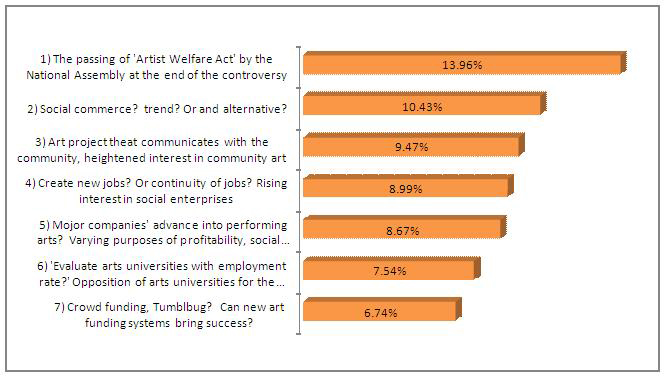
Expectations for Artist Welfare Act
The ''Artist Welfare Act'' that was passed by the National Assembly on Oct. was selected as the top news of 2011 Arts Management news. Though the people in the field of arts and culture identified with the view that the status and rights of the artists have been laid on legal basis, it won''t be easy in terms of implementing ordinances and preparing subsequent measures, collecting on-site opinions, handling urgent problems, etc. Some people are pointing out that even though there is high interest in artist’s welfare laws because of high expectations of improved work and creative environments, yet there is lack of practical understanding of the law. Some disappointments also settled in about the future effectiveness of the law as the legal implications were lower than what most had expected. However, the expectations or controversies surrounding Artist Welfare Act remain calm until the confirmation of various enforcement ordinance and regulation contents which will be implemented starting Nov., 2012. See related article from theApro
The Emergence of New Ticket Distribution and Funding System
There has been increase in promotion and marketing through social commerce in performing arts, and recently, there is also steady rise for exhibitions. However, as there is rise in related enterprises and fierce competition among them, so is there tendency to favor partial performances that are successful at the box office. This is also causing concerns for social commerce because the enterprises are demanding high discount rates. Certainly, there are also positive outlook that the art market can be expanded by activating the inflow of consumers to the market.
The Crowd Funding which are getting much attention as the new fundraising system in arts and culture have placed themselves. Currently, small-scaled projects are being conducted through this new fundraising system that can incorporate diverse fundraising activities and ideas. There is rising interest in this new system because the funds, though not large amounts, are available a little more freely and diversely compared to public grant funds and can be used for such costs as performance production costs, partial project fees, publishing costs for independent exhibition brochures, and equipment rental fees for independent films. It also has the advantage of providing opportunities for a more intimate communication with the sponsors.
|
|
|
A website for Crowd Funding (www.tumblbug.com) |
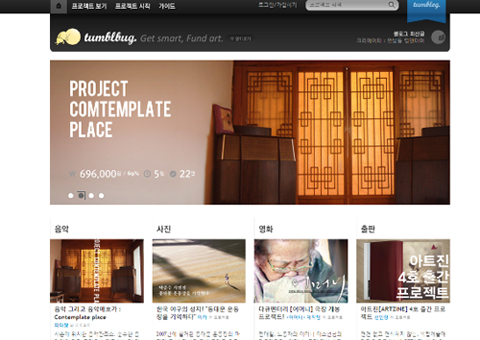
The new theaters which are founded and run by large corporation named Blue Square, D-cube Arts Center, and others opened in 2011. Although there are varieties of aims in the advancement of corporate theaters such as profitability, social contributions, art marketing, etc., there still exist voices that show concern in their monopolization of the market through huge capital and unbalanced commercialization.
The Value of ''Kind Art'' and Demand for Social Communication
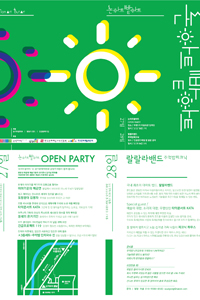
Community art is the 3rd news. There have been recent boost of interest in art projects that communicate with the community. Art projects that communicate with the local residents are expected to continue onto next year and some of them are Seoul Art Space Geumcheon which is one of the art spaces that is being operated by Seoul Foundation Arts and Culture (SFAC) with cooperation from Seoul Digital Industrial Complex, Community Dance of Incheon Art Platform and Nonartbutart ("non" meaning rice paddy, "but" meaning field in Korean) of Gyeonggi Cultural Foundation.
In addition, there are significant changes in the public art policies that are providing transitions into community arts such as the ''Percent for Art'' scheme'' (a regulation that sets aside 1% of the construction cost for art decorations such as sculptures in front of buildings or large murals when constructing a building that has a total floor area of more than 10,000㎡) which caused a lot of controversies through the amended Culture and Arts Promotion Act in past May, and the introduction of optional funding system.
|
|
| |
| Promotional flyer of Nonartbutart | Market & Forum of Social Enterprise |
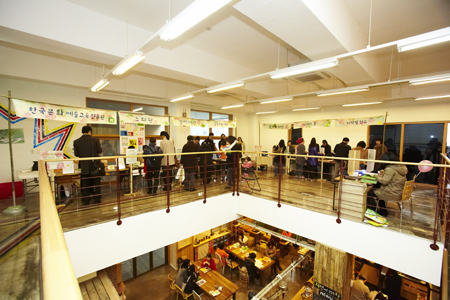
The social enterprise in the arts and culture was found to be the 4th news. It is not easy to reconcile the dilemma of social contributions and profit generation; however after the establishment of the Social Enterprise Promotion Act in 2007, social enterprise is growing rapidly as funding projects are actively implemented not only in the central government, but also in each of the local governments as well. Of course, due to serious economic downturn and unemployment issues, there are efforts for job creation by the overall society, but because it still hasn''t positioned itself as a stable and continuous policy, the demand for a new system and support measures that reflect such special areas is high.
Current Standing of Art?
As arts universities were included in the ''universities with limited government funding and universities with limited student loan'' which was selected and announced at the board restructuring of poor university management, the controversy whether arts universities can be evaluated through the employment rate has placed 6th the news. When speaking of the inherent meaning and value of art, the education system of arts universities should have an evaluation index from a separate field rather than the general performance index. It has been proposed that a refreshment in the meaning of art in the society is once again needed as the belief that social value of art and the perception of art is becoming more flexible has been debunked by this issue.
On the other hand, though it wasn''t selected among the top news, there were questions regarding the role and value of art as we witnessed disaster of force majeure and natural disasters that occurred all around the world this year. In addition, there have been demands of policies in relation to arts and culture industry within the nation that can take measures against disasters which resulted from the cancellation of the invited team''s performance due to the aftermath of nuclear power plant accident in Japan early this year, repetitive swine flu crisis, and flood damage of Seoul Arts Center, etc.
 PREV
PREV
.JPG)
.jpg)
.jpg)
.jpg)
.jpg)











.jpg','The 'Artist Welfare Act' that was passed by the Na..');)


