





Thoughts to Mull Over Surrounding Welfare Act for Artists
[FOCUS] Issues in World Arts Management: (VI) Status of arts managers
To understand the newest issues and trends of arts management, we have prepared the “Issues in World Arts Management.” Through analysis of home and overseas editors at “theApro”, this article is planning to organize, by areas and issues, the main keywords that are being dealt with throughout the world arts management sector, and to examine each country’s current situation and response.
Overseas(Ⅰ) Asia (Ⅱ) North America (Ⅲ) Europe
Korea(Ⅳ) Private arts institutions (Ⅴ) Supply of and demand for experts
(Ⅵ) Status of arts managers
Overseas & Korea(Ⅶ) Discussions
Declaration of Rights and Status of Artists
The National Assembly passed Welfare Act for Artists (Act) on October 28, 2011. It has been eight years since discussions on artists’ status started in earnest, two years since the legislation was first introduced, and nine months since Go-eun Choi died, whose death propelled the passage. The Act is to develop a model contract form, to set up the process of verifying the credentials of an artist, to provide occupational health and safety insurance coverage and to establish a foundation dedicated to welfare of artists. What is more meaningful than these specific measures to be taken is the provisions declaring the status and rights of artists. The Act promulgates, “the purpose of this Act is to protect the occupational status and rights of artists, to promote creative activities by supporting welfare of artists, and thereby to contribute to advancement of arts.” It also provides that artists shall be entitled to due respect as contributors to realization of a civilized nation and improvement of quality of lives of Koreans. Therefore, “artists are entitled to the rights to free activities, and to enjoyment of due spiritual and material benefits by means of artistic achievements.” It is a globally rare legislation of this kind. Few countries have enacted the rights and status of artists. It is an achievement acquired jointly by the administration and politicians.
|
|
| Discussions on Welfare Act for Artists |
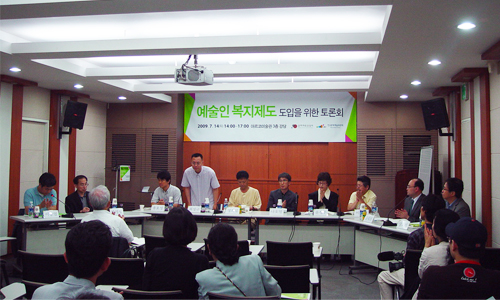
Let’s look back on the legislative history, especially on last June when its discussion stopped. To begin with, passage of the legislation seemed promising, smoothly passing through, backed by bipartisan support, the congressional committee on culture and arts. The steps left were passage through the judiciary committee and the entire Assembly. Since bipartisan support was promised, it seemed just a matter of time. But it began bumping into roadblocks. The labor ministry kicked in. A high-ranking ministry official argued that, under the current law, artists do not constitute part of the worker class and, therefore, are not eligible for unemployment benefits, since a person is not eligible for said benefits, if he or she is not an employee under control of an employer. The official also cited the fact that the requirement disqualifies those who work more like workers. For example, caddies, insurance salespersons, and drivers of concrete mixer trucks are ineligible for various types of benefits. In sum, artists do not constitute workers pursuant to the labor and relevant laws. Consequently, its passage was halted. In the end, the bill passed. The passed version does not contain any provisions entitling artists to unemployment benefits.
The situation is more complicated with regard to those in charge of arts management. The Act defines an artist as a person who, as occupation, contributes to cultural, social, economic and political enrichment of the nation through his/her artistic activities, and whose creative, performing and/or technical supporting activities are verifiable in accordance with the Executive Order issued or to be issued pursuant to Section 2(1)(1) of the Culture and Arts Promotion Act. What the law reads implies that clarification will be made with the implementation rules. But the provision is silent about arts managerial personnel. Considering the legislative history and ensued discussions, it seems natural that they are included within the class of artist. But the vagueness itself attests to their collective status.
Compared with traditional artists, the managerial professionals are peculiar in terms of the scope and the method of work performance. Arts management serves as a vehicle of communication with audiences, local communities, governments and corporate sponsors. In other words, it manages relations with diverse and mixed partners. Basically, corporations and government agencies speak different tongues from the one used by artists. That is why it is sometimes said that “translation” is necessary. They also differ in how they work. Arts management professionals work in a different way than traditional artists do for creation and performance. Conventional arts activities do not encompass such concepts as marketing, fund-raising and audience development. For this nature, arts management is often misunderstood. In addition, the professionals are treated as aliens to arts activities. They seldom get directly involved in creative activities, and the bond between artists and them is pretty weak. In a worst case, their activities are blamed for destruction of artistic values.
Unclear Status of Arts Management Professionals
The situation is more complicated with regard to those in charge of arts management. The Act defines an artist as a person who, as occupation, contributes to cultural, social, economic and political enrichment of the nation through his/her artistic activities, and whose creative, performing and/or technical supporting activities are verifiable in accordance with the Executive Order issued or to be issued pursuant to Section 2(1)(1) of the Culture and Arts Promotion Act. What the law reads implies that clarification will be made with the implementation rules. But the provision is silent about arts managerial personnel. Considering the legislative history and ensued discussions, it seems natural that they are included within the class of artist. But the vagueness itself attests to their collective status.
Compared with traditional artists, the managerial professionals are peculiar in terms of the scope and the method of work performance. Arts management serves as a vehicle of communication with audiences, local communities, governments and corporate sponsors. In other words, it manages relations with diverse and mixed partners. Basically, corporations and government agencies speak different tongues from the one used by artists. That is why it is sometimes said that “translation” is necessary. They also differ in how they work. Arts management professionals work in a different way than traditional artists do for creation and performance. Conventional arts activities do not encompass such concepts as marketing, fund-raising and audience development. For this nature, arts management is often misunderstood. In addition, the professionals are treated as aliens to arts activities. They seldom get directly involved in creative activities, and the bond between artists and them is pretty weak. In a worst case, their activities are blamed for destruction of artistic values.
|
|
| Discussions on Welfare Act for Artists |
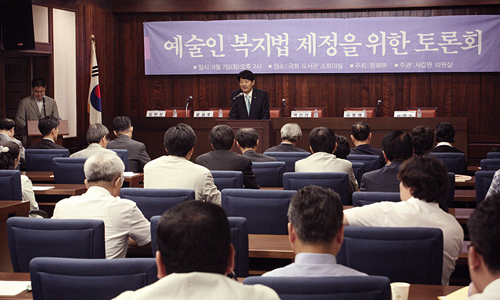
Behind this misunderstanding is the suddenly emerged importance of arts management. Arts management specialists highlight their importance in connection with publicly funded projects and large-scale shows. They carry out a significant role in innovative artistic processes like interdisciplinary arts. Now, no one or artist denies the important role carried out by program organizers, producers or arts managers. It is taken for granted that they lead or support organizations. I often define their job as the calling of the new millennium. (I stress the importance by defining directorship as that of the 20th century.) My delineation emphasizes the dual aspects of the job; namely, it is a future-oriented new job, and, at the same time, is yet to be stabilized. In another article, I remember addressing three major issues complained of by them: low compensation, lack of occupational stability, and uncertain future. I went on to cite as the reasons lack of capital power in the arts community, demand fluctuations for relevant human resources and newness of the job itself.
Ultimately it seems fair to say that arts managers’ status is undergoing a transitional period, showing a dual nature arising out of the nature of their job and the newness thereof. Many symptoms ensue, such as difference between idealism and reality, that between educational and field requirements, gap between actual requirements and institutional mechanism, lack of occupational identity, and difference between appearance and practice. Most of them share one thing in common: uncertainty and instability. What really matters is whether it is transitional in nature, or it is rooted in the nature of arts management. Of course, I wish it would be the former case.
Link
| See other articles on issues on world arts management :
(Ⅰ) Asia (Ⅱ) North America (Ⅲ) Europe
(Ⅳ) Private arts institutions (Ⅴ) Supply of and demand for experts (Ⅶ) Discussions
 PREV
PREV
.JPG)
.jpg)
.jpg)
.jpg)
.jpg)












.jpg','The National Assembly passed Welfare Act for Artis..');)


