





Shortage of Human Resources for Local Arts Organizations
[FOCUS] Issues in World Arts Management: (V) Supply and Demand of Professionals
To understand the newest issues and trends of arts management, we have prepared the “Issues in World Arts Management.” Through analysis of home and overseas editors at “theApro”, this article is planning to organize, by areas and issues, the main keywords that are being dealt with throughout the world arts management sector, and to examine each country’s current situation and response.
Overseas(Ⅰ) Asia (Ⅱ) North America (Ⅲ) Europe
Korea(Ⅳ) Private arts institutions (Ⅴ) Supply of and demand for experts
(Ⅵ) Status of arts managers
Overseas & Korea(Ⅶ) Discussions
Since the dawn of the new millennium, diverse arts policies have been put in place in earnest, stimulating foundation of relevant nationwide infrastructure and professional organizations like cultural foundations. Accordingly, the demand has risen for those majored or specialized in arts management. Departments and graduate courses sprang up, producing a considerable number of graduates every year. Arts management has outpaced the growth of the domestic arts and culture industry in terms of specialization and professionalism. When a renowned cultural organization or foundation recruits a handful of arts management professionals, hundreds of candidates compete. The fact, however, indicates how unbalanced supply and demand is. The situation is attributable to the fact that state-/locality-run or financially stable organizations dominate the interest of those who have majored in arts management, cultural policy, museum management, and program planning.
Supply of Arts Managers Unreflective of Industrial Demands
|
|
| |
| Educational Programs on Arts Management Hosted by Local Organizations and Communities | ||
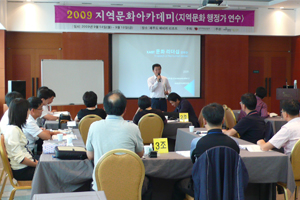
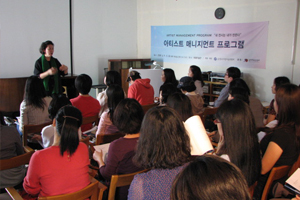
The organizations in the Seoul Metropolitan area are capable of absorbing only a fragment of the arts management graduates and professionals. For those who fail to settle in that area, the conditions are tough. They are seldom given opportunities to build career or to further training. In early days, field administers who once worked for arts groups or had experience with cultural administration entered college to hone up professionalism. These days, however, students major in it as undergraduate to begin with, or arts undergraduate majors specialize in it at graduate level. Their conversion is probably triggered by their concerns over uncertain future. Their desire, however, does not come from field experiences.
Therefore, the supply of human resources is self-created by the educational system. Without any field experiences or first-hand contacts with the reality they will be part of, they get to be called “professionals.” That is why numerous organizations pay attention to field experience when recruiting people. The new type of professionals act very sensitively concerning their rights and scope of work, but turn excessively conservative with regard to the flexible and diverse role-playing requirement on the field. What they have acquired at college is for only a handful of organizations. In reality, it is likely that organizations end up considering them unwilling to take up diverse job requirements.
Now, let’s take local communities exclusive of the Seoul and metropolitan area. A few cultural foundations, centers and art galleries are all that a local community has as its cultural infrastructure. The entry barrier thereto, however, is still considerable. And additional barriers lie in the sentiment of each community and its cultural dependence hindering autonomy. Indeed, things have got better with the central government’s funding for and investment in local infrastructure. Still, the gap from the Seoul area has not been narrowed. Independent local activist groups like The Federation of Artistic & Cultural Organization of Korea and the Korean People Artist Federation constantly point out the need for change. They plead for attention to isolation of arts activities from local communities, partly due to collapse of a coterie of artists and the devastating power of the media. They admit that finding out a way out is not easy, either, due to lack of information or due to old-fashioned thinking.
Reform of Infrastructure to Overcome Difficulties
|
|
| |
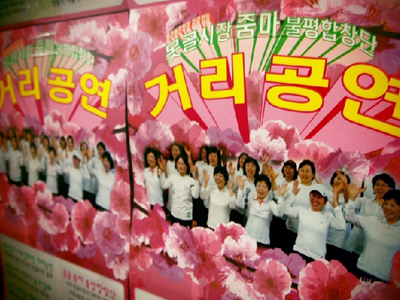
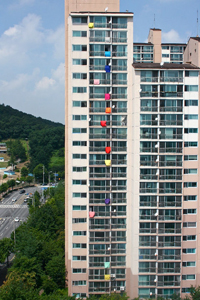
| Munjeonseongsi Project(Traditional Market Revitalization through Culture) | APAP(Anyang Public Art Project) |
Local communities feel distant from the growing industry of arts management and from the increasing pool of relevant professionals. The industry presupposes the existence of various arts products and market. Lack of these features, local communities have no means to catch up. A variety of problems worsen local situations, including outmoded management, lack of local heads’ attention to culture, lack of professionalism and closeness on the part of artists groups, and lack of attention to cultural content on the part of local residents. All these factors have driven more dependence on the cultural contents created in the metropolitan area, and further isolated local areas. Moreover, state-run cultural agencies and organizations have contributed to strengthening of centralized distribution of public financing from huge funds like lottery and cultural promotion funds. All these circumstances make it harder for local cultural facilities to get out of the cycle. Rather than locating and fostering local artists, cultural organizations barely keep afloat with the contents supplied from those in the central region. But they lack the power to propel local cultures. Furthermore, it is also difficult to imagine arts management professionals go down and get rooted in local communities under these conditions.
Recently on the rise are community arts projects combining residents’ participation, like those to promote public arts and traditional markets. These projects require a high level of skills to comprehensively organize events, not that of the creative capability. It is positive that numerous talented professionals participate in these projects, building up experience and know-how. Building up local relationships is not in their mind; rather, they try to catch up with cultural events taking place nationwide. This nomadic pattern does not contribute to fostering local know-how and resources. Angry or desperate, local artists have just holed up, hopelessly witnessing collapse of local community. Of course, it is also true that more and more producers and arts managers settle down in local communities and try to overcome practical limits and the local contexts. Their attempts seldom produce any fruits. Even when they do produce some results, the results come even after undergoing numerous trials and errors. What local communities really need is not the specialized professionalism, but the comprehensive competence, a competence that incorporates artfulness, organizing capability, and skills to communicate with others. Some alternative organizations have succeeded in settling down in local communities, and they do not distinguish the roles of artist, administer and producer. Should we mobilize those who have education based on different roles of arts and management, we can easily foresee what will happen. Arts management rooted in local cultural economy does not show any sign of improvement, with consolidation of outmoded administration and lack of human and other resources.
Link
| See other articles on issues on world arts management :
(Ⅰ) Asia (Ⅱ) North America (Ⅲ) Europe
(Ⅳ) Private arts institutions (Ⅵ) Status of arts managers (Ⅶ) Discussions
 PREV
PREV
.JPG)
.jpg)
.jpg)
.jpg)
.jpg)












.jpg','Since the dawn of the new millennium, diverse arts..');)


