





Vehicles in Need to Make the Field Level
[FOCUS] Issues in World Arts Management: (Ⅳ) Private arts institutions
To understand the newest issues and trends of arts management, we have prepared the “Issues in World Arts Management.” Through analysis of home and overseas editors at “theApro”, this article is planning to organize, by areas and issues, the main keywords that are being dealt with throughout the world arts management sector, and to examine each country’s current situation and response.
Overseas(Ⅰ) Asia (Ⅱ) North America (Ⅲ) Europe
Korea(Ⅳ) Private arts institutions (Ⅴ) Supply of and demand for experts
(Ⅵ) Status of arts managers
Overseas & Korea(Ⅶ) Discussions
Without affiliation with government agencies or corporate sponsors, small private arts and culture organizations function to secure the seeds of creativity and diversity in these areas. Diversity of living organisms protects the ample pool of genetic resources, and, thereby, helps them cope with unexpected situations in the future. Likewise, the small organizations harbor rich resources of our arts and culture, and the resources are the valuable assets of ours. Creativity in our society will get smothered, unless such apparently humble tiny organizations function as vehicles supporting the fledgling artists and artistic adventures that are not accommodated by existing formats or large organizations.
Uneasy Question of How to Operate Organizations
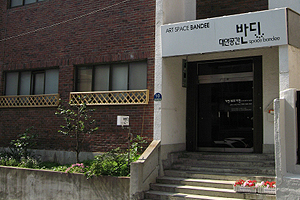 |
 | |
| Space Bandee | Culture Space Soom Island |
No one seems to dispute the importance of the role played by small arts and culture organizations. But the biggest problem faced by them is how to keep them afloat. So far, their survival has depended on individual gratuity or their own will to survive. If things continue as such, it is likely that they all get withered down. Nature of arts and culture makes it difficult to directly cash in on their activities. Once their role is recognized, some form of public support seems worthwhile. In reality, however, public funds for the art spaces and labor costs have almost dried up or decreased, citing the needs for more transparent operation of theirs.
Some forms of support still trickle in for individual projects. But those for individual artists and art spaces are almost gone. Changes to the support system, rather than lack of their utility, contributed heavily to disappearance of alternative spaces for visual arts. That is why the spaces substituted for alternative spaces have not yet appeared back on the horizon. More and more young artists work on the streets with project-based budgets. In need, however, is the space for their accommodation, since only organizations with some means are eligible for public funding. Should this condition continue, fatal ramifications would inevitably follow in terms of diversity. Of course, small entities are not always on the losing side. But their success stories are extremely rare, and no rule is applicable across the board. The sporadic success cases should not serve as an excuse to force every organization to be financially independent. Gearing every activity up to economic success ends in damaging the diversity in arts and culture, the concept that carries the significance of being a small organization. The dilemma lies in the fact that it is neither possible to pour public funds into unverified organizations. The public funds are another form of tax, and should be spent in the presence of social consensus and through legal mechanism.
Few dispute, in theory or in practice, the value carried by small-sized arts and culture organizations in the private sector. But it is difficult to find out ways for their survival. Besides some fortunate entities, it is likely that pursuit of commercial success often leads to loss of original goals. It is also impossible to expect helps from the public sector without the presence of social consensus on their public nature. Even in the presence of public help, it is highly unlikely to live by it, since public policies in Korea tend to flip-flop.
Monopoly & Unleveled Field
It is a general condition applying almost to all countries, that small organizations financially suffer. The condition is worse in Korea, though, largely due to lack of donations. Contrary to our hope, Koreans seldom make donations to the small entities, even when the entities fit their individual tastes and ideas. It is impossible to change the social trend overnight. Then, it is necessary to approach this issue from the perspectives of self-subsistence and public help. Hopefully, it is idealistic to obtain economic success without compromising artfulness. A general approach is to separate subsistence from artistic pursuit. One example may be the project-based approach. Numerous performing arts troupes come and go for a project. Another example may be in taking a second job, or some sort of “moonlighting” as college instructor or teacher. Suffering for the meager part-timer paychecks, artists are hardly able to pursue their artistic goals. Those in charge of management of small organizations may engage in small business activities, and use the proceeds there from for artistic purposes. It will probably be the second best option.
Reality gets in the way of realization of the artistic ideal that society unconditionally recognizes the social values of arts, along with its public support. Under these circumstances, it would be better off if state-funded or corporation-sponsored organizations should not compete with their smaller counterparts. Just as big Korean corporations monopolize the territories of small- and medium-sized enterprises, financially well-to-do large organizations without ideas materialize those of small ones, and take the credit as theirs. Then, small ones lose their soil for self-subsistence. So much for support! Of course, transparency prevails when using public resources, especially concerning their use and results. In fact, the priority ends in shutting out opportunities for small entities. What a consequence! An appropriate evaluation system is likely to help create institutional vehicles for offering various opportunities to them in a stable way. Let’s take sprouting creative centers for example. Wouldn’t it be wise to let small arts and culture companies take charge of their operation and to evaluate the results? What is most urgent for those involved in arts management and policies is how to make more small vehicles that can enrich arts and culture and give birth to creativity.
Link
| See other articles on issues on world arts management :
(Ⅰ) Asia (Ⅱ) North America (Ⅲ) Europe
(Ⅴ) Supply of and demand for experts (Ⅵ) Status of arts managers (Ⅶ) Discussions
 PREV
PREV
.JPG)
.jpg)
.jpg)
.jpg)
.jpg)












;)


