





Trends and Prospects of Asian Market Arts Market
[FOCUS] Issues in World Arts Management: (Ⅰ) Asia
To understand the newest issues and trends of arts management, we have prepared the “Issues on World Arts Management.” Through analysis of home and foreign editors at “theApro”, this article is planning to organize, by areas and issues, the main keywords that are being dealt with throughout the world arts management sector, and to examine each country’s current situation and response.
Overseas (Ⅰ) Asia (Ⅱ) North America (Ⅲ) Europe
Korea(Ⅳ) Private arts institutions (Ⅴ) Supply of and demand for experts
(Ⅵ) Status of arts managers
Overseas & Korea(Ⅶ) Discussions
Arts Renaissance in the Last Decade through Economic Growth
At the beginning of the 21st century, Asia experienced an unprecedented burst of renewed cultural energy on the back of strong economic growth in the region during the past decade. Its recovery from the financial crisis which swept through Asia in 1997 and economic stabilization prepared Asia to leverage on the new possibilities and platforms of arts creation by artists and their engagement with the public. A new sense of economic and cultural confidence encouraged Asian cities to express and market themselves for cultural tourism, cultural diplomacy and cultural export. Through cultural and art policies, the governments in Asian countries started supporting international cultural exchange projects. Successful businesses and enterprises in Asia became an integral part of the business of culture. In the past decade Asia has moved forward with its traditions to explore and embrace the contemporary and popular cultures as part of its identity. During this period, the capitals and cities across Asia have enjoyed exponential growth of artists, festivals, art centers and networks.
New art festivals mushroomed across Asia, as if Asia were infected with the festival virus. Of the ten original members of the Association of Asian Performing Arts Festivals(AAPAF) established in 2004, eight were festivals founded around 2000 and have now run a full decade of their existence. These include the China Shanghai International Art Festival, Hong Kong’s New Visions Festival, the Seoul Performing Arts Festival, and the Macao International Arts Festival. Along with these festivals, art centers, cultural complexes and theaters are proliferating throughout Asia, all of which promote the production and consumption of both domestic and international arts.
Asia opened its lucrative arts market and its attractions and artists full of new artistic inspiration, to the world. New arts markets and networks were created in Asia, including the Asian Arts Mart (the name changed to “ConversAsians” in 2010.), Performing Arts Markets in Seoul(PAMS), Association of Asian Performing Arts Festivals (AAPAF). Bilateral and multilateral networks and meetings brought greater international cultural interaction and discussions between Asia and Europe and America. In 2003, the first Congress of the International Society of the Performing Arts (ISPA) in Asia was held in Singapore. Also, the first international European Theater Meeting was held in Singapore in 2005 and subsequent meetings and back-to-back network meetings were held in major Asian cities, such as Seoul, Shanghai, Beijing, and Hong Kong. Economic globalization in Asia has also brought globalization of the Asian arts, with a special impetus given to developing creative contact between artists and producers in Asia and Europe that led to increasing levels of joint commissioning and joint production between Asian and other international artists.
These examples clearly demonstrate an Asian arts renaissance that was not prevalent in Asia until the end of the last century. While Asia escaped from the 2008 financial crisis relatively intact, the continuing economic crises in America and Europe cast a long shadow over Asian economies, raising fears of recessions to come. Can Asia overcome another round of economic instability? Can the Asian arts renaissance that has been fuelled by its economic engines remain unaffected? Most people’s answers to this question would be “No.” At the same time, we are acutely aware that the world has clearly become an ever more dangerous place under incessant assault not only from economic crises but also the violence of terrorism, earthquakes, hurricanes, bio-alerts, and yet undiscovered dangers.
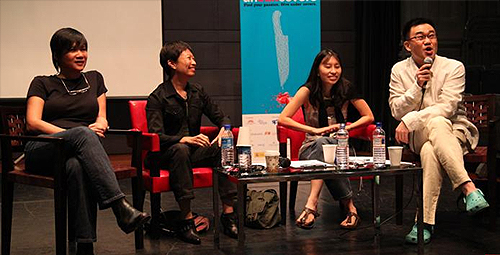 |
| Singapore Writers Festival 2009 |
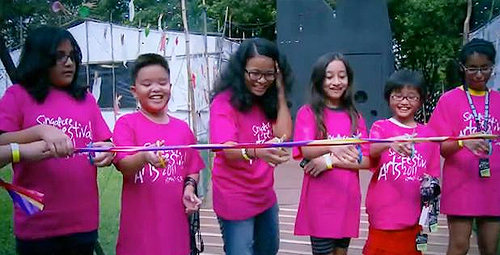 |
| Singapore Arts Festival 2011, Kids Arts Village |
Policy Changes and the Flow of the Performing Arts Market
I have considered a few scenarios on whether the above circumstances will lead to a re-evaluation of art policies and of attitudes toward art.
First, the governments and corporate sector will become more cautious about spending on arts. This does not necessarily mean reduced fund for the arts sector, but the funding may be re-directed at different priorities. It would not come as a surprise that the first casualties of any funding review will be the big expenditure items of major festivals and new infrastructural development for arts. Lower government subsidies with diminishing corporate sponsorship could affect the festivals’ capacity of producing, presenting and receiving a wide range of works.
These signs of changes in arts policies and management are particularly visible in Singapore. The National Arts Council is due to see significant increase in its budget based justified on the need for greater support community arts, and emphasizing the goal of making arts an integral part of the lives of Singaporeans. The strategies of the last decade built on making Singapore a “global arts city” appear to take a back seat. The current policy rhetoric also stresses greater support for traditional arts and local content development, and deeper engagement with Asia has greater priority over international ventures beyond Asia.
Meanwhile, we are likely to see conservatism and isolationism that is more reluctant to make new artistic challenges. Artists who continue to make big artistic statements in their work may be less favored over those who create work that may be more accessible or have a greater emotional connection with the audience. There could also be some downsizing of international collaboration and exchanges where much energy has been given over the last decade. This may not necessarily be the result of Asia’s withdrawal from the world, but rather the reduced capacity of the West in investing in artistic collaborations and projects with Asia.
Asian artists will also lose ground in the international market. The market for Asian artists especially in Europe may shrink due to cutbacks in European funding for the arts. Europe in the last decade has opened up to Asian cultures, often seen in the adoption of Asian themes in their programs. This interest may now be reduced. On the other hand, Asia will come under pressure to receive more western artistic products, as artists outside Asia continue to see Asia as a land of opportunity for their works.
 |
 | |
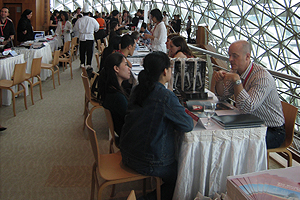
| A Table Talk at the 2010 Asian Arts Mart, renamed as “ConversAsians” |
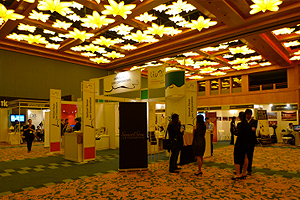
Booth exhibition at “LIVE! Singapore!” |
How to Respond to Such Changes
Then what potential opportunities should arts managers develop in such situation? Also, what could they do to improve their work and their constituents? Arts managers need to recognize the changing contexts and conditions, and learn to adapt to work with pragmatism and to reassess their ways of working. To do this, the following will need to be considered.
Arts managers and artists could win support and public loyalty by exercising their social responsibility to develop projects and relationships with a positive social impact. There could be new explorations of processes of creation and management – integrating ordinary people in the process of artistic financial contributions from the larger community rather than simply awaiting more government or corporate contributions.
At the same time, they also need to constantly remind policy makers and the public of the importance of the artist as the center of creativity and renewal, and emphasize the meaning that artists give in times of adversity. They should never lose sight of their own roles which is the service to fulfill their artistic visions and ambitions that will inspire communities, and to prevent artists from being permanently and narrowly relegated simply as a social tool.
Arts managers and artists should guard against pressures and temptations to turn inwards and resist parochialism in the arts. They should continue to look beyond, and explore new markets in East Europe and Latin America to forge new links and find resonances to support artistic collaborations.
Arts managers should take the opportunity for more training to further professionalize and equip themselves with new knowledge and skills for a constantly changing and connected world that will see greater intersection of arts with education, health, environment, and science. At the same time, we may need to learn to operate in a new economic order in which economic stability become punctuations within longer periods of economic uncertainty, and economic recovery tending to be short-term rather than long term.
Ultimately, art managers in Asia should not be too pessimistic. In fact, room for optimism remains. First, Asia has not been a stranger to economic and other crises such as SARS. We have survived, have shown resilience, and have rebounded with renewed energy. Second, the long-standing social agenda of the arts within Asia may convince governments of the reckless courage of making sweeping spending cuts. (In the case of Singapore, we have successfully argued in previous financial crises that the arts budget should not be cut as it already formed a small percentage of the national budget, and further cuts would destroy the hard fought achievements that we have made.) Third, China’s economy is expected to continue to set the pace, and Asia as a whole is regarded as a region of opportunity, and hence the world will continue to look east and engage with us culturally.
Link
| See other articles on issues on world arts management :
(Ⅱ) North America (Ⅲ) Europe (Ⅳ) Private arts institutions
(Ⅴ) Supply of and demand for experts (Ⅵ) Status of arts managers (Ⅶ) Discussions
 PREV
PREV
.JPG)
.jpg)
.jpg)
.jpg)
.jpg)












;)


