





‘The Challenges We Face’ by the Performing Arts Experts
[FOCUS] 2011 PAMS _ Round Table, the Ground Relay
On the past October 13, 2011, there were simultaneous round table talks at the rehearsal room in The National Theater of Korea, the KB Haneul Youth Theater, and others while the Performing Arts Market in Seoul (PAMS) was in progress. Round table is a place where home and abroad performing arts experts meet according to their interests and occupational groups to share their knowledge, experiences, and opinions. People can learn about the current status and trends in the performing arts of each country centering on issues of interest, and people can also become aware of issues and form bonds through sharing mutual opinions. The round table, which is a networking program for home and abroad participants of art market, had prepared 4 sessions and discussed issues with dance professionals, theater/festival professionals, producers, and arts managers. I will introduce the main stories from 3 of the sessions.
What are the Strategies for Audience Development?
Round table 1 _ Dance Professionals
Virve SUTINEN _ (Sweden) Director of Dansen Hus Stockholm
For the development of audiences, we established strategies primarily for children and young people. The most important aspect when establishing strategies is that you must approach it systematically. I believe the responsibility is with arts organizations and institutions as well as with the artists. We first looked at the terms related to audience development to come up with the strategy. Then, we observed the cases of museums, and this is where we gained much inspiration. After seeing what kind of services they have been providing, we analyzed the audience data such as to who have been coming to see our performances. Based on this information, we tried to forecast the future trends. Through these kinds of processes, we realized that ''learning'' is very important in audience development. ''Learning'' is the key, not just marketing and promotions to attract audiences. In the end, the theme we selected was ''atypical education'' and ''lifelong learning.''
Dansen Hus Stockholm is a performing arts center with a 800 seat and a 140 seat theaters which centers around contemporary dance in Sweden and overseas.
Bertram MULLER _ (Germany) Director of Tanzhaus NRW
I believe creating ideas into products, and advertising and marketing them to people is also equally applied in arts. What we need here is communication and engagement, and we as art creators must also follow. Of course, artworks are different than regular products. Let''s think about dance. Ballet has a very strong brand value. As dance education became widespread, ballet became very common that anyone can come across it. If so, how shall we brand contemporary dance? Could someone like Steve Jobs really appear in the world of dance as well? Could we really meet someone that adheres to their beliefs and at the same time be open minded towards the consumers? We must continuously contemplate how we can complete this feat.
|
|
| Bertram MULLER |
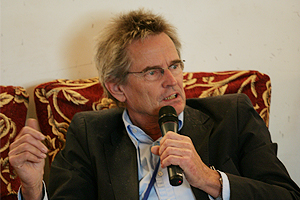
Tanzhaus NRW has been introducing artworks with artists who encompass diverse cultures and dance genres, and has been cooperating and maintaining continuous relationship with arts organizations.
Sari PALMGREN _ (Finland) Choreographer/Dancer of MAD Productions
Performances are important, but it is also important to attract and pull people in. We must show what kind of work we''re doing. In our case, we offer programs that attract people. We have created a Sunday brunch program where people can naturally enjoy their brunches and watch the dance performance. We also plan and choreograph special dances for specific sites. We sometimes even allow people to sleep on the stage. Then, people feel closer to the performance stage. They perceive the theater as an easy place to be rather than a difficult place to access. This is why, it is important to work with the community. It is important to know the level of community and individual. When people get to know the local artists, there is a better chance for them to come see the performance.
Sari PALMGREN graduated from Finland Theatre Academy with dance major, and is active in an organization that manages dance movies and dance festivals.
Laura COLBY _ (U.S.) Director of Elsie Management
Even after the performance is over, through various programs, we try to show the audience a friendlier side that ''dancers are people too.’ We were able attract many audiences through Facebook and Youtube. There were many concerns about content ownership, but now we have put aside those worries. As the world is becoming smaller, I believe being held up on such issues is being impractical. This is why we are encouraging artists and performance organizations to put up their rehearsals on Youtube. There is a TV channel called Tendu TV in New York and it televises ballets and contemporary dances. A TV channel that allows dance performance downloads and dance in high-definition view has appeared.
|
|
| Laura COLBY |
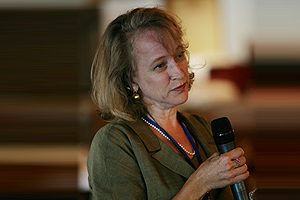
Laura Colby has begun her career in arts management since 1980 and is now managing Elsie Management. She is currently conducting various projects with North American dance organizations.
How Should We Communicate with the Community?
Round Table 2 - Theatre/Festival Professionals
Andrew WOOD _ (San Francisco) Executive Director of San Francisco International Arts Festival (SFIAF)
I had once conducted a project for underprivileged youths, though the performance was plenty enough to arouse interest through its powerful social message and participation from top directors and actors in the field of theater, nobody forgot how the performance was made, based on what community. When young people go to see these plays, they feel like they are seeing themselves and become emotionally immersed. There were participation from residents of other regions, and we were able to involve diverse classes of people. Our goal is to create much more social values. Our perspective is very conservative. I think it is wrong for an artist to create an artwork in some region and escape out of there like a moonlight flit. We must give some thoughts on how to maintain the relationship with the community.
SFIAF is an annual festival based on local artists.
John HERBERT _ (Chicago) Executive Director of Legion Arts
There was a huge flood in the region that the art center was flooded with more than 10 feet of water. We thought, we should get a little closer to the community during the period of flood repairs, and after this we emerged with a changed identity. Maybe it was a request or maybe it was an opportunity, but either way both were correct. We were able to rebuild the art center through a lot of government funds, and the funds provided an opportunity to contribute to the community as the funds came in the form of an investment. However, although it is good to contribute to the community, there are also some obligations that prove difficult to carry out as a cultural space. We are continuously contemplating how we should organize our position, and how we should act so that we are able to contribute to the flood repair and carry out our duties as a cultural space at the same time.
Legion Arts is located in Chicago and it is playing the role of a community center as it covers various forms of arts such as music, art, and movies.
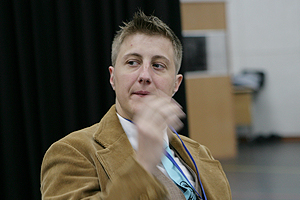
Scott SCHOFIELD _ (Alaska) Executive Artistic Director of Out North Contemporary Art House
The concept falls under the notion that community theater is for the community and it exists for the community. It''s like saying, "We welcome everyone." I have lived in several states in the U.S. and also worked in professional theaters, and the community theaters that I''ve experienced during those times felt like communities of certain people. It was community which surrounds the people. This is very exclusive. I felt like they were exclusive community theaters. They evangelize to people just as Christians do. They don''t tell people to come and experience the world of theater. Community theater is where people who want to be on the stage and people who will create the stage come together and make it. I believe independent theaters and community theaters are different. In the case of independent theaters, it is about making a culture that can be projected externally. For community theaters, it in itself is the community. It is exclusive, and itself is the theater of the people.
|
|
| Scott SCHOFIELD |
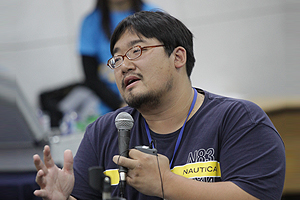
Myung-Kuk KYE _ (Korea) Assistant Director and Programmer of Jarasum International Jazz Festival & World Music
I had once conducted a project for underprivileged youths, though the performance was plenty enough to arouse interest through its powerful social message and participation from top directors and actors in the field of theater, nobody forgot how the performance was made, based on what community. When young people go to see these plays, they feel like they are seeing themselves and become emotionally immersed. There were participation from residents of other regions, and we were able to involve diverse classes of people. Our goal is to create much more social values. Our perspective is very conservative. I think it is wrong for an artist to create an artwork in some region and escape out of there like a moonlight flit. We must give some thoughts on how to maintain the relationship with the community.
|
|
| Myung-Kuk KYE |
How are We Going to Deal with the Changes in Production Environments?
Round Table 3 _ Producers
Bilqis HIJJAS _ (Malaysia) Artistic Director of My Dance Festival 2011
Our biggest challenge is the funding. In the Malaysian contemporary dance community, there are absolutely no government aids or regular funding. In addition, there aren''t any programs in the Ministry of Culture where we can even request aid. There are no official windows of opportunity where we can receive funds, and despite our efforts, it is likely we won''t get anywhere. This is why we heavily rely on funding from foreign governments. We also rely on international foundations like Australian organization or the Japan Foundation. As for Asia Link and other small-scale supporters, we get a lot of help from Arts Network Asia through collaboration. Sometimes their ways aren’t what we want, but it is important to get monetary support.
|
|
| Bilqis HIJJAS |
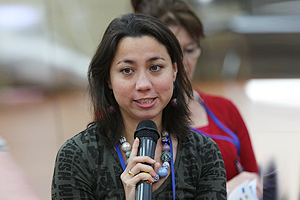
Alison M. Friedman _ (China) Director of Ping Pong Productions
First of all, because China has a strong central government, every organization is run by the government. There are many local music and dance groups, but they were all receiving support from the government. But, after the 11th 5 year planning was reported in 2006, funding started to decrease. Actually, the funding goes to the obvious organizations in China. For example, when famous stars appear at some theater and cause better ticket sales and raise the image of the theater, so does the government''s image and more funding is given to such theaters. Therefore, the issue with independent artists is being caught up in money. Because it is difficult to earn money through experimental theater and dance, there is lack in programming which leads to a vicious cycle. That''s why people in contemporary arts such as my colleagues and I are committed to breaking the chains of this vicious cycle. Developing the audience has become our new concept as we perform at small scaled performances and festivals, and communicate to the audience after free lectures or demos.
|
|
| Alison M. Friedman |
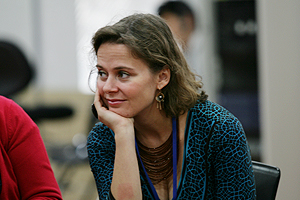
Claire MORAN _ (Scotland) Producer of Cryptic Theater
Scotland has been experiencing changes in funding system. 2 years ago, the arts council was disbanded and an organization with a different name took its place. There were also many discussions on how to configure this organization. A major problem is that there are no more funding and even talks about setting up funding, but instead a new program called ''commissioning'' is being introduced. In Scotland, the main keywords nowadays have become quality, participation, and internationalization of artworks. It is on a different path than the past arts council. However, I believe the changes in the past 2 years isn''t about setting up funding, but related to the potential and growth in terms of theatrical art.
Cryptic Theatre is located in Scotland which consists of around 20 employees. It is currently operating Cryptic mentoring in order to fostering young artists.
Minako NAITO _ (Japan) Programmer of Tokyo Metropolitan Theater
Modern or avant-garde market is shrinking, and it has become a very difficult situation. In addition, due to the natural disaster on March 11th, the Japanese society is a bit numb at the moment. People began to ask what the function of art is. There are still unsolved issues with electric and nuclear accidents. So, I am contemplating what I can do to help in this situation. But, there are those who criticize and say, “Where is the electricity to run a performance when there''s barely enough electricity for daily living?” Also, Japan doesn''t have arts administrators as public officials. They do have the authority to manage the budget, but due to 2 year job rotation, the experience does not accumulate. This has always been the problem.
The Tokyo Metropolitan Theater has been built as a culture & art space for the Tokyo residents, and it is currently being actively used as a platform for international cultural exchange.
 PREV
PREV
.JPG)
.jpg)
.jpg)
.jpg)
.jpg)












;)


