





The Three Elements for Entering the Global Market
[FOCUS] Trends of PAMS Choice of Past Seven Years (Ⅲ): Music
This year’s Performing Arts Market in Seoul (PAMS) was held for five days from October 10th to 14th. The PAMS serves as a venue where world performing artists and producers share ideas, and discuss various aspects of the arts, for example, from inception to marketing. As before, the PAMS chose Asia as the focus region of this year, and held a variety of relevant secessions and programs. theApro reviews major programs of the PAMS 2011 and its trends of the past 7 years.
Trends of PAMS Choice of Past Seven Years
(Ⅰ) Theatre (Ⅱ) Dance (Ⅲ) Music (Ⅳ) Multidisciplinary
PAMS Choice is obviously aimed at expanding Performing Arts of South Korea to go abroad. If the aim of ‘where’ and ‘what’ is presented more clearly, the artists preparing to go abroad or the arts management support centers helping these artists will be able to approach such goals more efficiently. This has always been greatly desired. Through the selections of PAMS Choice during the past seven years, among the various ways to expand abroad, at the least, there is a ‘sense’ that ‘world music’ seems to work in the area of Korean music and may have resulted mainly from the news that ‘it was well received.’ Though it is too early to tell what sort of activity the musicians who are nursing their constituency in this area with the ‘small potential’ could do or survive abroad while ensuring the market, there seems to be some extent of a guideline gained for the works and organizations to go abroad compared to the early days of PAMS Choice.
Failures and Successes of PAMS Choice
During the past seven years, twenty-three groups have been selected by PAMS Choice in the field of music. It was disconcerting to see a name that has become already unfamiliar among these groups. After searching through the news on the internet, the most recent news found on the group was the selection of the group made by PAMS Choice six years ago. Though the members of the group may have activities in the field of music, trails of the group selected by the Arts Management Service and their works were difficult to find. From this perspective, the criteria for selection indicating ‘failure’ or ‘success’, when reviewing South Korea''s trend in music ten years from now, was decided on what group could expose their ‘presence.’ For the group that is unstable in their consistent domestic and international activities while maintaining the same ‘name’, though it may seem harsh, it seems necessary to sort out the ‘failed selection.’
 |
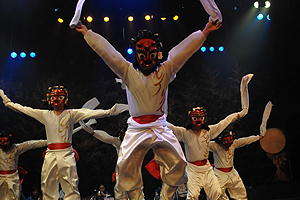 | |
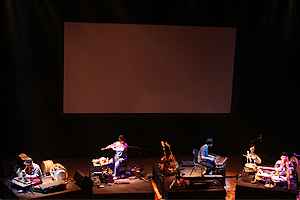
| Space Bamboo _ GongMyoung | Non-verbal performance OnE _ ChungBae Traditional Performing Arts Troup |
Since the 1990''s, young musicians in the 20''s and 30''s who majored in Traditional Korean Music began activities by organizing a new concept of performing groups as a way of finding their own musical identity. The musical groups consisting of two or more members, through different cycles of formation and disbandment, had opened up the ‘small group era’ with concepts such as ‘creative music group’, ‘fusion group’, and ‘world music group.’ The main motivation for launching a group is that groups are the core factor of selecting process of various public supports, and the examples are the Culture & Arts Fund and PAMS choice, the Experimental Indie Traditional Korean Music Series-Cheonchmanbyeol Concert, and the 21st Century Traditional Korean Music Project. But the problem is that they group and disband easily. When the performers leave the group before they acquire a character, even the good contents that they have created in the beginning fades out, and it becomes more difficult to gain meaning beyond ‘learning experiences of young musicians.’ Such phenomenon can also be seen in the PAMS Choice selection. When the groups of musicians are selected by looking at their capacity and activity achievements during application time, after a year or two, they fall into a ‘dormant stage’ where they stop their musical activities or voluntarily go on stage as a group without invitations, and furthermore, stop planning overseas concert. For now, this is an issue for both the field of Traditional Korean Music and PAMS Choice to solve, but it seems the way to reduce failure is to figure out which group has clear set contents and who has the will to come together and further develop their area of works.
Another example of failure to be pointed out is Da''ak (茶樂) concert by theThe Society for New Composition in Korean Traditional Music. After being selected by PAMS Choice in 2005, it was well received and had gone abroad to stages in the United States, Australia, and Europe. As much as Da''ak had published ten albums, it consisted rich contents and was equipped with ability to integrate tea, literature, dance, and music to tell its story through the stage. Da''ak was well-known as a model that showed the potential for Korean culture to go abroad. However, not only Da''ak stop going overseas, but they are also rarely seen at home. Why is it so? What happened to the overseas market that embraced them before? What was the local reaction like? Why are they not inviting them anymore? If there is an analyzing report, it could be referred to as a ‘representative example of learning from failure.’
The most representative example of success could be Gong Myoung[Who&Work]article view. They have been selected for slightly different performances in 2005, 2008 and 2011. As a team that has been selected three times during the past seven years and used this momentum to do the most overseas performances, it is necessary to look into the factors for its success. Though there is a small problem of high transportation fees and handling because it has many instruments that goes on stage, through its focus on percussion consisting of four musicians performing for about seventy minutes, Gong Myoung has the strong point of showing an interesting performance by balancing the keynotes of the world''s universal percussion music with the unique characteristics of Korean music. Their performance prevails everywhere. They have a sense of community among the members of the group and a sense of responsibility for the stage, and have been networking with a good impression. When the joy that could not be felt through the album is increased exponentially on the stage, the audiences are impressed. Such characteristics of the performance act as the factor that calls them to the stage.
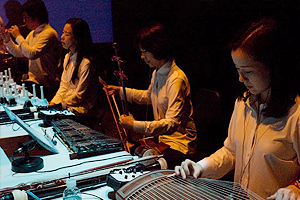
Besides Gong Myoung, Noreum Machi and the Cheongbae Traditional Performing Arts Troupe are also receiving attention for its characteristics of performance and have gone abroad. But there is a need for its inherent nature of folklore to be complemented with system and strategies to work in the world music market. Among the groups, Be-Being is a group that is hopeful. When thinking about this group from the beginning till now, the creative ideas shown by the leader of the group is greatly highlighted. Rather than the capabilities of a group consisting of performers, the performance gives the sense that it has been made through the leader’s producing system. While there is a lot of news that it is being well received abroad locally, it is not very well-known domestically. If the group Be-Being continues to make small achievements in overseas performances, it would be seen, meaningfully, as an example of an outstanding producer. A method of approach could be applied by analyzing the tendencies and contents the overseas audiences want to see in Korean performances, and deciding on a goal and target for overseas performances. Unlike the group Be-Being, the groups Kang Eun-il & Haegumplus and Tori Ensemble could be picked out as groups consistently achieving success overseas through their musical capabilities of company members. Though their music varies, it is their outstanding ability to play music that impresses the audience. Even though their reasons and motivations for joining a group are different, they could be picked out as a stable model equipped with the sense of art and performance for overseas performances.
 |
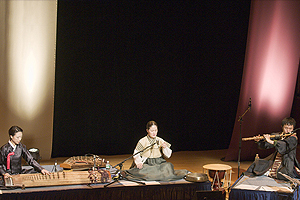 | |
| Li And Sa _ Be-Being | Tori, Sori, Nori _ Tori ensemble |
Raising the meaning of PAMS Choice
It was more meaningful than any other field from the perspective of PAMS Choice as guidance to an effective method of route in going abroad during the past seven years. Even though there were examples of failures, a lot has been learned from it and this obviously is also a meaningful achievement. After reviewing the groups selected during the past seven years, groups that were recognized to hold the potential for growth could be confirmed to have at least one or more of the following: outstanding personal capabilities as a musician thinking about going abroad, a group with a good producer, a group with a unique content. In contrast, a conclusion could be made that it is desirable to exclude from the selection for groups which holds true of the following: a group operating with integrity but are average in capabilities, producers, and content; a group that seems unlikely to be around in ten years; a group that has other priorities and could do performances abroad only during their spare time; a group with either an ambiguous identity or overly particular. In the case where the group is considered to be more efficient with albums than their performances in the local stage, a different method to support such a group needs to be developed. It is hopeful for the groups with distinct goals and strategies of ‘going abroad’ will realize their dreams through PAMS Choice in the future.
 PREV
PREV
.JPG)
.jpg)
.jpg)
.jpg)
.jpg)












(1).jpg','PAMS Choice is obviously aimed at expanding Perfor..');)


