





Prevailing Re-creation in Independent Format
[Focus] Trends of PAMS Choice of Past Seven Years(Ⅰ): Theatre
[Focus] Trends of PAMS Choice of Past Seven Years(Ⅰ): Theatre
This year’s Performing Arts Market in Seoul (“PAMS”) was held for five days from October 10th to 14th. The PAMS serves as a venue where world performing artists and producers share ideas, and discuss various aspects of the arts, for example, from inception to marketing. As before, the PAMS chose Asia as the focus region of this year, and held a variety of relevant secessions and programs. theApro reviews major programs of the PAMS 2011 and its trends of the past 7 years.
Trends of PAMS Choice of Past Seven Years
(Ⅰ) Theatre (Ⅱ) Dance (Ⅲ) Music (Ⅳ) Multidisciplinary
The Korean theatrical community meets the world in various ways. The first step in communication is the indirect meeting through critical records and publications, which deliver esthetic characteristics and discourses on the Korean theatre. More practically, performances function as useful media stimulating productive relationships out of international exchange. The practical approach is the most general and favored method of meeting, which spreads through the open channels of the global era and the opportunities given via festivals. In this context, the PAMS has marked itself as one of the most representative venues for international exchange of performing arts in Asia, and the PAMS Choice is the institutionalized state-run venue for distribution and circulation.
Overcoming Language Barriers
32 dramatic representations have been selected as the PAMS Choice for the seven years since 2005 (4-5 pieces on annual average), and presented at overseas markets. Most of those works were domestically certified of their artfulness, and selected in consideration of their competitiveness overseas. At the same time, the decisions were rendered, considering such factors as our expectations for their possible contribution to global promotion of our culture and assistance to global people in understanding the contemporary lives of Koreans. Thus, the criteria adopted for the PAMS Choice differ from the general criteria of performing arts that assess the competitiveness of each piece, based on its esthetic completeness. In other words, the works winning the PAMS Choice are more likely to be hailed by overseas audiences, since, among others, they are chosen in consideration of the short-term itinerary nature of the tours. |
|
| |
|
House number 1-28, Cha-sook''s |
Thou Cannot Say I Did It |
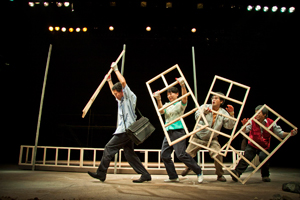
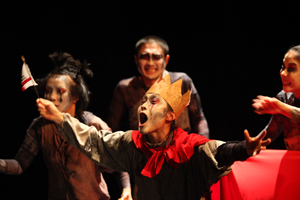
In this context, the list of the winning pieces is persuasive in summing up the advance of the Korean theatrical community of the last decade. The convenience stems from the shared understanding of theatrical variety of forms and contents covering our cultural tradition and contemporary status. Moreover, the selection shares the formalistic features conducive to audiences’ understanding with different cultures. In other words, the winning works excel in terms of the capacity to realize visual and audio images through physical media of expression. Let’s take the PAMS Choice 2011 for example. Selected for the 2011 event were House number 1-28, Cha-sook''s by Theatre Nolddang that has incorporated therein the conceptual ideas about construction and constructing processes, and the Shakespearian farce Thou Cannot Say I Did It by the performance group TUIDA that has won the Choice three times, along with Yohangza Theatre Company, partly due to its environment-friendliness and creativity. Also on the list were The Inspector, or the adapted version of Gogol’s The Government Inspector, by DONG Theatre Company that instilled therein dynamic diversity by encompassing elements of Namsadang (i.e. Korean itinerant male troupe), of performance of the traditional music and of techniques of mobile installation art; and, Killbeth, or the action adventure version of Shakespeare’s Macbeth, by PlayFactory Mabangzen that converted it with strong physical energy.
Under the brand “PAMS Choice,” the four pieces do not deviate much from the goals pursued by it, which await the attention of the global performing arts communities. Three of the four attested to their competitive edge by “monopolizing” major awards in Korea last year. Tuida’s performance seems a reasonable choice, although it was introduced too late in the season to attract much attention. The group had already demonstrated itself through The Tale of Haruk and Hamlet Cantabile, and excellently carried the theme and messages of the original piece Macbeth in witful parody. What the four works share is the creative independence in delivering their shows, unbounded by the theatrical grammars and formal logic. In addition, they also employ similar topics or the format of narrative in common. Except House number 1-28, Cha-sook''s, the rest three were inspired by the Western canon or modern classic texts. In short, they contributed to Korean re-creation by encompassing free ideas of the postdramatic era, based on audiences’ background about the original pieces. Avoiding large-scale discourses, they are free from the dichotomic structure like West v. Korea or tradition v. modern trends. Instead, things are physicalized only through cultural mixture, indefinable play of life, maximized physical expression and image, and aggressive imagination. Even in the only creative piece, narrative technique prevails, which has been transformed via the process of materializing construction-based ideas.
Need for New Way of Support
The trend of the 2011 PAMS Choice stays on the same path, when putting things in retrospect. The history of the past seven years is not a fossilized tradition; rather, it is still in progress. Looking back on things rather roughly, things can be classified, as follows: First, Koreanized re-creation of Western canon pieces like Greek tragedies and the works by Shakespeare, Zola, Gogol, Ibsen, Brecht and Genet (15 piece like A midsummer Night''s Dream) ; second, a group of creative pieces rooted in Korean tradition (eight pieces like Come on MUTU!) ; and third, a group including modern shows (three pieces like The Sea Fog), children’s drama When His Watch Stopped Working, and translated versions like Green Bench. |
|
| |
|
The Inspector |
Killbeth |
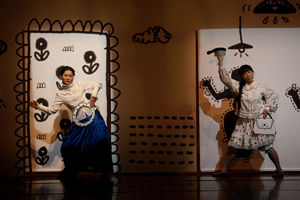
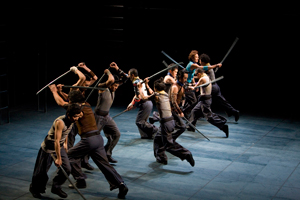
Interestingly the three types observe the above order of circulation; namely, success in overseas markets stands out in works like A midsummer Night’s Dream by Yohangza Theatre Company that jump-started overseas tours, which are still ongoing, after winning the Choice, Woyzeck by Sadari Movement Laboratory, Pansori Brecht ''Sacheon-ga'' and a pansori project ZA by Jaram LEE[Who&Work] who has attracted a lot of attention from Europe, Killbeth by Mabangzen that first acquired an overseas experience at the Beseto Theatre Festival held in China this September and is on a tour to Turkey and Belarus, and The Tale of Haruk by Tuida that appeals to simple local emotions.
In the meanwhile, the pieces getting inspiration or materials from the Korean tradition failed to attract overseas audiences, contrary to domestic expectations. The failure is related to the limited pool of pieces. What matters more is the role of the Korea Arts Management Service that hosts the PAMS. It is important to accurately project overseas demands. Therefore, the PAMS Choice should take new approaches in selecting winning pieces, apart from the existing pool, such as support for commissioned production and international collaboration. This could be one of the ways to read the trends of the PAMS Choice of the past seven years as well as to understand contemporary ethos of performing arts.
Cross-reference
| Trends of PAMS Choice of Past Seven Years(Ⅱ): Dance Go
| Trends of PAMS Choice of Past Seven Years( III ): Music Go
| Trends of PAMS Choice of Past Seven Years( IV ): Multidisciplinary Go
 PREV
PREV
.JPG)
.jpg)
.jpg)
.jpg)
.jpg)












;)


