





New Dance in Need
[Focus] Trends of PAMS Choice of Past Seven Years (Ⅱ): Dance
[Focus] Trends of PAMS Choice of Past Seven Years (Ⅱ): Dance
This year’s Performing Arts Market in Seoul(PAMS) was held for five days from October 10th to 14th. The PAMS serves as a venue where world performing artists and producers share ideas, and discuss various aspects of the arts, for example, from inception to marketing. As before, the PAMS chose Asia as the focus region of this year, and held a variety of relevant secessions and programs. theApro reviews major programs of the PAMS 2011 and its trends of the past 7 years.
Trends of PAMS Choice of Past Seven Years
(Ⅰ) Theatre (Ⅱ) Dance (Ⅲ) Music (Ⅳ) Multidisciplinary
Creative Korean dance pieces started tapping, in earnest, on overseas markets in the 1980s. In the past, a couple of Korean choreographers/dancers danced in the world stage like Seung-hui CHOE (1911-1969. Known as “mother” of new dance, CHOE was a Korean dancer and choreographer advertising to the world the beauty of Oriental curves and dances) and Taek-won JOH (1907-1976. Together with CHOE, JOH toured various countries like Japan, China, the United States, the Great Britain, and Germany). Changmu Dance Company (founded in 1976) once attracted the global community, but it was a one-time event falling short of widening the arts markets. Despite its long history, the Korean dance did not command much attention in the global market. This situation comes from the lack of awareness of the importance of market. The more fundamental problem, however, lies in shortage of dance pieces appealing to the international audiences.
Celebrating its 7th anniversary this year, the Performing Arts Market in Seoul (PAMS) has endeavored to address these two issues. 41 dance pieces have been shown at the PAMS for the seven years. The genre produced more selections at the PAMS than any other genres (e.g. theatre, music, and multidisciplinary). Still, it marked lowest in advancing its works to overseas markets. Nonetheless, dance is the biggest beneficiary of the PAMS Choice. The key to the successful advance depends on administrative support. Now that the PAMS offers it, the Korean dance community is equipped to tap on the global market. Participating in the PAMS as member of the selection committee, I wish to what criteria were considered for the PAMS Choice, along the trends, and the resulting ramifications, as in the following three categories:
Perspective Unbound by Genre, and End of Trichotomy
By the mid-1950s, Korea did not have delineations about new dance. The genre of new dance spun out, upon its end, three genres: traditional Korean dance, ballet, and contemporary dance. When founded in 1962, the National Dance Company of Korea played various works belonging to diverse genres. Later, however, the trichotomy was enforced and observed at colleges. As a result, dance performance has become specialized and maneuvering techniques become diversified. Eight years after the foundation of the National Dance Company, the Korea National Ballet was founded. In addition, the Korea National Contemporary Dance Company was recently established. All these moves attest to the earnest adherence to the division of genres. Consequently, dance colleges have advanced not only practical performing skills, but also the academic background. But the adherence to genres is fading out. Especially, the trend is more noticeable in the global community. The reason is that the global community has experienced postmodern dance focusing not on technical expressions but on ideas to be expressed, and that the ensuing contemporary dance values creative ideas and fresh personality of a choreographer. The mainstream is dominated by the key words like crossover, omnidirectional and total theatre. In this context, the adherence is outdated. Aware of it, the selection committee heeds individual artistic spirits of each choreographer, rather than encircles itself within the frame of trichotomy. No ballet work was among the 41 choices. Most winning pieces belonged to contemporary dance. These facts attest to our selection policy.
|
|
| |
|
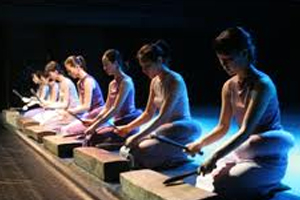
Internal & External |
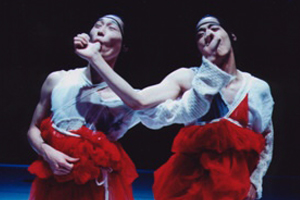
Janghwa & Hongryeon-Vengeance of the two sisters |
Focus on Individual Originality of Choreographer
Winning PAMS Choice pieces mainly either copied Western choreographic methodologies, or reflected elements of traditional Korean dance like There (by Kim Young-hee Mutdance), Burying Together (by KIM Eun-Hee Dance Company), Internal & External by NOW Dance Company), and Janghwa & Hongryeon-Vengeance of the two sisters (by LEE Kyung-ok Dance Company). In case of the pieces bearing traditional elements, tradition dictates everything from music to costume and to spatial arrangements. Domestically called “creative Korean dance,” the work of this genre presents the physically acquired traditional dance centered around contemporary materials and topics. Globally, this hybrid genre is deemed as heavily cultural contemporary dance. Leading works in the Korean contemporary dance are those by Won KIM, Sungsoo AHN, Aesoon AHN, Eun-me AHN, Aesoon AHN, Ho-bin PARK and Sungyop HONG. Irrespective of what is melted in their works, their tool of expression is originated from the West. For example, Sungsoo AHN and Sungyop HONG intensively employ the basic principles of ballet, while Ho-bin PARK and Eun-me AHN add theatrical elements close to expressionism. Still, most of them are based on the principles of contemporary dance.
|
|
| |
|
Pallae-Womanhood Story |
Darkness Poomba |
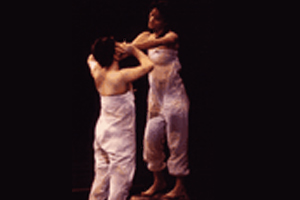
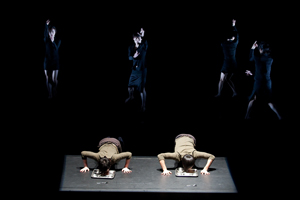
Despite the binary classes based on language of dance, they commonly point to a change, which is the escape from the passive view of creation completely depending on traditional originality latent in Korean dance. Pallae-Womanhood Story (by Nam Jeong-ho & KNUA Choreography Troop) and Darkness Poomba (by Modern Table & Jae-Duk KIM Project) are good examples. These pieces are lauded for their expression of Korean themes in contemporary language. Ultimately, they are rooted in individual philosophy, not in national or ethnic culture. This ethos is a very affirmative eco caused by contemporary dance and the fundamental element that a professional company should equip itself with. Propelled by this trend, young choreographers with strong personality have won PAMS Choice since 2010, such as Jae-duk KIM, Soon-ho PARK, Chang-ho SHIN, young-jun AN, Insoo LEE, and Young-doo JUNG. In addition to the originality, they have assumed different approaches. For instance, they analyze target areas, or conceive works tailored for overseas marketing by producing pieces physically possible to tour around the world. These efforts of theirs will propel long-term success, and help the Korean contemporary dance appeal to the global audience.
Looking for Korean New Dance
History of dance is the history of new dance. As the human race constantly marches for something new, dance has followed the path. Especially from the 20th century when modernism emerged, new brands of dance appeared on the horizon, driven by the search for something new. Every time a “new dance” emerged, it was extolled as a cutting-edge art. In the 1920s, for example, German contemporary dance was termed a new dance of Germany in the Untied States, referring to Mary Wigman’s expressionist dance that was alien to most Americans. Fine definition of it was not attempted, just naming it new dance, since the definition was believed to need more works to appreciate. The new dance, however, was reborn as Tanztheater by Pina Bausch. In the meanwhile, the Untied States witnessed the birth of Merce Cunningham’s new dance, which served as soil for the birth of postmodernism. After postmodernism, nouvelle danse emerged in France. Actually, nouvelle danse translates as “new dance” in English. It categorically refers to young dance of the age stressing spirit artist and visual effects. Although advocated by Baku Ishii and later adopted in Korea, the new dance of Korea was born in the same context.
Looking back on the 41 PAMS Choice winning pieces, I agonized over what is the esthetical identity that can define new dance of Korea. Compared with global trends, the winning pieces showed strength in technical expression, but lacked philosophical thoughts and choreographic capability. All told, I am not sure whether or not we discovered the fresh impression that could mark the turn of this age. In response to this assessment, choreographers ask back, how experimental choreography should be to be labeled as new. I have no doubt that they themselves recognize some shortcomings of their works in terms of global competitiveness. The term of validity of newness depends on how much a choreographer herself recognizes the value of newness and the importance of criteria, and how much she respects them. (These issues carry no bearing on the size and budget of a piece.) Furthermore, national power should be invested to sustain the newness for some time. Only then, is the new dance of Korea to be appreciated. Now, real challenge and the opportunity to advance are right in front of us.
Cross-reference
| Trends of PAMS Choice of Past Seven Years (Ⅰ): Theatre Go
 PREV
PREV
.JPG)
.jpg)
.jpg)
.jpg)
.jpg)












;)


