





Right Now and Here in Asia
[Focus] 2011 PAMS Focus Session II: Review of “Talk about Asia”
|
This year’s Performing Arts Market in Seoul(PAMS) was held for five days from October 10th to 14th. The PAMS serves as a venue where world performing artists and producers share ideas, and discuss various aspects of the arts, for example, from inception to marketing. As before, the PAMS chose Asia as the focus region of this year, and held a variety of relevant secessions and programs. theApro reviews major programs of the PAMS 2011 and its trends of the past 7 years. |
|
|
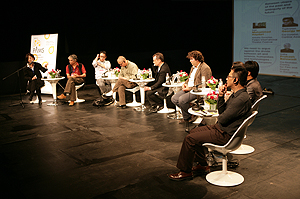
It is no more of an exaggeration to say that the world performing arts community focuses on Asia. Recently, a sharply increasing number of Western, especially European, festivals and theaters plan Asia-related programs. Attesting to the trend, more non-Asian presenters visited the PAMS this year. Somewhat persuasive hypotheses are proposed to explain the trend: Bound by artistic materials and methods, Europe has shifted its attention to mystic Asia, propelled by its freedom in movement and collaboration cross borders within the region; or, money-stripped amidst the global economic crisis, European theatrical troupes are tapping on the ample pool of resources offered by some Asian countries to make up for the nose-diving arts budgets.
The PAMS avoids the unconditional welcome or categorical denial of the Western approach to Asia characterized as single collective noun. It believes definition of Asia should come within the region, and the belief comes out of the context. The PAMS selects a focus region every year, and offers intensive opportunities to provide information on it. Previously in 2006, Asia had been the “focus,” and became the focus again this year. But in the former, collaboration among Asian artists commanded the attention, while programs of this year were designed to hear voices in and outside Asia.
|
|
|
| ||
|
Lee-Chun YAO of Guling Street Avant-Garde Theatre(GLT) |
Prakash Belawadi of Centre for Film and Drama in Bangalore |
Yasuo Ozawa _ Independent producer |
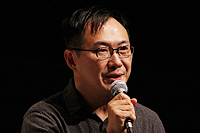
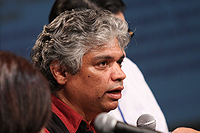
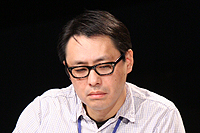
The session “Talk About Asia” was structured to share the topics of each Asian country’s performing arts community, and took place at the National Theater Company of Korea on October 10th, or the first day of the PAMS 2011. Each presenter’s topic was about performing arts themselves, on social surroundings around the art scene, or further on association with the past of society or history.
Presenters of Korea and Taiwan proffered the direct topic of theater. Namsan Arts Center’s director Gyu-seog LEE expressed his concern over the state-led drive to promote medium-sized theaters. The drive, he opined, might harm the independence of small theaters or theater companies in the private sector. He proposed balanced policies to promote not only state-owned theaters, but also the private theatrical community. ([theApro]: Era of Medium-Sized Theaters). Producer of Guling Street Avant-Garde Theatre, Lee-Chun YAO of Taiwan elaborated on the end of the Taiwanese “small-sized theater” movement which was initiated in the late 1980s, and introduced Guling Theatre’s experimental, avant-garde, and multidisciplinary activities aimed to break down the myths about the existing cultural mainstream.
The topic of Asia progresses from theater to society. Speakers from India and Japan associated the ramifications of economic development with arts. Propelled by fast economic growth incomparable with the average global economic progress, some Asian countries have consolidated their economic statuses, while the excessive growth has given rise to numerous social evils. The evils have become visible to the world.
Founder and operator of Centre for Film and Drama in Bangalore, Prakash Belawadi of India pointed out as the most serious problem the diminishing cultural diversity caused by fast economic growth and urbanization. Marked as one of the leading IT countries along with Korea, India centers its IT industry in Bangalore. So accumulated, capital is dismantling rural towns and driving local artists pursuing traditional arts to cities for new jobs, related Belawadi. In addition, using 16 official languages in India, diverse mass media are springing up for each of the languages. But the commercial capital has taken up the media, and uses them as channels for instilling regimental culture of its choice. The situation has got worsened due to lack of young human resources able to produce various contents. Under the current Indian circumstances where the government controls and supervises arts, rather than supports them, he concluded that artists should define the roles of arts along with technology and industry, and protect languages and culture.
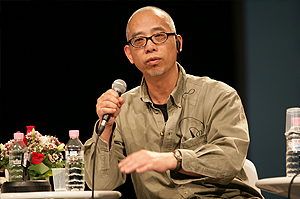
Japanese independent producer Yasuo Ozawa addressed the PAMS under the title “Japanese Performing Arts Scene after Earthquake on 11 March and Nuclear Accidents", saying to the extent that the series of incidents has consolidated his attitude and will as independent producer free from all political and other powers. Citing a quote “civilization invented accidents,” Yasuo Ozawa expressed his concerns over the Western, especially European, performances centered around the 11 March earthquake and ensuing nuclear accidents. He snapped, “It’s still ongoing, and is a very dangerous situation directly related to life itself. Thus, it is improper to take it as interesting artist theme.” He continued, “What really matters is to look into the reality. From there, we will perceive new attitude and viewpoint.”
|
|
| |
|
Wen Guang WU of Caochangdi Work Station |
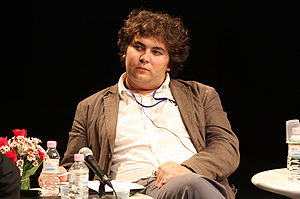
Georgy Mamedov _ Curator |
Most Asian countries carry the memory of past and historic scars graver than the present. Bearing harsh experiences with the modern era as colony or through war, the traumatic experiences of individuals and the states still affect them.
Holding executive directorship of the Amrita Performing Arts for 14 years in Cambodia, American artist and producer Fred Frumberg explained three stages of his process of creating contemporary performing arts. Contemporary young Cambodian artists have grown without learning the brutal history of the country. Thus, it is necessary to teach them about Cambodian history and traditions. Through the teaching, it is further necessary to lead them to discovery of modern ways to bridge the gap between the memory of the past and the contemporary capitalism, and to ultimately find their tradition and language via modernization. Lastly, he wishes to break down the prejudices against Cambodia lingering in and outside the country with the activities. In other words, he wages activities to set forth a new national identity different from the image of a country scarred with tragic history. Frumberg defines his work as the process of helping Cambodia find out what it has learned and lost without staying in the memory of the past.
It was Wen Guang WU of China who specifically introduced how to meet the past. As co-founder, WU established the Caochangdi Work Station with Living Dance Studio, which is the first Chinese independent performing arts company. Since its foundation, the Living Dance Studio has not received any help from the Chinese government or private donors in running the art center. Instead, it engages in diverse business activities like training programs, workshops and festivals. WU introduced Memory Project, along with young artists born after the 1980s. The project was conducted in the format of interviewing rural Chinese people about the Cultural Revolution in the 1960s and the Great Chinese Famine. It is difficult to run an art center in a financially independent way. The absence of outside helps, however, liberates artists in choosing works that reflect reality and affect society, explained WU. Likewise, curator Georgy Mamedov of the Central Asian country Tajikistan explained that, despite the independence from the old Soviet Union, five countries in the region still suffer from lack of identity and communication without completely overcoming the past.
Asian producers participating in the session showed concerns over the categorical classification of Asia as a culturally common region, despite the diverse stories of Asian countries. They agreed that Asia should only refer to geographical categorization. In addition, they cautioned that they did not represent their countries. Each of them stressed that the stories they presented were individual ones as performing arts practitioner. Still, they shared the need to understand the diverse stories and perspectives existing in Asia prior to discussing details like collaboration. They agreed the understanding is more in need, since they are part of Asia.
 PREV
PREV
.JPG)
.jpg)
.jpg)
.jpg)
.jpg)












 ..');)


