





[Focus] 2011 PAMS Focus Session I: Review of “Ask Asia”
As an academic program of the Performing Arts Market in Seoul(PAMS) 2011, the Focus session was organized under the title “Asia, Partner for Creative Cooperation.” The PAMS selects a focus region every year, and provides the information on performing arts of the region. For example, it selected Asia in 2006, Europe in 2007, Latin America in 2008, North America in 2009, Northern Europe in 2010, and came back to Asia this year. The selection was to reverify the potential of Asian performing arts with their overseas advance and growth of art markets, and to set forth new horizontal relations based on diversity and uniqueness.
|
|
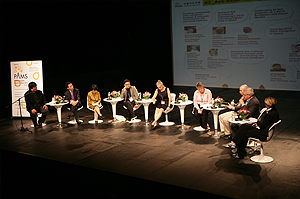
In the first session held under the topic “Ask Asia: The Reason to Focus on Asia,” representatives of global performing arts practitioners expressed their views and perspectives on Asia, reported their collaborative projects, and shared relevant information. The session revealed how much attention Asia commands as partner of collaboration, and what is the future. Eight panel members belonging to various regions and organizations presented the activities of their organizations and their collaborative programs.
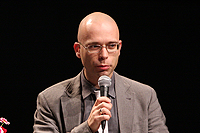
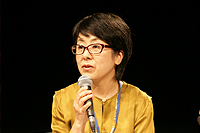
For example, the Polish state-run institute of the Adam Mickiewicz Institute has an ongoing Asia-related project since 2009. The project helps Polish artists tap on cultural events hosted by Asian nations. Introducing it as an organization similar to the Korea Arts Management Service, Marcin Jacoby in charge of Asian affairs said that the institute keeps an eye on Asia as a new marketing target. Heeding Asia from political and economic perspectives, Polish policy makers were encouraged at the active cultural promotion by the Korean government, and the promotion resulted in more solid foundations for cultural exchange with Asia, added Jacoby. Program director of the Saison Foundation, Hisano Atsuko predicted Asia’s cultural growth amidst the changes in the world economy, and expressed the wish to continue intra-Asian exchange without governmental initiation. Atsuko also introduced support programs tailored for overseas artists and art administrators, which are to be operable only by the private sector. Especially, the foundation provides researches on Japanese arts and arts management by inviting overseas arts management experts in order to build up the relevant infrastructure.
|
|
|
| ||
|
Marcin Jacoby of Adam Mickiewicz Institute |
Hisano Atsuko of Saison Foundation |
Sioned Hughes of Visiting Arts |
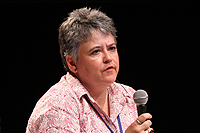
Sioned Hughes, who is the program director of the British Visiting Arts, elaborated on the exchange of information necessary for organizational international exchange, construction of partnership, and overseas working. Especially, the “One Square Mile” program was presented as a new model for international collaboration. The program is to build mutual networks simultaneously between the participants living overseas and closely associated local communities, and the participants from other areas. Thereby, it is to share the problems with others. The program is also an example of overcoming distance and differences while pursuing international collaboration or co-production.
Director of the Singaporean Arts Network Asia, Tay Tong asserted that it is necessary to appreciate the diversity of Asia, advocating as Asian for dismantlement of the borders dividing Asia. Tong set forth a specific goal of establishing a fund named Asia Mobility Fund through voluntary participation and exchange, presenting concrete guidelines as well as philosophy. Mascia Pavon of the Napoli Teatro Festival, who takes charge of its Asian programs, presented specific cases of collaboration with Asia. Relatively young being first presented in 2008, the festival once formed a troupe consisting of members with different nationalities and language backgrounds. But Pavon showed a strong will to advance the festival by forming partnerships with Asian countries. Running the Malta Festival Poznan for more than 20 years, Michał Merczyński said that it is to operate a weekly Asia-Europe program in 2012. He takes in mind not the geographic Asia, but the cultural region of Asia. In Warsaw only, Vietnamese immigrants number over 70,000. As the second generation settles down, a new culture is being formed and changes are being made. But he said the new trend is not limited to Poland. He added, metropolitan cities in Asia are undergoing the same change; and, thus, to accommodate Asia, it is necessary to abandon its geographic delineation.
|
|
|
| ||
|
Tay Tong of Arts Network Asia |
Mascia Pavon of Napoli Teatro Festival |
Michał Merczyński of Malta Festival Poznan |
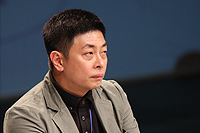
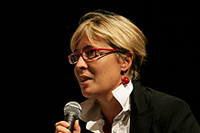
Panel members paid attention to Asia as new partner for collaboration and expectations thereof, and as new market. Especially, CEO of the Seoul Foundation Arts and Culture Ho-Sang AHN opined that a change is being perceived within Asia. So far, AHN argued, Asians are outwardly directed to conduct direct exchange with the Western markets. Now, the outward attention is being redirected inward upon awareness of the need for intra-Asian exchange. In fact, the expectation that Asia would mark the upper position in the world economy has somewhat affected the expectations for Asian culture and arts. All participants agreed that the ultimate success, however, depends on how much Asians can endeavor to tolerate other culture, and it is vital to consistent and continuing collaboration within Asia as well as with the West.
Secretary-general of the International Network for Contemporary Performing Arts, Mary Ahn Devlieg paid attention to the process of understanding the East and the West as a single community in order to boost exchange between them. Closing the session after heated discussion with other panel members, Devlieg pointed out the importance of communicating with local communities to help people understand arts as public goods, shunning protests and demonstrations against relevant budget cuts arising out of the international financial crisis. Devlieg admitted to the difficulty of accepting Asia as communal partner. She, however, stressed that understanding Asia should be achieved not through calculation of economic and political efficiency and advantage, but through mutual exchange.
 PREV
PREV
.JPG)
.jpg)
.jpg)
.jpg)
.jpg)












;)


