





New Challenges for Contemporary Arts, Gathering in Gwangju
[Focus] 2011 Asian Arts Theatre Residency_Gwangju
[Focus] 2011 Asian Arts Theatre Residency_Gwangju
From May 18 to 27, 1980, residents of Gwangju City and neighboring provinces stood up against the military ruling, demanding freedom. The government harshly cracked down on the uprising, and produced heavy causalities in the process. Since then, the city has been identified with the pain of modern Korea, and represents human rights, democracy and peace.
Sitting on an area of 501.25㎢ populated by 1,468,000 people (as of 2010), the city is domestically famous for traditional Korean arts. Its fame has been elevated for Gwangju Biennale, which first took place in 1995.
Hub City of Asian Culture
Based on these historic and art backgrounds, the Roh Moo-hyun administration enacted a special act, founded a special agency within the culture ministry, and commenced a national project. Under the project, 5.3 trillion Korean won (consisting of 2.8 trillion won from the national treasury, 0.8 trillion won from local budgets, and 1.7 trillion won from private investors) will have been invested. This project is intended to boost the city''s communication with global communities, and to mark it as a cultural hub by actively accommodating the Western cultural mainstream.A program of the project is to build cultural facilities around the center of the 5/18 uprising. The key facility is the Asian Culture Complex, which is to be opened in 2014. The complex will house the Cultural Exchange Agency, Edu-culture Agency for Children, Asian Culture Information Agency, Cultural Promotion Agency, and the Asian Arts Theatre. In anticipation of the grand opening, various programs are being carried out to accommodate individualism, localism, nationalism, Asia and the world, with the focus on contemporary Asian values and the concept of "Asia Contemporary."
The Emerging Mecca of Creating and Producing Contemporary Arts
The Asian Arts Theatre of the complex consists of one grand performance hall (6,744㎡in area, 2,000 seats), which is dividable up to three spaces, and one proscenium Hall(3,169㎡in area, 518 seats). Incorporating old Asian values as well as its contemporary characteristics, the theatre aims to present quality art performances that serve as channel for communicating with the world through future-oriented artistic expression. Especially, the organizers wish to foster grounds for creative efforts by utilizing other facilities of the complex and resources, technologies and human resources, and further plan to carry out the entire process of creating, producing and distributing them in an integrated way. The directions of the program are summed up, as follows:
First, the organizers intend to develop a contemporary festival brand. In other words, they plan to produce experimental and creative contemporary Asian art pieces via reinterpretation of traditions and reflection of multiple cultural ingredients, humanities and philosophy. Thereby, it aims to establish contemporary Asian festivals, artist residency festivals in an interwoven, and nomadic way.
Second, they pursue foundation of a connection and development network covering and enabling development of ideas, and production thereof in the theatre by creative producers in and outside Korea. Also, they establish a network via co-productions, collaborations and international exchanges.
Third, the theatre will operate diverse community programs to connect audiences with domestic and overseas art communities, and further with local communities.
|
|
| |
|
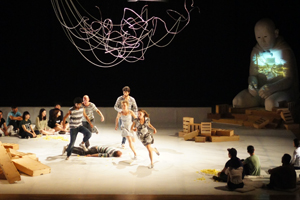
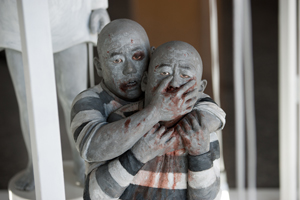
Nameless Forest ⓒ Hub City of Asian Culture, Ministry of Culture, Sports and Tourism of the Korea | ||
International Competition for Grand Opening Festival
In 2010 and 2011, the theatre solicited (proposals for) projects to be performed at the 2014 grand opening festival to encourage quality creative pieces and boost collaboration between domestic and overseas artists. The invitation was for international collaboration projects led by Asian or Korean artists, and for the non-Asian projects being conceived or produced centered around Asian themes in collaboration with Asian artists, which can be first performed at the theatre. The priority was given to performing projects that reinterpret Asian themes or traditions in a contemporary way, that incorporate ingredients of bordering art genres, that embrace the local characteristics of Gwangju City, or that maximize spatial features of the grand hall of the theatre. Based on the criteria, the following projects were chosen in 2010 and 2011. Each winning piece was awarded a 20 million Korean won subsidy (tax included).
|
|
|
| |
|
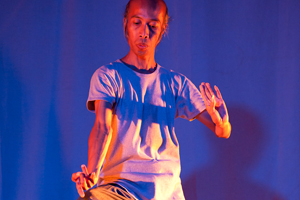
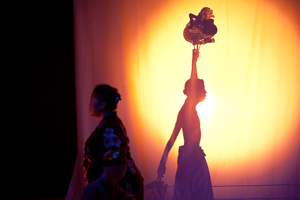
Collaboration Indonesia Thailand Artist ⓒ Hub City of Asian Culture, Ministry of Culture, Sports and Tourism of the Korea | ||
2011 Asian Arts Theatre Residency_Gwangju
The 2011 Asian Arts Theatre Residency-Gwangju presents, prior to the grand opening of the Asian Arts Complex, the (proposals for) projects selected in the 2010 and 2011 international competitions that were held to promote quality creative works and collaboration between domestic and overseas artists. The program was designed to help producers of the selected (proposals for) projects and to serve as an open venue for communicating with the local community. In addition, it is to verify whether the projects square with the artistic direction of the theatre and to help set up an administrative model of the theatre for phase-based assistance for production of art performances. |
|
| |
|
Artists'' Talk |
Farewell Party | |
|
ⓒ Hub City of Asian Culture, Ministry of Culture, Sports and Tourism of the Korea | ||
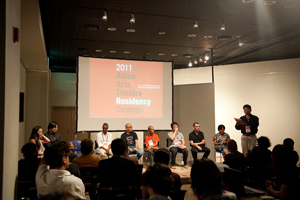
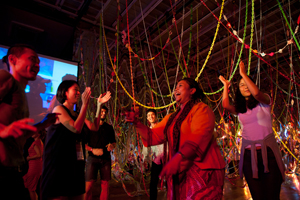
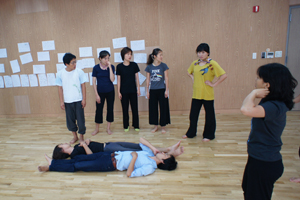
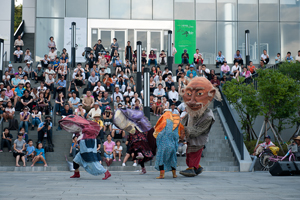
Under the auspices of the Office for Hub City of Asian Culture of the culture ministry, the Residency-Gwangju was held from August 29, 2011 to September 4, 2011. Performed on invitation during that period was the 2010 winning piece Nameless Forest, which was produced by Dean Moss (choreographer, media artist, and director) and Sung Myung Chun (Korean sculptor). Also played as an outdoor function was the nomadic puppet show Theatre Nomad; Old Song''s Odyssey, which was co-produced by the Korean Performance Group TUIDA and the Australian group Snuff Puppet. Especially in the latter, local troupes participated. Born through collaboration with local artists, the 2011 winning project of Mugidance paved the way for modern application of traditional Asian formats of performing arts and for further interpretation by incorporating therein the elements of dance, music, and songs of the northern Thai region of Lanna and those of music, puppet, songs and dance of the Indonesian region of Java. Sungmin HONG''s Typological Archive Project–Tradition/Hundai demonstrated how to newly express the four key words set forth by the theatre: Asia, integration, City of Gwangju and grand hall. It was an archiving performance where the artists born or raised in the local community were invited and their lives were depicted. During preparation of these three projects, or Performance Group TUIDA''s Theatre Nomad; Old Song''s Odyssey, the Indonesian winning piece of Mudidance born in collaboration with Thai artists, Sungmin HONG''s Typological Archive Project, about 60 members of local art and civic communities participated in the entire production thereof. In addition, during the residency, they shared their thoughts with artists, through, for example, open workshops about how to produce performing pieces, and watched the projects.
|
|
| |
|
Theatre Nomad; Old Song''s Odyssey workshop ⓒ Hub City of Asian Culture, Ministry of Culture, Sports and Tourism of the Korea | ||
Invite Artistic Director
The Asian Arts Theatre is looking for an artistic director who is to take charge of all preparations for the grand opening of the complex. Among the individuals recommended by each country, the theatre will select and screen a pool of candidates. Once selected through the open international screenings, the director takes charge of all preparations for the 2014 grand opening festival, and all the programs of the theatre for the following one year.  PREV
PREV
.JPG)
.jpg)
.jpg)
.jpg)
.jpg)












.jpg','From May 18 to 27, 1980, residents of Gwangju City..');)


