





Era of Medium‐Sized Theaters
[FOCUS] Contemporary Medium‐Sized Theaters in Korea & Changes in Producing Styles
[FOCUS] Contemporary Medium‐Sized Theaters in Korea & Changes in Producing Styles
|
This article is the excepts of the presentations on Korean medium-sized theaters made at the symposium titled "The Current State of Korean Theater: The esthetics of theatre directing at the era of Medium-Sized Theaters" which was held to celebrate the 2nd anniversary of the Namsan Arts Center under the auspices of the center and the Korean Association of Theatre Critics. |
For the last five years, the number has tripled of the medium-sized theaters (i.e. theaters with 500 – 1,000 seats each) that represent themselves as producing theater , and are operated by government or municipal agencies. Accordingly, their importance has increased as well in the Korean performing arts community.
Representative examples of the theaters are the Main Hall of the Arko Arts Theater (608 seats), the Towol Theater of the Seoul Arts Center (671 seats), the M Theater of the Sejong Center (639 seats), the Theater Yong of the National Museum of Korea (862 seats), the Chongdong Theater (400 seats), the Dongsoong Hall of the Dongsoong Art Center (450 seats), and the Yonkang Hall of the Doosan Art Center (620 seats).
What could explain the renewed attention to the medium-sized theaters? In short, two phases offer the answer: young directors and producing theaters. Promoting themselves as producing theaters, the theaters have rolled up their sleeves in production, hand in hand with young artists (i.e. writers and directors). Widening the horizon as the venue where audiences meet art pieces, the theaters have assumed the active role as planner and producer in creation as well.
The same rationale applies to and explains the public favor commanded by the three theaters opened in 2009: the Myeongdong Theater (558 seats), the Namsan Arts Center (480 seats), and the Main Hall of the Daehangno Arts Theater (498 seats).
|
|
|
| ||
|
Myeongdong Theater |
Namsan Arts Center |
Main Hall of the Daehangno Arts Theater |
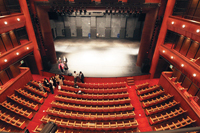
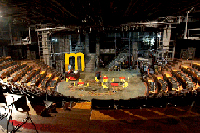
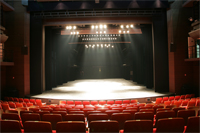
Marking itself as the sole medium-sized theater in Korea during the 1960s to the 1970s, the Myeongdong Theater was closed in 1976. Since its revival 34 years after its closure, the theater has been serving middle-aged and elderly audiences with its quality presentation of canon-based art pieces. Centered at the tourism hub of Seoul swarmed by foreign tourists, the theater has introduced quality classical works under the mottoes of "quality, popularization and globalization." For example, it re-opened itself with Long Day’’s Journey into Night (written by Eugene Gladstone O’’Neill, directed by Young Woong LIM). Then it has presented contemporary art pieces, under the directorship of experienced directors, such as The Merchant of Venice (written William Shakespeare, directed by Yoon-Taek LEE) in 2009; and Putujuće Pozorište Šopalovic (written by Ljubomir Simović, directed by Byung-Hoon LEE), Don Quixote (written by Cervantes and directed by Jung-ung YANG), The Habit of Art (written by Alan Bennet, directed by Jung Hee PARK) and The Pitmen Painters (written by Lee Hall, directed by Sang Woo LEE) in 2010.
|
|
| |
|
Long Day’’s Journey into Night |
Romeo and Juliet |
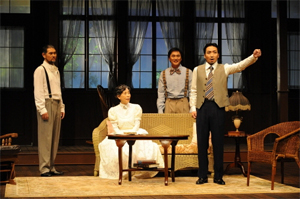
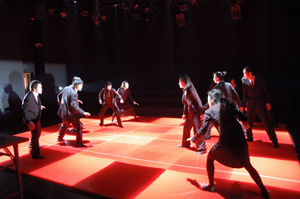
The Namsan Arts Center (formerly known as the Drama Center) opened itself to public under its current new name in 2009 when the Seoul Foundation for Arts and Culture took charge of its operation on commission from the Seoul municipal government. Under the motto of "Contemporary and New Wave," it has offered itself as venue to young creators who try to reflect the contemporary social phenomena and historical issues in Korea into their works. Starting with We’’ve Got Visitors Today that was a brainchild collaboration of six young writers and directors, it has produced, ali vs. ali (written by Jae-Seung AN, directed by Hansol YOON) and Bright Blue Day (written by Kyung Jin JUNG, directed by Sun Woong GO) in cooperation with Seensee Company. Besides, the center organizes and hosts every fall the Festival Jang, which is designed to promote interdisciplinary genres and arts. In addition, it has been introducing to Korean audiences overseas art pieces. It presented Tokyo Deathlock’’s Romeo and Juliet (directed by Junnosuke Tada) at the festival, and Shaubühne berlin’’s Hamlet (directed by Thomas Ostermeier) in 2010 upon joint invitation with the Seoul Theatre Olympics.
Open in 2009, the Daehangno Arts Theater is run by the Hanguk Performing Arts Center. In 2010, the Hankuk Performing Arts Centre merged with the Arko Arts Theater that had been run by the Arts Council Korea from 1981 and the Daehangno Arts Theater. The two theaters of the Center offer their four halls to help private troupes make presentations at medium-sized theaters. The Daehangno Arts Theater hosts theatrical pieces, while the Arko Arts Theater serves as venue for dance performances.
As the number and role of medium-sized theaters increase, the core of theatrical performance is being shifted from repertoire-oriented presentations at small theaters to produced pieces for medium-sized ones. Another new trend is that focus of production has shifted from on director to on artistic achievement, and from on producer- and commercialism-oriented art pieces to on public theater-led artful pieces. In the process, the audience pool is being enlarged.
|
|
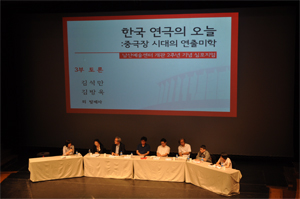
At the symposium, various opinions were expressed as to how to cope with the era of medium-sized theaters. Pointing out the shortage of professionals experienced in planning and artful production of the art pieces appropriate for the medium-sized theaters, director Sung-youl LEE of Baeksukwangbu Theater Company and director Kyung-Mo AHN of Yeon Woo Theater Company opined to the extent that a long-term approach should be taken not only to create favorable environment for production by theaters’’ taking the leading role, but also to accumulate the know-how within them. That way, they asserted, the human infrastructure for the medium-sized theaters is to be built up. Theatrical critic Sung Hee KIM stressed the role of artistic directors and dramaturges (i.e. critical advisers on all things related to theater and theatrical performance) in developing aesthetics of theatre directing and theatrical pieces. Others emphasized the importance of developing plays and the technique of direction tailored for the medium-sized theaters and that of performer’’s practice of diction and acting.
 PREV
PREV
.JPG)
.jpg)
.jpg)
.jpg)
.jpg)












;)


