





Korea Arts Management workforce employment status and job satisfaction
In the view of ''Arts Management'' as an occupation, there is a need to examine if Arts Management -the Arts Management here will be limited to the workforce working in planning services- is included in the Korean Standard Classification of Occupations(KSCO), and the fact is that the jobs that are responsible for Planning Management isn''t yet identified as independent occupations according to KSCO. This fact may reflect the decision that this kind of jobs are unique and isn''t universal enough to be considered as a candidate for independent occupation according to KSCO.
In 2007, I had surveyed 482 Performing Arts Institutions/Organizations through the commission of Korea Arts Management Service. Although the main objective of the survey was to grasp the demand for Planning Management workforce, I also wanted to find out the actual status of the employed Planning Management workforce in Performing Arts Institutions/Organizations at the time. Looking back from the current perspective since 4 years earlier, I will try to weave the past findings with the current situation as the data will serve to be a useful tool for drawing the comparison. For detailed contents you may refer to 「Research of Professionals in Performing Arts Planning Management - Survey result analysis of supply and demand」(Korea Arts Management Service/Korea Labor Institute, Seung-Yeol YEE and others, 2008)
60% for those employed are serving 1 year contract or more
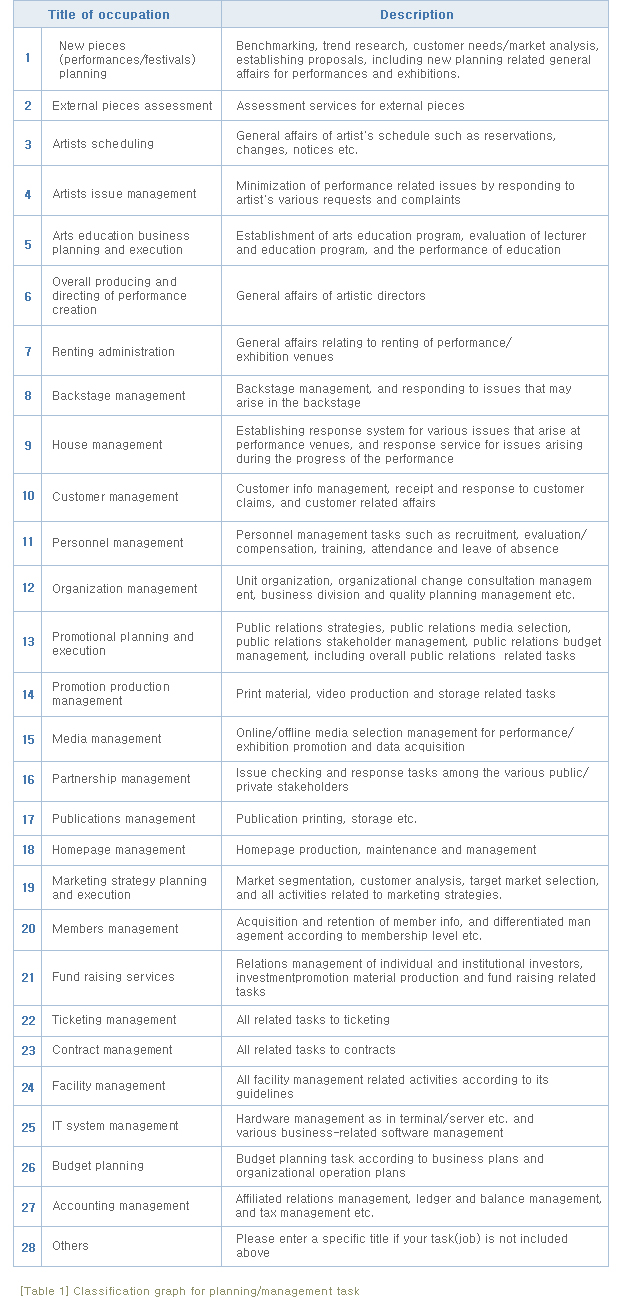
The classification [Table 1] of planning/management services was presented to the target Performing Arts Institutions(Organizations), and had them fill in all of the info about the currently employed workforce in the survey table. Through this survey, I was able to obtain information from 1,424 personnels employed by 482 different establishments. The findings were first, full-time (more than 1 year contract) was 63.4%, employer/self-employed was 22.8%, part-time (more than 1 month and less than 1 year contract) was 10.3%, and day labor (less than 1 month contract) was 3.4%. |
|
|
|
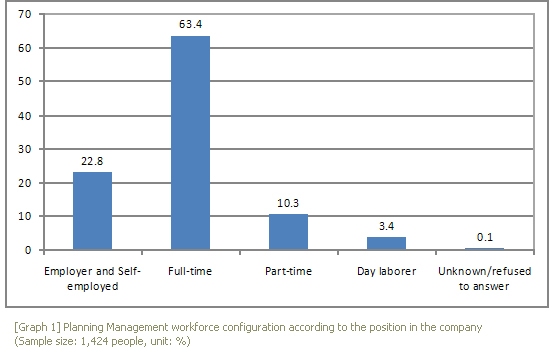
The results seen on this graph might raise the question that the survey was biased due to concentration of the data pool of full-time workers, but this might be only a reflection of the difference in the ''understanding of the position'' between the workforce and the employing companies. In other words those employees that are working or planning to work for more than a year, though without a written or verbal contract, might have considered and classified themselves as a part of the full-time work force on the survey.
The lot falls under less than 5 years of experience
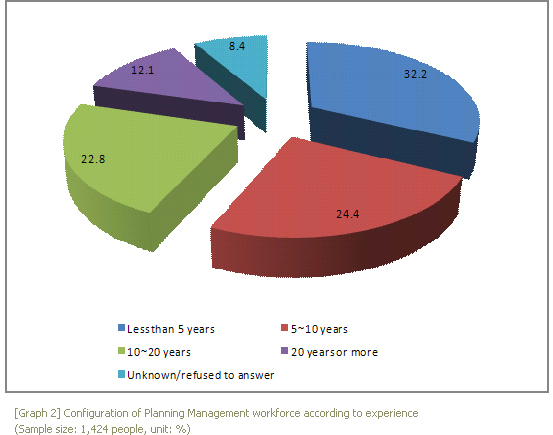
The average experience of the target people were 9.1 years. But, when viewed through distribution, the highest was less than 5 years of experience with 32.2%, then 5~10 years (24.4%), 10~20 years (22.8%), over 20 years came out to 12.1%. At the time of the survey, I also did an interview survey and found cases where performance artists and staffs employed at small-scaled agencies were making transitions into Performance Planning workforce. These transitions from performance to planning field might depend on circumstances such as the current performance being suspended or a shift in the priority of the employee during a helping process of other performance planning. But, there were some cases where people with interest in Performance Planning changing their career from non-related companies. Contrastingly, there were considerable new recruits with less than 6 ~ 12 months of continuous service year. |
|
High prospects but low wage
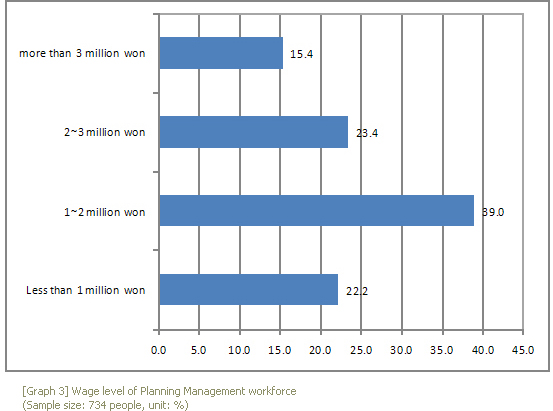
The average wage of the 734 Planning Management workforce were verified through the survey. It was found that the then monthly average wage was around $1,620(1.769 million won), and the distribution from the lowest to the highest wage was found to be from $92(100 thousand won) to $7,640(8.3 million won). Employer''s average wage was around $1,850(2.018 million won), full-time $1,740(1.896 million won), part-time $680(7.42 hundred thousand won), and the day laborer $910(9.92 hundred thousand won). In the distribution view, $920~$1,840(1~2 million won) average wage segment showed the highest ratio. During the in-depth interview, it was found that the lowest wage average for new recruits of small-scaled companies began as low as $550(6 hundred thousand won). In the case of play performers, though not formal Performance Planning personnel, the training members hoping to be actors had worked as assistants and failed to receive wages for their work. In conclusion, majority of the workforce in the field of performance planning had significantly low wages excluding few large-scaled performance theatres or Performance Planning companies, and national organizations of performing arts. |
|
|
|
|
|
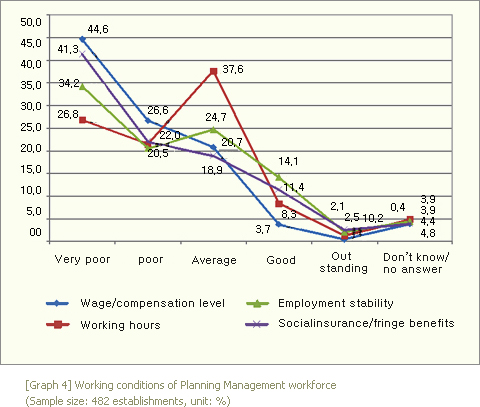
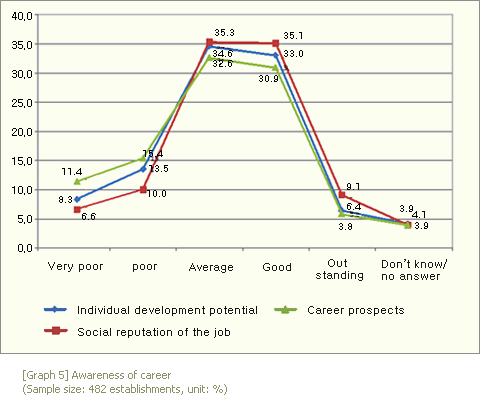
Despite the poor working conditions
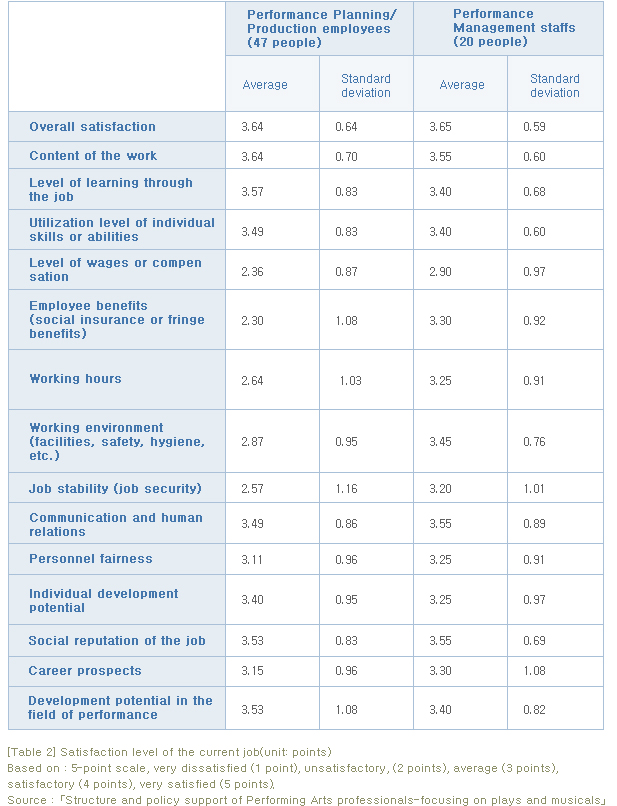
Unfortunately, there was no research done for the job satisfaction or work values as the survey was geared towards workforce survey. There was an online poll(Apr.21 ~ May 11) from the webzines [weekly@Arts Management] of Arts Management Service before I wrote this report, and the result was that the main reasons that influence job satisfaction for people in Arts Management was "occupation as a prospect and development potential" (52%), "exercise and development of personal skills" (27%), "wages and fringe benefits" (10%), "communication and human relations" (8%), and "job security"(3%). When this data is seen side by side with the above survey results, we can speculate that a considerable amount of workforce had an optimistic view on the career possibilities of Arts Management despite its poor working conditions. Additionally, from the 2007 Korea Labor Institute survey that targeted performing artists in the field of plays and musicals, I would like to introduce a satisfaction survey results of Performance Planning/Producing employees(47 people) and Performance Venue Management staffs(20 people).
According to the results it can be said that the overall satisfaction(5-point scale) was relatively high with averages of 3.64 points(Performance Planning/Production employees), 3.65 points(Performance Venue Management staffs), and slightly higher 3.68 point average for the other performance artists(206 employees). When we take a look at each of the 14 items, we can see that the satisfaction for content of the employees work, the level of learning through the process of work, the utilization level of individual skills or ability, conversation and human relations, social reputation of the job, and development potential in the field of performance are high; but, the satisfaction level for fringe benefits, level of wage/compensation, and job security were low. Though, this result is from a small sample pool and is confined to the fields of plays and musicals, I think it is safe to assume that it is universal as the overall Planning Management workforce of Performing Arts have pretty mutual level of satisfaction results.
|
|
The abilities needed for the job were able to be observed in the result through four classifications of artistic ability, technical skills, business skills, and communication skills. The levels of business and communication skills for Performance Planning/Production were higher than other occupations. Furthermore, this data allowed us to see the differences in the level of skills required among different positions in the field of Performance Planning/Production, and it was found that the lower hands-on positions required the most technical skills compared to other occupations, where the middle positions required higher level of expertise in the field and communication skills.
|
|
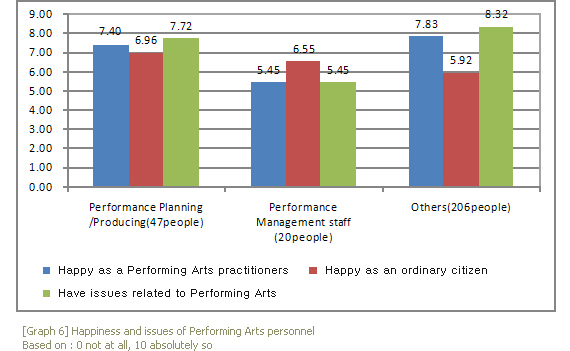
This report was written for the May 2011 special issue "Arts Management as an Occupation", of the webzine [weekly@Arts Management](Korea Arts Management Service publication]. Click on the link below to see the article in Korean.
 PREV
PREV
.JPG)
.jpg)
.jpg)
.jpg)
.jpg)












;)


