





The journey which is full of surprise
written and researched by Judith Staines, Sophie Travers, MJ Chung
「International Co-Production Manual」was first planned by Korea Arts Management Service (KAMS) in the course of developing and pursuing overseas marketing strategies and activities in the past five years to meet the rising demand. At the beginning, attention was given to how to tap on the global market. During the recent couple of years, however, the trend has undergone a tremendous change, due to, for example, changing international environment, new awareness by Korean arts of the need for international exchange, and the demand for cultural and artistic exchange and collaboration. The core in international exchange is being shifted from advance to collaboration, as demonstrated by the increasing demand for international co-production. Taking place every year, the Performing Arts Market encompasses a program titled "Looking for International Partners (LIP)" which is for promotion of sharing of ideas, and for cooperative partnership among performing arts professionals. The program attested to the high demand for the manual.
As these backstage snippets of conversation, advice and cathartic confessions from interviews with experienced international co-producers in Europe and Asia demonstrate, it is high time for this publication.
「The International Co-Production Manual」
The word "collaboration" is often preceded by epithets like creative and artistic. In the meanwhile, the term is prone to the misinterpretation that it is a means of survival amidst the global economic turmoil. Consequently, a question often ensues, "Why do we have to cooperate?" The Manual is silent as to questions like "How do we collaborate creatively and artistically?" and "What do we have to prepare for the cooperative production?" Director of the German festival Theatre der Welt, Frie Leysen replies, "There is no key formula for co-producing. Every co-production is different, and everything depends on the needs of the artist." Our newly created manual hopefully serves as a vehicle for sharing information with other Asian and European artists and producers, and their various experiences in co-production and collaboration. Thereby, a new ear of artistic and creative co-production and collaboration wishfully springs up.
|
|
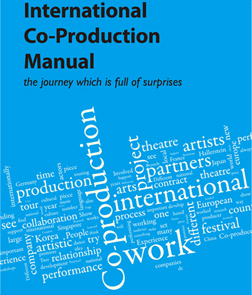
The Manual defines international co-production as "contractual act by two or more production partners of creating and distributing production or procedural projects." It further defines as its applicable genres music, theatre, dance, circus and interdisciplinary arts. It also delineates the contextual and geographical scope of the study on international co-production within Asia Pacific and Europe.
The Manual consists of four major chapters. Addressed in Chapter 1 titled "Methodology" is the importance of how to find out common grounds among people of different cultures and values. It is likened to the fable where six blind individuals describe an elephant after touching it in its different parts. Rather than focusing on historic and theoretical knowledge of international collaboration and tour, the manual concentrates on the present and the actual experiences and sharing thereof, arising in the course of international co-production.
Titled "The Manual," Chapter 2 systematically describes the trends and the methods of co-production. In other words, it explains the entire co-production process in its subchapters named after the order a work is created in an international co-production project: Types of Co-Production, Trends in International Co-Production, Starting Points, How to Build Experience and Capacity, Phases of the Co-Production Process, Contracts and Fees, Communication, Risks and Challenges, and Advice and Suggestions.
The next chapter is the "Case Studies" section, which constitutes the main part of the manual. The manual offers 15 different categories of co-production experiences and types such as Asia-Asia, Asia-Europe, and Europe-Europe projects. It incorporates 30 artists, producers and directors of 21 European and Asian countries. Selected online, the cases cover the projects in the recent five years, where partners of two or more countries participated in production and planning. The writers of the Manual focus on showing the different aspects of the cases, in consideration of artistic content, scale, level of experience, type of partnership, regional features, culture and economy. Interviews contemplate such issues as how a project was born, what it meant to work internationally, what were major processes and procedures, what were problems and how they were tackled, and what results followed, along with tips for better future. Most interviewees agree that the only way of learning about international co-production is to actually participate therein. They also point to the importance of communication, mutual understanding and trust as the means of tackling diverse problems.
|
|
| |
|
UK-Japan Co-Production Shun-kin(2009, Theatre) |
Australia-Korea Collaboration Strangeland (2009, Physical Performance) |
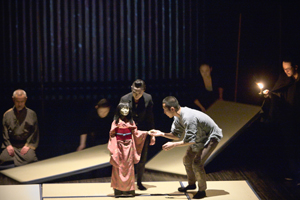
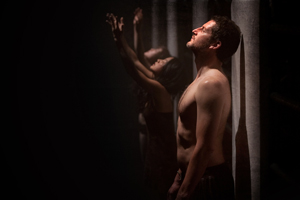
The Manual authors learned, through interviews, that the key to successful co-production lies in human and cultural communicating skills, deep dedication to artistic endeavor, and strong will to complete art works. The 15 cases in the Manual introduce you to the artists and producers who build up trust through a rough journey of mutual understanding and communication encountered during co-production, and finally prepare themselves for next journeys by closing the awesome one.
Experiences are the most important thing, there is no advice.
- Dejan Pestotnik (KIBLA), Slovenia
Build artistic trust with a partner before starting a co-production and then you can find a positive solution when you face a difficulty in the journey which is full of surprises. Always be honest about a problem and face it and find a solution together, then you will find the true meaning of international co-production.
- Claire Sung (Wuturi), Korea
If you want to find out what you are and what you are not good at, make an international co-production. Never leave a project without having tried everything – it is a waste of all the effort that goes into making it happen.
- David Pledger (Not Yet It''s Difficult, NYID), Australia
The "Research Resources" chapter closes the Manual, defining various terms used differently by different producers and listing additional Asian and European cases worth our attention. Also included in the chapter are the checklist and references for preparing international tours.
The Manual is the brainchild of the second international collaboration project between the KAMS and the IETM (International Network for Contemporary Performing Arts). They first joined their hands for the IETM Satellite Meeting in Seoul in 2007. The IETM made a significant and meaningful contribution to the birth of this Manual and, further, to successful international partnership in the future, with its database on inter-European partnerships, collaboration, and, in particular, experienced know-how of European experts in performing arts.
The Research Team comprised UK-based author and mobility expect Judith Staines, experienced arts manager and consultant Sophie Travers of Gallus Arts Advisory in Australia and Korean performing arts producer and journalist M J Chung, based in London. Preparing this Manual itself symbolizes a long, winding journey. Three writers who had never met before worked together despite the 11-hour physical difference. This Manual is the journey of which is full of surprise.
This Manual is available in PDF format. For more information, please go to either from the KAMS'' performing arts exchange website theApro or the IETM website.
 PREV
PREV
.JPG)
.jpg)
.jpg)
.jpg)
.jpg)












.jpg','「International Co-Production Manual」was first plan..');)


