





The Status of Performing Arts Facilities in Korea
2010 Performing Arts Survey - Survey on performing arts facilities, Korea
2010 Performing Arts Survey - Survey on performing arts facilities, Korea
|
Survey Overview Survey _ 2010 Performing Arts Survey (survey on performing arts facilities) Basic Year _ 2009 Targets _ 772 performing arts facilities in the nation Contents _ Facilities, operation, performance record, financial status, HR etc |
Is it possible to compare the management performance of Seoul Arts Center and small theaters located in Daehangno Jongno-gu Seoul (there are over 120 small theaters)? If possible, how would they be different? Maybe it is meaningless to compare different types of performing arts facilities which are different in size and way of operation. However, comparing by grouping performing arts facilities depending on the features will generate a significant outcome.
Recently released 「2010 Performing Arts Survey」(as of 2009) compares the management performance by grouping the performing arts facilities based upon the characteristics of foundation and operation. Result shows that there is a difference in management performance depending on the features of performing arts facilities. In other words, there are strengths and weaknesses in operation and other factors of the groups. Especially, the difference in management performance of the public facilities or which of the private facilities is obvious. It is difficult to explain whether such differences are from the unique characteristics of the groups, but some features can be found in the comparison of the management performances among the groups.
Recently released 「2010 Performing Arts Survey」(as of 2009) compares the management performance by grouping the performing arts facilities based upon the characteristics of foundation and operation. Result shows that there is a difference in management performance depending on the features of performing arts facilities. In other words, there are strengths and weaknesses in operation and other factors of the groups. Especially, the difference in management performance of the public facilities or which of the private facilities is obvious. It is difficult to explain whether such differences are from the unique characteristics of the groups, but some features can be found in the comparison of the management performances among the groups.
Central government-run facilities,
High in revenue and good management performance
High in revenue and good management performance
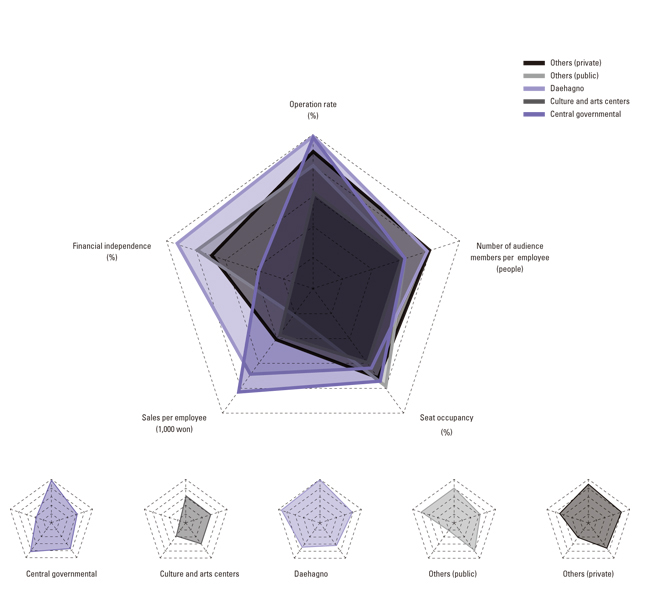
In the survey, the targets(all performing arts facilities) were divided into 5 groups- Central governmental(national), Culture and arts centers(regional governmental), Daehagno, Other(public) and Other(private) facilities. Management performance were observed in 5 factors - ’’Operation rate’’, ’’Number of audience per employee’’, ’’Seat occupancy(including paid and complimentary tickets)’’, ’’Sales per employee’’, and ’’Financial independency’’. The factors of management performance were analyzed based on the profitability and productivity, and it does not reflect 100% of the unique characteristics of performing arts.
|
|
|
[Figure] Comparison of Operational Records by Facility Type |
|
Category |
Facilities by characteristics | |||||
| Central governmental |
Culture and arts centers |
Daehagno | Other (Pubic) |
Other (Private) | ||
| Major operational records |
Operation rate (%) | 99.1 | 61.7 | 99.0 | 78.4 | 87.5 |
| Number of audience per employee(people) |
3,097 | 2,998 | 3,840 | 3,104 | 3,924 | |
| Seat occupancy (%) | 73.1 | 59.2 | 63.4 | 78.8 | 71.3 | |
| Sales per employee (1,000 won) | 58,375 | 26,256 | 48,436 | 14,846 | 28,728 | |
| Financial independence (%) |
36.8 | 14.9 | 92.4 | 78.6 | 68.6 | |
[Table] Major Operational Records by Facility Type
Following is the comparison of management performances of the central govemmental facilities, culture and arts centers and theaters in Daehagno of the 5 character groups. First, Of total 772 performing arts facilities, most of the central governmental facilities are ranked in Top 10 in gross sales, and overall management performances except for financial independency (gross expenditure vs. sales) are excellent or similar to the management performance of the private facilities. Also, as public facilities, their operation rate and sales per employee are competitive with the private facilities.
At halls show poor management performance among the public facilities,
Performing arts facilities in Daehagno show a signifiacant result in sales
Performing arts facilities in Daehagno show a signifiacant result in sales
Whereas, ’’culture and arts centers’’ which is one of the representative public facilities shows a weak management performance compared to the other performing arts facilities including the private facilities. Its management performance is even poorer than other(public) facilities. The number of culture and arts centers(178 as of 2009) has increased rapidly in last 10 years, and the operational efficiency and performing programs need to be changed and improved.
The number of performing arts facilities in Daehagno Jongno-gu Seoul has increased as fast and many as the number of culture and arts centers in recent years. It takes over 10% of the market in the number of facilities and size (sales). Most of the performing arts facilities in Daehagno are being operated for a small number of audience, but their management performance shows a very significant result. Especially, their operation rate and financial independency are better than other groups. However, their seat occupancy is relatively weak considering the characteristics of the facilities.
The number of performing arts facilities in Daehagno Jongno-gu Seoul has increased as fast and many as the number of culture and arts centers in recent years. It takes over 10% of the market in the number of facilities and size (sales). Most of the performing arts facilities in Daehagno are being operated for a small number of audience, but their management performance shows a very significant result. Especially, their operation rate and financial independency are better than other groups. However, their seat occupancy is relatively weak considering the characteristics of the facilities.
Need to improve the operational efficiency rather than to expand the size of facilities.
In the operational efficiency, the central governmental facilities are leading the market, and the performing arts facilities in Daehagno show stable management performance in the overall factors including infrastructure. However, the result reveals that there are a number of culture and arts centers as representatives of the public facilities, but their management performances need to be improved. Of course, the characteristics and ways of operating public facilities and private facilities are different. Nevertheless, the management performance of those facilities should be improved.
As mentioned earlier, there are too many performing arts facilities in Korea compared to the population. Therefore, it is more important to improve the operational efficiency and to develop arts programs than building more facilities. The Performing arts survey which is released annually will suggest the flow of management performance of the performing arts facilities in index.
As mentioned earlier, there are too many performing arts facilities in Korea compared to the population. Therefore, it is more important to improve the operational efficiency and to develop arts programs than building more facilities. The Performing arts survey which is released annually will suggest the flow of management performance of the performing arts facilities in index.
|
[Reference] Glossary Characteristic groups :Performing arts facilities are divided into 5 groups depending Central governmental :Performing arts facilities established by the Central government Culture and arts centers :Public performing arts facilities established by the Daehagno :Private performing arts facilities located in Daehagno Jongro-gu Seoul Other (private) :Private performing arts facilities located in places other than Daehagno |
 PREV
PREV
.JPG)
.jpg)
.jpg)
.jpg)
.jpg)












.jpg','Is it possible to compare the management performan..');)


