





Review for Artists-in-Residency 2011 Jindo, Korea
|
By Josef Aichinger |
Target of the residency-workshop: Korean artists, who know each other, but have never worked together, meet international artists from renowned residencies in searching for Korea. An encounter of people from different artistic backgrounds, held at the Namdo Music Center in Jindo, also in interaction with people from Sopo-ri in order to share stories of life and music, to express various forms of art, and to discover folk music from the farmers, the melodies of ocean and sounds expressing toughness of life.
Initially I''ve assumed that this invitation is referable to my former visit at PAMS in October 2010. So I considered it as a start of cultural exchange program between Korea and Austria. Even I was asked to go with two or three traditional musicians from Austria as artists in residence and participants of the workshop.
Actually I couldn''t really imagine at first, how to induce a productive and gainful exchange between two contrarian musical traditions. I couldn’t see any approach to Korean and Austrian traditional music, as Austrian folk and traditional music is absolutely different from Korean one. Korean is based on Buddhism and shamanistic faith – Korean music can be divided into at least four types: courtly, aristocratic, scholarly, and religious. For inexperienced ears of Europeans it sounds like deep avant-garde or New experimental Music, whereas our Austrian traditional music goes back to diverse ethnic influences like Slavic or Hungarian, alpine rhythms etc. Thus there are no connecting factors to any Asian musical styles in our tradition.
It was obvious for me to go with two Austrian musicians familiar with traditional music, even experienced in classical as well as contemporary, open minded in experimental and improvised music. Michael Bruckner is a primary musician in the range of traditional and contemporary music, also an interdisciplinary working artist as a sound sculptor and a performer. As a musician for some time he employs macro photography as an artistic supportive part of sheet music. Renald Deppe is a composer, a painter, and an author, interested in the fields of "graphical transcription" of musical sequences - the unconventional "directory" of sound memories as graphic notation.
Furthermore KAMS has invited international artists: Brazilian pianist Benjamim Taubkin, known as an open minded and high experienced musician in wider range of Latin tradition – as well as two musicians from India, Anil Srinivasan, a pianist, a composer and a music educator, established in the South Indian cultural, and Sikkil Guruchan, the first generation vocalist from a reputed family of flautists - both more trained in classical Indian music.
|
|
|
|
open lab at Incheon Art Platform | |
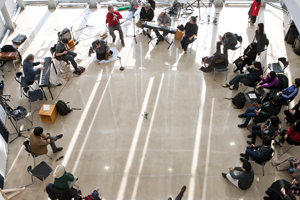
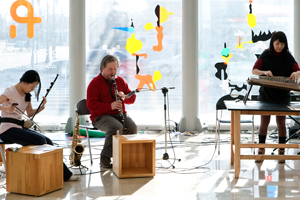
So first we had to find out participant’s propensity – in which class each musician wanted to take part. Which music they wanted to play and what’s expected. Finally on the second day, a real dynamic and creative exchange has started. Soon we recognized participant''s interests and experiences in their musical ranges and realized their individual abilities, skills and likings. This caused an enthusiastic atmosphere as a clear approach had arisen, which was the basic for a successful workshop. Even some language problems have partly occurred. Residencies didn''t speak Korean and some participants had no English ability. All the more we were all astonished, that this deep conversation and positive confrontation in such high intensity could develop in very short time, not to forget the fantastic support.
Even it was all this impression we’ve got in Jindo, which seems to be the land of incredible sound and nature - meeting these people at this village Sopo-ri in Jisan-myeon, Jindo-gun, and singing about life’s pleasure, rage, sadness and excitement in such an incredibly dedication and devotion was fantastic.
All in all this residency workshop was quite a unique and unexpected experience in several respects, and I was truly surprised at the variety of Korean arts, and the potential of possibilities that inheres in a confrontation between people of different artistic backgrounds, and great difference of their culture. Probably it was this disparity what brought this dynamics. Korean culture in general I found is very open, communicative and lively. Above all in Sapo-ri village I''ve felt deep coherences among Korean art genres. Even this calligraphy museum was inspiring – seeing all this brought us closer to understand a bit more about Korean music, and why it sounds like this.
|
|
|
|
at Jindo Sopo-ri village | |
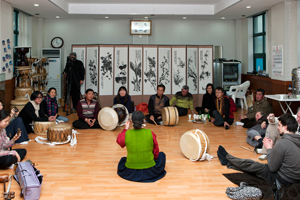
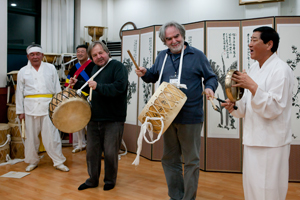
Without doubt, we experienced many of miraculous and wonderful things there. Finally I allow myself some thoughts from artists and scientists to submit, which were in our mind during our stay in Korea.
These countries of more and more repeatedly rising sun, moving faster and becoming steeper, hotter, bigger, brighter, and richer – which urges more prolifically - have to make significant decisions for our future. For all of us on this little round (still blue colored) ball, named "Earth" – perhaps a cultural exchange brings us closer to some more meaningful decisions.
"Everything that musicians are doing - either composing, conducting, or playing instruments - it means the attempt to share feelings and thoughts about music with other people as for artists nothing is real, until they have shared it with some others.."
_Leonard Bernstein
And that’s exactly what we all felt in Jindo with all these wonderful people we’ve met there. So everything we have seen, listened to, talked about, smelt and felt there was a great experience for us all. However, I do not mean to just express here the admiration or adoration of Korean music. In some way there’s always something to question and fathom out the mutual cultural basics. Although in Korean culture exists the highest artistic potential and great resources which might be a great gain even for international music scene, actually at this point I get an inducement for mentioning some matching citations, which implies the attitude and thoughts I''ve felt at this moment:
"modernization" is also a companion of colonialism and neocolonialism. An indifferent symbolization of "traditions" or of "soul" is also a companion of totalitarianism. The trust in the name of modern education is highly worthy of support. But this should not be confound by a non-linear or unbalanced simultaneity, of this has alerted even German philosopher Ernst Bloch. The preservation of identity is now one of the most important virtues, but this should not be confused with autistic stubbornness. In this respect, a modern world of experience might be the mirror to a new area for Koreans ... (even for the whole of Southeast Asia)"
DU - YUL SONG
_ Associate Professor at the University of Münster, Germany
"It was on the turn of the last century, as Korean people were faced with European music, by a German conductor. These were mainly for military music. Since then, we are - in our education - in a permanent conflict between our traditional Asian music and culture of European-American running in the time more and more overweight has won. in MAN NAM I attempted to create an encounter of two cultural worlds in order to overcome the culture shock in myself ..."
YUNGHI Pagh Paan
_ born in Cheongju, South Korea in 1945 - Professor of Composition in Bremen
This conflict Yunghi Pagh Paan is talking about exists worldwide and seems the biggest problem especially for ambitious musicians, even in the reality of creative arts. Nevertheless, I met a lot of people also of young generation in Korea, who are totally aware of their cultural heritages. Even in Jindo I could feel such great positive moments, but I also have recognized some tendencies, which made me worried in terms of commercialized music that are the same as the one elsewhere in the world. It is not my task to criticize or point out aspects of tendencies in commercialized art, but just facing the way, where to music industries goes resp. how music can be used (or abused), what can damage a cultural identity… it''s just to give an impulse for thoughts in the proper direction.
How far is for me Korea or how close is Korea made for me from Berlin? I live every day with this question, at composing, on thought or on memories. Korea is really far away, very far away. however I''ve not forgotten a minute. because this spatial distance, particularly for Asians, to shorten so flexible and so easy, because the Asians have great intuitive powers. for me thirty years are gone, but the memory, as I have lived there, it''s like yesterday, so clear and so fresh ... my musical source arisen there. so far away is Korea so far, and yet so close.
Isang Yun
_ born 1917 in Tong Yong, Korea - 1995 in Berlin
If you preserve cultural traditions as "pure ", it weakens. The usual ethnomusicology has considered and worked, as such a weakening inheres in their interest. too often it''s a deal with music which is not played by vital and vibrant people ..."
Joachim-Ernst Berendt
"When I began my carrier as a composer, I hated everything that came from Japan. But with my study of Western music, I discovered our own tradition, and gradually I began to deal with it, to study it ... What JOHN CAGE’s eastern ways of thinking in the field of Western music has opened, had activated me after ten years of studying Western music and gave me a newly awakened interest in Japanese and other Eastern traditions ... I would like to develop in two directions coevally, the one concerning Japanese tradition, and as Westerners, in terms of innovations ...
I''m not intended to delete this fruitful contradiction - on the contrary I want to see these poles in productive combativeness. So I avoided isolating my tradition and can even penetrate into future with each new work . "
Toru Takemitsu, composer
_ born 1930 in Tokyo - 1996 in Tokyo
In view of the fact, this residency-workshop-project was the very first of this type in Korea, the result was really fantastic. It shows, that Korean artists possess huge potential of creativity and best supposition for an international culture exchange. I guess it gives enough reasons to install and establish a workshop-residency program, which might be unique and radiant for international music market.
Residency program for musicians gains internationally more and more significance. Therefore it should ensure AIRs that they are integrated in proper and fruitful surrounding of global cultural activities.
The result of Residency-workshop for us Austrian guys, we may state, is that this big success was not just in terms of gathered experiences on a surprising cultural adventure, but even we have taken many inspirations from all this fantastic artists, including people we have met in Jindo, Incheon and Seoul.
 PREV
PREV
.JPG)
.jpg)
.jpg)
.jpg)
.jpg)












.jpg','As an organizer of Austria’s most renowned festiva..');)


