





Change and Challenge:
Public Theatres’ Leap into the Global Era
KIM Suk Man,
President of PTK(the council of the Public Theaters of Korea) / Conductor of the Seoul Metropolitan Theater
Korean Theater Review (November 2010)
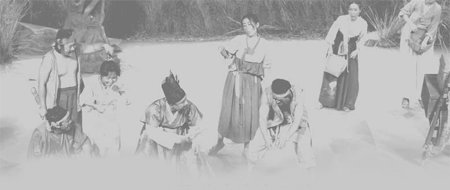
PTK(the council of the Public Theaters of Korea) held two meaningful events in 2010: the 2010 members’ training event in Jeonju, North Jeolla Province, on Feb. 4 and 5 and the first theatre festival in Gyeongju, North Gyeongsang Province, from Oct. 6 to 15. Back in February, 150 representatives from public theatres gathered to introduce their operations and share opinions about each theatre’s experiences staging works. The accompanying seminar addressed the direction of development. A festival presenting works by nationally-respected theatres from around the country has long been desired. Nine theatre companies finally united in Gyeongju October after two years of preparation under the guidance of the Gyeongju Municipal Theater with support from the city.
Through these two events, theatres came to understand each other’s circumstances better, identify common obstacles blocking development and share ideas about stimulating growth. The following accounts relate to those two events.1)
1. Public Theatres Building Creative Work and Individual Identities
Most public theatres in Korea have similar foundation statements. Unlike commercial theatres, public theatres were founded as part of culture & art policies that fit local government objectives such as:
- Enhancing opportunities for citizen and for culture and art to flourish
- Enhancing the attractiveness of the city and province as a cultural center
- Developing and promoting the primary businesses in the region
- Increasing the commercial reach of culture and art
- Enhancing the international reputation of public theatres throughout the province
- Enhancing the competitiveness of and appreciation for local arts
- Reducing cultural disparity between urban and provincial locations and promoting fair development.2)
Public theatres basically have three general expectations. Using those of the Seoul Metropolitan Theater as an example, the first is creation of a public theatre developed through fair competition. The second is the theatre’s staging of a permanent repertoire beyond the ability of small private theatres since they cannot produce a classic (Western and Eastern) repertoire or large-scale contemporary fringe plays. The third is the development of an international reputation for the municipal theater commensurate with the city’s size.
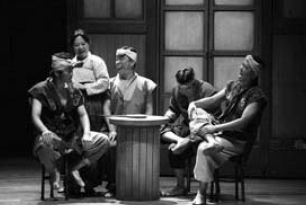
The problem is that the theatres rarely possess the kind of creative environment needed to live up to public expectations. In order to successfully establish a unique and viable identity, public theatres need to draw up and strictly implement mid- and long-term, well-defined development plans that utilize the government, citizens and performance sector of their region.
The proper creative environment has a major impact on the theatre’s organization and selection of its repertoire. Typically, conductors, artistic directors and standing directors are responsible for selecting the stage repertoire. The theatre’s repertoire and regular activities are the most important reflections of its identity. With the exception of Gyeongju Municipal Theater and Pohang Municipal Theater staff, the conductor, artistic director and standing director normally serve one- or two-year terms.3) If the tenure of the artistic director is short and there is no self-production system within the theatre, findings show it is difficult to execute mid- and long-term development plans since he or she is responsible for the key duties of repertoire discovery, member training and overall creative activities.4)
2. Changing Theatre Operations
Most public performing arts companies have a permanent staff in central roles. Theatres are no exception. They are usually composed of one director, one or two planning members, and a troupe of actors. Some theatres set the retirement age for its actors at 55 years old. This system has the following problems:
- Closed operations centered on members whose status is guaranteed
- Difficulty creating fresh ideas to rejuvenate the group
- Lack of communication with the larger art industry
- Lack of resolve to adapt to trends and changes within the performing arts industry
- Greater administrative requirements to take care of the welfare of permanent members
- Potential for members to become complacent and neglect self development5)
As for counter measures to solve these problems, a few operating systems are considered below:6)
Open Theatre Operating System: Retain some permanent members, but expand openness with auditions for every project. The merit of this system is that it can bring healthy tension to the group and induce members to improve their capabilities through tempered self-training. The injection of talented artists from outside can also help to improve project quality, marketing and overall competitiveness.
Member Pool System: Actors are selected through auditions for every performance and cast members are secured through short-term contracts for each role instead of paying a regular salary. Since there are no permanent members, related administrative costs are reduced. And as it is comparatively easy to secure actors for the roles, multiple projects can be underway at the same time, satisfying a variety of audience preferences.
Temporary Contract System: This system keeps permanent members under contract only for a certain period of time (typically the incumbent director’s term). Members are evaluated and reorganized at the end of each contract period or at the time of the director’s replacement. The merit of this system is that actors who lack artistic capability or harm group cohesion can be replaced fairly easily. Also, it can spur actors to improve their artistic capability by stimulating healthy tension and active metabolism within the group for a fresher ambience.
Despite the various merits of these operating systems, it can be difficult for existing public theatres to transform overnight. Moreover, these systems can carry inherent flaws, the largest one being the difficulty sustaining a repertoire in the absence of permanent members. If long-term positions are not guaranteed, securing talented members can be difficult and may result in higher than expected expenditures. Also, it is still uncertain how the re-organization of the National Theater (now underway) will impact municipal and provincial theatres. Taking the above into the consideration, it may be more practical for public theatres to maintain their current operating system while expanding openness through auditions for cast members.
3. Structure and Characteristics of Theatres
Who defines the characteristics of public theatres? The recent forced dissolution of the National Theater has led to a strong debate about the role of public theatres in Seoul and in the provinces. Do public theatres have autonomous creative capability? The answer is mostly no. Out of 11 local theatres across the peninsula, only a few are equipped with adequate facilities and manpower to produce independent original performances. Theatres show their characteristics through their repertoire. The process and method of producing a performance is the same for both public and commercial theatres. An artistic director chooses a work or requests one from a playwright. Since most permanent members are actors, a designer is also secured from outside. Casting outside actors is not easy because when permanent members have fewer roles, the payroll increases. If permanent members of its troupe are not utilized, a theatre can be accused of inefficient operations. Hiring outside talent can also reflect poorly on the regular company members’ skills.
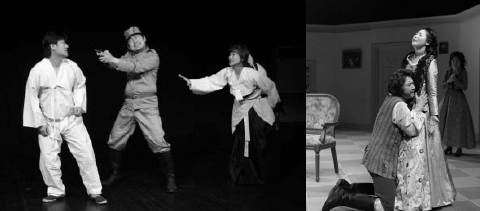
Public theatres must move beyond an actor-centered operating system toward one with a structure which enables production of independent works. It should possess sufficient actors and resources to stage at least two works simultaneously. If able to hire outside actors, the minimum number of actors has to be at least 30. Besides planning and production, marketing and PR departments are also required. In order to be able to produce original works, a theatre should be fully equipped with a permanent director, acting director, music director, choreography director, permanent art director, and technology director. Theatres should grow large enough to be able to stage one performance while practicing another. Only when these guidelines are met can there be genuinely popular public theatres that meet local cultural needs.
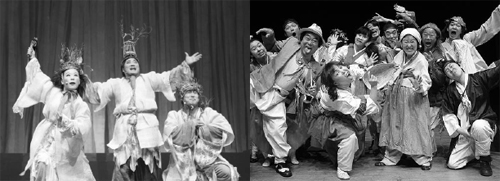
From time to time – when public theatres are not producing the right level of works and their members appear unmotivated – the Production System7) gains popularity, and there is momentum to avoid hiring permanent troupes. This is particularly strong when theatres are unable to cast convincing actors in roles because permanent members are given priority over better actors from outside. Public theatres are responsible for their own operation; the art director or review committee should be held accountable for this phenomenon.
Looking from one side, the Production System seems to have only merits, but it also has two major problems. One is that a solid repertoire cannot accumulate, and the other is that it is difficult to create original works that fit the theatre’s identity. A public theatre should stage performances that correspond to the objectives of its foundation. Besides their regular performances, public theatres carry quasi-public responsibility to organize cultural and artistic activities for local residents, mini tours, arts education for citizens, and community participation programs. In general, private theatre companies’ production systems are competitive and match market and capital oriented principles, but public theatres must craft different systems.
This is not to say that public theatres must be shielded from harsh environments as if they were plants in a green house. A fair evaluation system should review the art and permanent directors’ work. Actors, staff and designers should be evaluated as well, and appropriate responsibility and compensation provided as per the evaluation results. The key is how to set up a fair evaluation system.
4. Who Owns Theatres?
Just as the National Theater is not owned by its members, municipal and provincial theatres are not owned by theirs but rather by the tax-paying citizens of their communities. One problem with this is that the direction of the repertoire and purpose of performances can easily change with the appointment of a new organization head or art director. Ideally, a public theatre should be led by someone with expertise and vision perfectly matched to its stated objectives. This would ensure that its development goals are met and a rich, creative environment established. However, occasionally, leaders change organizational and execution plans at will. Some now strongly advocate measuring success by quantitative evaluations, but counting the number of tickets sold is a poor way to evaluate the success of a work. Evaluations of the performance and participants (actors, staff, designer) must be done from multiple angles and objectively through fair indicators that combine professional critiques and audience reactions. Reviewers should also judge how well administrators developed appropriate cultural activities and creative works. The creative and administrative sections have to function organically as one body to serve the audience well.
Municipal and provincial theatres need to establish an honorary or citizen membership system to engage local residents to sign up. This is part of the process of relying on local strengths and capabilities to make theatres more approachable. Theatre membership is a passive system. In order to evolve into professional city or provincial theatres, organizers need to adopt programs and systems that encourage more active citizen participation.
1) Since restructuring of the National Theater is underway, some contents may need future revision
2) Refer to page 23 of the 2010 Council of the Public Theatres of Korea member training source book
3) Most public theatres’ art directors can serve consecutive terms. The average contracted period for most public theatre directors is 2~4 years, but many surveyed within the industry felt that successful mid- and long-term development plans required a creative director in place for at least five years.
4) For example, Seoul Metropolitan Theater has a relatively high outside dependency level. The staff never exceeds 11 members. Currently, it is ten: 1 head director, 2 acting coaches, 1 planner, and 6 actors. Since its dependency level is high, there have been no cases of self production or staging the same performance again once it had been finished.
5) See page 26 from the above source
6) Refer to page 26~28 of the same source book
7) A Production System operates with a permanent director and production system (planners) but no actors under long-term contract. Most Daehangno companies operate their theatres under this system. Seoul Metropolitan Opera, part of the Sejong Center, has no opera singers under exclusive contract.
 PREV
PREV
.JPG)
.jpg)
.jpg)
.jpg)
.jpg)












 h..');)


