





Korean Theatre Review (December 2009)
Korean Theater Review has announced the list of the best productions of the year. The monthly has been selecting the Top-7 plays of the year since 2006 to highlight performances that received particular attention from audiences and professional theater critics during the year.
This year’s Top-7 performances were picked from plays staged from November 2008 to October 2009 and recommended for outstanding quality by the editorial committee of the Korean Theater Review and a 25-member jury that consists of theater critics, reporters and an authorized committee for children’s plays. The final list includes four debut productions, including new production and translated works; one repeat performance; one debut children’s play; and one overseas performance. Unfortunately, provincial performances could not be included due to procedural problems. Also, starting from this year, the selection will exclude musicals.
The selected performances are as follows: The Best Debut Production category includes The Gift of the Gorgon from the Experimental Theater (Sil-heom-geuk-jang), Don’t Be Shocked from the Theater Golmokgil, The Turtle of Darwin from the Seoul Metropolitan Theater, and White Cherries from Doosan Art Center. Other works that received considerable support include Gyeongnam, Changnyeong-gun, Gilgok-myeon from Baeksukwangbu Theater Company; Spring Days, which was showcased at the Seoul Theater Festival; Who Will Save 20-something Koreans? from Dream Play; Yisang Counts To Thirteen from 315 Warehouse Theater (Sam-il-ro-chang-go); and Peer Gynt from Yohangza (Yeo-haeng-ja).
In the Best Repeat Production, the winner is Copenhagen, which was coproduced by the theater group ChungMac and Doosan Art Center. Other noteworthy performances were En Attendant Godot from the Sanwoolim Theater Company, A Country Doctor from Beksu, and Buni, Deogi, Yeolsu from Gampo from Yiru.
The Best Children’s Play went to The Invincible Trio from Hakchon for the second consecutive year. Many children’s plays are staged on a long-term basis. With creative debut productions in short supply, several noteworthy plays were staged in 2009 apart from The Invincible Trio. They include Adventures in My Room from the Sadari Theater Company and The Sun Girl and the Moon Boy from Odi.
The most impressive performance invited from overseas this year was Das Kapital from the German theater company Rimini Protokoll. Other highly recommended overseas productions include The Attic from Yoji Sakate, which was organized by Arko Arts Theater; Platonov and Moscow Psycho, which were invited to the Seoul Performing Arts Festival, and The Seagull from Seoul Arts Center.
This year, the theater community was criticized for failing to improve the quality of plays in line with their quantitative growth. It is time of year to reflect on the past and set new goals. We wish Korea’s theater community a successful 2010, and we thank all members of the committee for their valuable input.
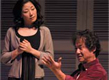
● Best Debut Productions
The Gift of the Gorgon (Experimental Theater)
Don’t Be Shocked (Golmokil)
The Turtle Of Darwin (Seoul Metropolitan Theater)
White Cherries (Doosan Art Center)
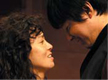
● Best Revival Performance
Copenhagen (ChungMac & Doosan Art Center)
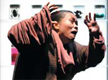
● Best Children’s Play
The Invincible Trio (Hakchon)
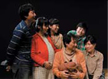
● Best Overseas Production
Das Kapital (Rimini Protokoll)
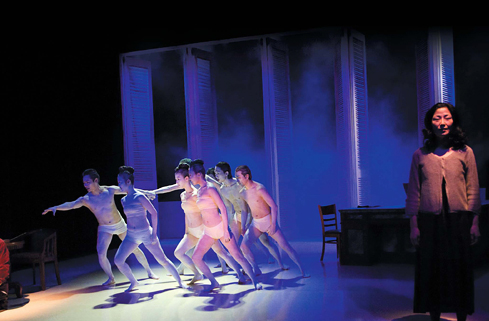
The Gift of the Gorgon by Experimental Theater
Date: November 18-23, 2008, June 10-21, 2009
Performance Hall: Namsan Arts Center, Arko Arts Theater
Original Writer: Peter Shaffer | Translator: Nam Yuk-hyun | Director: Koo Tae-hwan
The Gift of the Gorgon is a play that fully displays Peter Shaffer’s talent as a playwright. It is based on the legend of the Gorgon (Medusa), who had the ability to turn men into stone. The play sheds light on today’s theater world, which is as hard as a stone, with no disputes or reasoning existing in it anymore. Its storyline encompasses the present and the past, deals with the main character Edward’s works and legends, and easily transcends time and space, which only theater plays can do. Though Edward declares theater dead, the audience ironically learns from this that the theater is far from dead. The impressive acting of CHUNG Dong-hwan as Edward DAMSON and SEO In-sook as his wife Helen is yet another reason this production evokes a standing ovation every time.
This time as well, The Gift of the Gordon presents a subtle and complex structure from the familiar dramatic point of view. It allows the audience to interpret it in their own way and is intertwined around several subjects. One of them is a story of an artist who succeeds thanks to the artistic inspiration that he receives from his young wife, whom he regards as his poetical muse. It is a familiar scenario often occurring in movies about artists. The other subjects include sharp conflicts between the artistic and popular aspects of theater, historic terrorism and pacifism, the comparison between Orthodox primordialism and contemporary British popular culture, the ultimate definition of “revenge” and “forgiveness,” and the role of theater in society.
- By SHIM Jung-soon (drama critic), from the July edition of Korean Theater Review
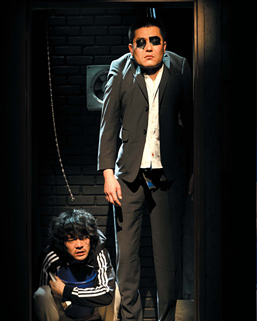
Don’t Be Shocked by Golmokgil
Date: January 7-February 1, 2009, July 3-26, November 11-15
Performance Hall: Sanwoolim Theater Company (small theater), Arko Arts Theater (small theater)
Playwright, Director: PARK Keun-hyung
This production debuted at the small theater of the Sanwoolim Theater Company in January 2009 as part of the “100th Anniversary of Korean Theater – Sanwoolim Theater Company Presents Theater Directors” series. It deals with the subject of family, but, like all of PARK Keun-hyung’s works, it dispels fantasies about the ideal family. Its high quality, outstanding cast and production kept it in the spotlight throughout the year. The story of the sons and their wives, who hang their father’s dead body in the bathroom and continue to attend to their everyday problems as if nothing has happened even after a stranger shows up amidst it all makes the phrase “Don’t be shocked” pointless and leaves audiences face-to-face with harsh reality.
“What can be more painful than recognizing yourself in people whose actions you would never approve of? PARK Keun-hyung is a bad director, because instead of caressing and entertaining his audiences, he gives them a hard time. CHANG Young-nam, KIM Young-pil, KIM Joo-wan, LEE Kyu-hee and KIM Dong-hyun are also bad actors. How can they tell this shocking and desperate story in such a haughty and cunning way? This time as well, CHANG Young-nam chose to look ugly, while KIM Young-pil’s dry acting was hateful and brutal. KIM Joo-wan’s poignant portrayal of despair, hatred and yearning caused more pain to audiences.”
- By LEE Kyung-mi (drama critic), from the February edition of Korean Theater Review
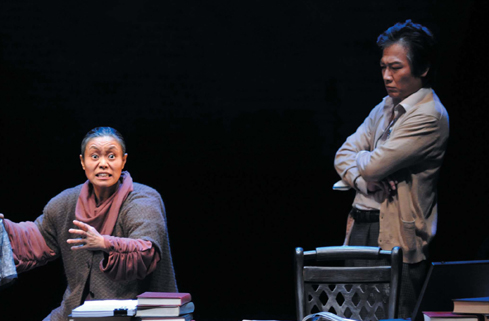
The Turtle of Darwin by Seoul Metropolitan Theater
Date: October 9-November 1, 2009
Performance Hall: Sejong M Theater
Playwright: Juan MAYORGA | Art Director: KIM Seok-man | Director: KIM Dong-hyun
The Turtle Of Darwin was staged by the Seoul Metropolitan Theater in 2009 to mark the 200th birthday of Charles Darwin and the 150th anniversary of the publishing of his book On the Origin of Species, as part one of the “World Contemporary Plays” series. The play has an interesting plot about the turtle Harriette, which Darwin brought from the Galapagos about two centuries ago and which evolves into a human being who learns about European modern history. But the genuine charm of this play lies in Harriette’s sayings and the revelations of the selfish nature of humans through the actions of people that she meets. The reason this play was able to strike a chord not only with European but Korean viewers as well lies in the skeptical portrayal of human history and evolution.
The message that The Turtle of Darwin sends is, “Everything is possible,” which is one of Hitler’s sayings. This play criticizes humans for committing inhumane acts. In the way Confucius placed emphasis on “fate,” human beings have a future only when they act as humans. The final scene where Harriette punishes humans who try to use her is very sad. It is heartbreaking to see Harriette having no other choice but to adapt to this world not as a human-like turtle but as a turtle-like human.”
- By LEE Eun-kyung (drama critic), from the November edition of Korean Theater Review
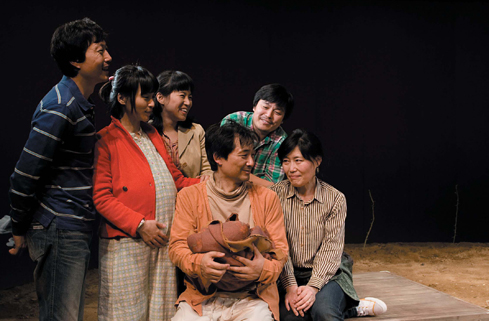
White Cherries by Doosan Art Center
Date: June 16-July 5, 2009
Performance Hall: Space 111 (Doosan Art Center)
Playwright: BAE Sam-shik | Director: KIM Dong-hyun
White Cherries is the final part of Doosan Art Center’s scientific play series. This play celebrates the role of science in life. Its plot revolves around a 500-million-year period that is juxtaposed with the everyday life of a family to reveal the transience of human life compared to the magnificence of Mother Nature. This performance has received rave reviews for dealing with such universal subjects as life and death, birth and extinction, and stories of ordinary people. “This play was produced as part of Doosan Art Center’s scientific play series, but rather than focusing on science, it introduces a philosophical view with science as a motif. The reason it was able to tug on viewers’ heartstrings lies in the way it depicts science as part of people’s everyday lives and nature. When geologists speak about time and space 500 million years ago -- using the example of trilobites found in Yeongwol -- the town is depicted as a sea from the Cambrian period as the the trilobites’ 500-million-year jouney to meet the audience is set in motion. Amazing scientific facts are presented in a philosophical and delicate way. Facts and philosophical arguments are presented not as material for hardcore subjects but as interesting and vivid stories.”
- By KIM Sung-hee (drama critic), from the July edition of Korean Theater Review
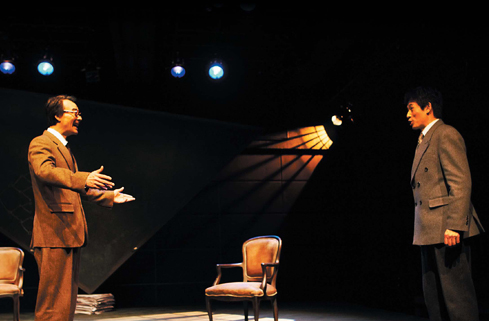
Copenhagen by ChungMac & Doosan Art Center
Date: May 19-June 7, 2009
Performance Hall: Space111 (Doosan Art center)
Playwright: Michael FRAYN | Translator: Yang Young-il | Director: Yoon Woo-young
Copenhagen is a more scientific play than any other type. It includes many difficult words like “complementarity,” “the uncertainty principle” and “uranium-235,” but that only makes it more impressive. Using the theories of physics, it is a subtle, dramatic portrayal of the uncertainty and insecurity that everyone feels inside. Why did Heisenberg go to Copenhagen to find Bohr? This question is repeated many times throughout the play. The more it is repeated, the more obvious it becomes that Heisenberg’s actions and motives are insecure. It is the odd contrast between uncertainties in the atomic world and those in human life that sets the overall mood of the play. It provides audiences with a new perspective on uncertainties in life while also helping them discover hope.
“Actor NAM Myung-ryul keeps the spotlight on himself by portraying Professor Bohr in a very intelligent and exquisite way, perfectly expressing his profound feelings and attaching significance even to the slightest changes. The way the meaning of the phrase “see exactly” was conveyed in the second half of the play was the highlight of the production. When three people are shown on stage together, and one of them looks at the other two, the latter disappear from the spotlight, while the former still fails to recognize the obvious fact that he is the center of the universe. Their intertwined relationship emphasizes the uncertainty of life.”
- By LIM Seon-ok (drama critic), from the July edition of Korean Theater Review
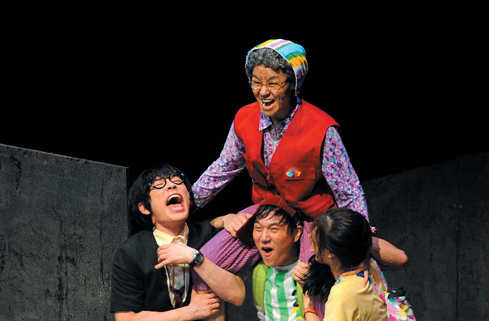
The Invincible Trio by Hakchon
Date: October 1-November 6, 2009
Performance Hall: Hakchon Blue Small Theater
Original Play: Bella, Boss und Bulli by Volker LUDWIG
Music: Birger HEYMANN
Adptation/Director: KIM Min-gi
Mixing/Music Director: CHUNG Jae-il
Sunny is a third-grader who moves to a small city in Korea from the U.S. along with her divorced mother. One day in front of the school, she witnesses one classmate, Pungi, extort money from another, Chin-ah, who comes from a rich family. Later she discovers that an older student, Gal-goo, had ordered Pungi to get money from Chin-ah. As Gal-goo continues to threaten Chin-ah and Pungi, the other kids finally join hands to expel Gal-goo. The main characters of the play are third-graders. It has received positive feedback from children and adults alike for catering to the needs and expectations of children by dealing with true-to-life subjects such as school violence. The events that the main characters become involved in and their serious conversations strike a chord in children’s hearts and inform adults about their most worrisome issues.
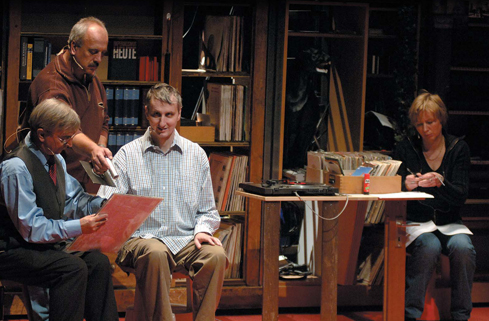
Das Kapital by Festival Bom & Rimini Protokoll
Date: March 27-28, 2009
Performance Hall: Arko Arts Theater
Directors: Helgard HAUG, Daniel WETZEL
Das Kapital was the opening production of the Festival Bom 2009. It is a semi-documentary and the first post-drama theater production to be introduced in Korea. The plot revolves around various people who have been influenced by Karl Marx’s theory. They are real-life experts who tell about their lives in an improvised way without scripts. During the performance, the audience receives copies of Das Kapital that were piled up on stage earlier, while the play’s Korean translator, Professor KIM Shin-joon, read lines from the book to interact with the audience. The production sought to go a step further from simple “reenactment” and suggest a new direction for the performance arts.
“This is a documentary play of sorts with the elements of a post-drama play. The directors of Rimini Protokoll are not interested in delivering the messages of scripted dramas or reenacting them. Rather, they collaborate with ordinary people who have something to say about certain subjects. Writers’ scripts no longer serve as records. It is real-life stories that fulfill that role. Therefore people who appear on stage don’t need to act and can instead express their thoughts and share their knowledge and experience in a natural way. (…) This play not only provides audiences with a shrewd perspective and critical thinking on capitalism, but also shows the meaning of theater to today’s people and ways for theater to survive. Theater plays reflect the reality of contemporary life while also changing it. That is why there is no right answer when it comes to theater. This is also the reason we should search for ways to change theater and question its ‘familiarity’ instead of accepting stereotypes and falling into complacency.”
- By KIM Hyung-ki (drama critic), from the May edition of Korean Theater Review
 PREV
PREV
.JPG)
.jpg)
.jpg)
.jpg)
.jpg)












;)


