





By CHOI Yun Woo (parodia@hanmail.net)
Korean Theatre Review (December 2009)
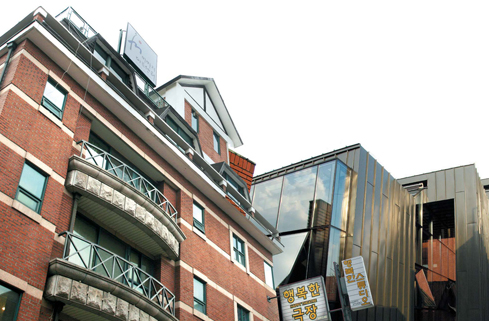
The number of small theaters around Daehango exceeded 140 in 2009. Many theaters opened in this area in the 1980s following the lead of the Culture and Arts Center (now Arko Arts Theater). This ”College Street” quickly became a mecca for Korean theater and for the performing arts since the basic need of a performance is often an arts theater.
In May 2004, Daehangno was officially designated a Cultural District in a government effort to impart a unique character to the area. Despite the original intent, however, soaring real estate costs and rental fees caused theaters run by artistic organizations to close one after another. Many of the theaters remaining are simple buildings called theaters to take advantage of tax breaks.
I miss the days when it was easy to “catch a play at a small arts theater” -- when people didn’t care how crowded or uncomfortable the seating was. And I believe that I’m not the only one who feels this way. The reports of new theater openings are heard less and less these days. Most of the places that are called theaters are really only venues that artists lease temporarily to show their work. Few theaters offer long-running performances by a stable troupe or provide a chance for new experiments.
There is now growing interest in and approaches to indirect support for the performing arts community. Venues like Wonder Space and Sang Sang Nanum Theater leased by the Ministry of Culture, Sports, and Tourism are examples of subsidized commercial properties as is Seoul Foundation for Arts and Culture’s Daehangno Studio II. This is in part due to the realization of a structural problem – the lack of theater spaces where artists can freely experiment with new ideas.
We have good news here: the opening of Mimaji Arts Center in Dongsung-dong and Studio Darak on the roof of the 3-story Arko Arts Theater building. While Arko Arts Theater is a public facility, Mimaji Arts Center is privately owned and founded by Professor Go Seung Gil of Chung-Ang University. But both theaters’ roles and functions are in line, providing affordable spaces where artists can expand their creative activities and research
Multipurpose Arts Studio for Experimental Performances, Public Readings, Showcases and Rehearsals: Arko Arts Theater Studio Darak
At 6 pm on October 22 this year, an opening ceremony for Studio Darak was held on the roof of Arko Arts Theater. Darak took over a year to build and was designed by Urban Engineering Professor YU Seok Yeon at the University of Seoul. It consists of an open 185.17㎡ area with a ceiling over 6.5 meters high. Visitors can see the sky from its transparent, removable roof. The space is surrounded by glass walls in all directions. The spatial volume created by the angled roof and outdoor landscaping increase visitor’s satisfaction all the more.
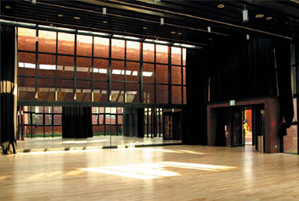
Studio Darak was originally planned as a rehearsal room similar to the one in the center’s basement. But after Artistic Director CHOI Yong Hoon took up his post in 2006, the theater began to rethink how the new space could be used for multiple purposes. The design was the key question then: the biggest challenge being how to preserve the appearance of Korea’s first-generation architect KIM Soo Geun’s original work and make the new space blend with the existing theater as a whole. Fortunately, at Studio Darak’s opening, many praised it for having its own architectural merits while being in harmony with the entire theater.
Every Monday, the studio hosts a play reading for writers who have won a prize in the Spring Literary Contest. From next January, Darak will be open to the public; anyone can submit an application to use the facility for anything from small-sale experimental showcases and play readings to academic seminars, creative workshops, performance rehearsals, and meetings. It is literally a multipurpose space for cultural and arts activities. As it is run by a public theater, users can use the space at the low cost of 150,000 won per day (50,000 won per hour). Artistic Director CHOI hopes the space will spur the creativity of young artists, and the studio is quickly gaining the interest of artists and festival managers who would like to use it for small-scale performances or workshops.
Studio Darak will begin taking bookings quarterly from January next year. Its size limits it to groups of 70 or less, but it is still a good option for those looking to stage showcases, play readings, academic seminars and many other events.
A Theater Museum at the Heart of Daehangno: Mimaji Arts Center
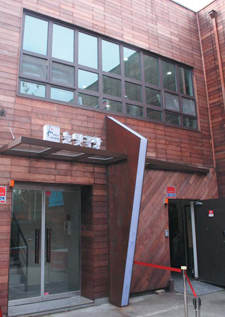
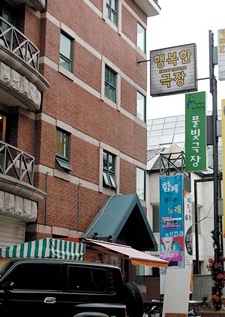
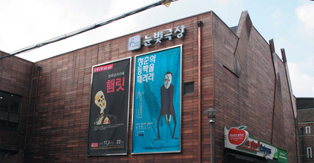
Housed in a building in Dongsung-dong behind Marronnier Park, newly opened Mimaji Arts Center consists of the Pulbit Theater, Oasis Theater , and Happy Theater and the separate Nunbit Theater in Myeungryun-dong.
Financed by Chung-Ang University professor GO Seung Gil, the center is a multi-purpose culture space named after a pioneering Korean actor from the ancient Baekje Kingdom. Mimaji introduced the musical play Giak to Japan in 612, setting the stage for Japanese theater.
The Mimaji Arts Center’s Pulbit Theater on the first floor has around 120 seats and targets highly experimental performances by young artists. The Oasis Theater on the third floor is used exclusively for the play A Raid at the Oasis Cleaner by the troupe Modl Theatre, a longtime partner of Professor Go, and the troupe PAPA Production leases and manages Happy Theater along with its rehearsal room Happy Studio on the lower levels. The Oriental Theater Museum is on the second floor, and the Oriental Performing Arts Institute and other facilities are still under construction on the fourth and fifth floors. In all, the center holds four theaters, including the 300-seat Nunbit Theater annex.
Professor Go says that opening theaters was not his motivation for the investment. Rather, he wanted to arrange financial support, so that the only theater museum in Daehangno and the first Oriental theater museum in the world could be opened and managed seamlessly.
Go feels that theater museums and libraries are indispensible sources of knowledge for actors and directors, but he became frustrated by the government and local authorities’ lack of interest in developing them. He is confident that once he paves the way for a theater museum, government and private support will follow. In anticipation of such a museum, he has gathered Asian theater-related materials from many parts of the world during more than 200 trips over the past 40 years.
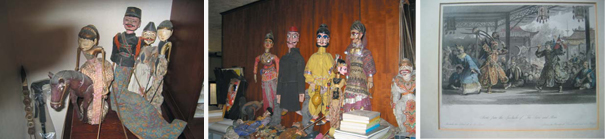
The collection covers various materials, including 30,000 books, 1,000 magazines, 10,000 theses, 500 posters, 1,000 programs, 2,000 video tapes, 500 CDs, 300 LDs, 1,000 VCDs, and over 200 DVDs. Among the most treasured items in his collection are 200 rare and virtually unknown plays, scripts, and stage designs created before and during the Japanese colonization of Korea from 1910 to 1945. Among them are acting scripts used by HONG Hae Seung, PARK Jin, and SEO Hang Seok, stage scripts from the Dongyang Theater and a large number of unpublished plays.
Items in the collection pertaining to Chinese theater include Akmuyong of the Han Dynasty, 20 Sawhajeonjo of the Jin Dynasty, 10 Akmujeonjo, masks, and about 500 puppets used for Tang Dynasty puppet and shadow plays. From India and Southeast Asia, Go has amassed over 300 dolls from puppet and shadow plays, added to these are about 100 more from Tibet, Nepal, and Turkey.
Go wants the soon-to-open Oriental Theater Museum to become both an important resource for researchers interested in Oriental theater and a Daehangno landmark. He draws inspiration from the Musee national des Arts asiatiques Guimet in Paris, which was founded from the private collection of one person and re-opened as a national museum thanks to the integrity and uniqueness of its collection.
We hope that the Oriental Theater Museum at the Mimaji Arts Center can write a new chapter in the history of Korean theater. The venue will host periodic special exhibitions and function as both a museum and library where users have access to materials year round. Video screenings and other educational programs for theater professionals and researchers are planned, and the venue is also available for theater community events and academic seminars.
The Need for Functional Spaces
The two theaters covered here are a reminder of how desperately Korean theater needs spaces for numerous functions. Besides the demand for special facilities, artists are looking for open, widely available spaces where they can freely talk about and experiment with their ideas -- rough stones can only become precious gems if properly refined. All that we can do for now is to help these two theaters effectively play their desired role as a space to meet the needs of artists. In addition to government support, the interest and affection of individual patrons can make a difference.
Photos courtesy of Arko Arts Theater and Seo Dong Jin,
Studio Director, Mimaji Arts Center
 PREV
PREV
.JPG)
.jpg)
.jpg)
.jpg)
.jpg)












;)


