





Korean Theater Review (October 2009)
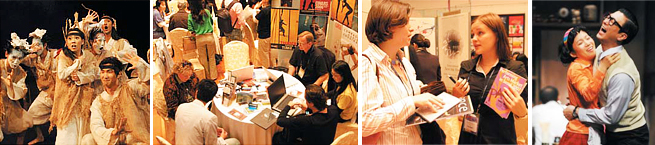
The Performing Arts Market in Seoul (PAMS) 2009 is just around the corner. At the forefront of efforts by local performance artists to enter overseas markets, PAMS has laid the foundation for the introduction of Korea’s many performing arts to the world. This year, over 40 applications have been filed for extensive marketing campaigns. The first PAMS back in 2005, although coming relatively late compared to other countries, was significant in that the Korean government proactively initiated a project to promote pioneering efforts to market the performing arts.
In 2009, Korea’s performing arts community is making extensive efforts to find markets around the globe in collaboration with the government, market experts, and organizations. A growing number of government branches and organizations, including the Ministry of Culture, Sports, and Tourism (MCST), Korean Arts Management Service, Korea Foundation, and the Ministry of Foreign Affairs and Trade (MOFAT) have joined the effort to provide support for PAMS; expanding its scale and scope to cover education, promotion, marketing and the employment of artists as well as direct support for performances.
About 10 years ago, the World Drama Festival was held in Korea in 1997, giving the nation its first major encounter with performance artists from around the world. At that time, some industrious private troupes in Korea periodically had opportunities to perform before foreign audiences, so there were many opportunities to enter the global market had they been fully committed. The fact that many troupes raise the need for a more systematic and stable marketing system to help them find an opportunity in the global market might suggest that the local performing arts community could not conceptualize how to make this happen on its own.
As the feature story of this issue, the following articles look at the way global marketing efforts by the Korean performing arts community have been changing and improving. By raising problems with related support systems and reflecting on the role and outcome of the ongoing PAMS in the context of the overall global performing arts market, we invite you to consider how local performance artists could more easily secure larger audiences beyond the borders of Korea.
- Korean Performing Arts Expansion Overseas: Changes before and after 1997 - HEO Soon Ja
- Support for Performance Arts Debuting Overseas _ YEOM Hae Won
- The Roles and Achievements of Performing Arts Markets – with a Focus on Seoul (PAMS) _ PARK Ji Seon
Korean Performing Arts Expansion Overseas: Changes before and after 1997
By HEO Soon Ja (Theater Critic, Professor of Seoul Institute of the Arts)
Korean Theater Review (October 2009)
I.
The term ‘global village’ signifying the shortening physical distance between civilizations has been consigned to history. Instead, ‘globalization’ and ‘digitalization,’ embracing even the spiritual realm of sympathy and communication as a channel of meta-discourse, have become ubiquitous in our daily lives. In this era of diversification and pluralism in the pursuit of wealth, the value of culture and arts directly linked to the quality of life has increased sharply, raising the need for a different mindset. Within this cycle where art becomes a part of our daily lives and our daily lives become a part of art, performing arts stand out in their vitality. They are also on the move horizontally to every corner of the planet where ‘theater is the world,’ connecting cultures in the name of global exchange. If exchange is based on interactive democratic communication, then its meaning is largely one-sided for us, at least in terms of international relations. Characterized by the strong longing for or influence from Western culture, Korean theater was particularly generous to imported performances while slow to promote aspects of Korean culture that were appealing for either their unique or universal qualities, thus curtailing communication. Growing efforts have been made in a better organized manner to improve the situation since the late 1990s. More diversified and specialized modes of exchange and a robust network have been developed by launching a support system and task-force team, expanding research and development and investment, and increasing human resources. Moreover, besides their entrepreneurial zeal to enter the global market and find huge success in the culture industry, young artists’ voluntary participation for the sake of spurring creativity has played a role in boosting global exchange. This article analyzes Korean artists’ past performances in the global arena to advance theater and mutual understanding. Specifically, we discuss the past and the present divided by large-scale international events (e.g. the 1997 International Theater Institute (ITI) World Congress held in Seoul and the World Theater Festival, a direct inspiration to the Korean performing arts) in the late 1990s when the practical concept of the exchange of culture and arts began to surface.
II.
Starting with numbers: the 1990s saw an explosive cultural opening after the collapse of the East European nations and the end of Cold War ideology following the fall of the Berlin Wall. Theater from that region had debuted before Korean audiences during the 1988 Seoul Olympic Games Culture and Arts Festival. We applauded incredible works from East European counties which were seen for the first time and works from the rest of the world which stimulated Korean performance artists. Even amid such historical glasnost, only 11 Korean theatrical performances were staged abroad per annum. In the meantime, foreign groups were busy bringing their performances to stages all across Korea, recording, in the least, an overwhelming triple advantage. This numeric contrast, although perhaps to simple of a comparison, suggests that our global exchange in the form of overseas performances was sluggish or even flat.
In the 1960s, Korea poured all its energy into economic development and construction projects. While Korean theater started a new chapter with the birth of contemporary drama troupes, global exchange in that realm was still a long way off. In February 1958, YOU Chi Jin and other pioneers of contemporary performing arts joined the UNESCO-affiliated ITI and established its Korean Center in recognition of the importance of international relations. This served simply to initiate nominal global exchange of Korean theater; full-blown activities took some more time. Following the 1960s, new theories and practices transforming the concept of theater worldwide became a powerful influence in Korea. Though a little bit late, in the 1970s the Korean theater community recognized and began to follow an urge to reflect Western theater. As a result, Korean theater nationwide during those years began to respond sensitively to overseas theater trends, hastening the first explosion of popular culture. Meanwhile, the local theater community struggled to find an identity as Korean artists by seasoning contemporary theater with traditional aesthetics.
Setting the 1970s as the beginning of global exchange for Korean theater, overseas performances took the form of road shows led by the government, associations, or organizations; short-term invitations or friendship visits based on personal relationships and networking; and proactive performance tours motivated by a mix of foreign invitations and genuine desire to perform overseas. In actuality, there is no big difference between the driving factors of that decade and those of today. If forced to point out any differences, those from the 70s tended to passively meet the challenge of a new world by merely organizing performance tours for the purpose of exchange, while today there is strategic, specialized planning to find marketable opportunities in foreign countries. Among the early examples are the Korea Mask Drama Association’s overseas performances of the Bongsan Mask Dance in 1976 and 1978 and the global tour of a traditional puppet play performed by SHIM Woo Seong. In 1976, the Woman’s Theater took the plays San Guk, On His Excellency, the Vicious Excellency, and Crane, You Are Love to America to entertain Koreans living there. In 1977, the Dongnang Repertory knocked on the door of the world market with Tae. That play and Le Prince Hamyul, an adaptation from the works of Shakespeare that was directed by Ahn Min-soo, can be regarded as genuine, full-on overseas performances. The two shows toured the United States and Europe at the invitation of the La Mama Theatre of New York and Michury Theatre of the Netherlands, totaling 48 performances, and leaving foreign audiences greatly impressed with the inherent conflicts between traditional Korean and Western dramas.
Beginning with a tour of What Should We Become? (1981) in France, Theatre-Libre took the lead in staging Korean productions in front of audiences around the world with the subsequent Blood Wedding at the 1984 Nancy World Theatre Festival and 1985 Barcelona Theater Festival. This was the result of the dramatic convergence of three elements: 1) an organization, ITI; 2) the diplomatic ability of its CEO KIM Jeong-ok; and 3) its unique Third
YEO Seok Gi, “Korean Center of International Theater Institute over the Past 30 Years- History and Development,” I.T.I. 30th Anniversary Special, Korean Center of International Theater Institute, 1989, pp. 10~11
AHN Min Soo, ”International Exchange of Theater Arts and Problems Today,” I.T.I. 30th Anniversary Special, ibid, pp.302~30
Theater based on the ‘collective creation’ concept with the 5th Third World Theater Festival held in Seoul in 1981. Furthermore, Korean theater debuted in Japan in 1983 via Minae’s The Seoul Post. Mokwha performed Chunpung’s Wife and Tae for Japanese audiences at the Doga Arts Festival (1987) and Mizui Festival (1988), while the Street Theatre Troupe was officially invited to put on Ogu: Mode of Death at the 2nd Tokyo Theater Festival in 1990. While the main repertory of overseas performances in the 70s and 80s consisted of works that mixed subjects unique to Korea with traditional styles, that classic of the contemporary Western drama Waiting for Godot was a huge critical success at the Avignon Off Festival when staged by the company Sanwoollim in 1989. Following the rule that successful performances abroad directly lead to more opportunities, the drama was brought to the stage in Beckett’s hometown Dublin with high praise from the local media in October of the next year and even made it over to Eastern Europe in 1994 by the invitation of the Polish National Troupe. That was just the beginning of a long journey that took it to the Dublin Beckett Center in 2008 and the SCOT summer season in Toga back in August.
The Asia-Pacific Theater Festival (1991) wrote a new global exchange chapter in the early 1990s, and the period reached its climax with the foundation of the Besto Theatre Festival in 1994 and the World Theater Festival in 1997. Hosted alternately by Korea, China, and Japan, the World Theater festival showcased the leading dramas of each country, with the 1st Festival held in Seoul featuring the Korean productions Moonlit Baekma River and O Chang-gun’s Toenail. Since the subsequent festivals in Tokyo and Beijing showed The Last Princess (1995) and In a Mountain and a Field When Spring Comes (1996), respectively, they have remained a regular channel for Korean dramas to gain global exposure. Throughout the 90s, several productions made a remarkable difference by greatly expanding the genres, performance modes, and types of events Korean companies drew upon: Among these key performances were Mokwha’s Chunpung’s Wife and Street Theatre Troupe’s A Dead Ritual for a Living, which were invited to the Tokyo Alice Festival in 1990; the outstanding achievements made by the young actors of the troupe Freedom in Istropolitana, the Czech Republic’s festival for international theater academies; young performance artists’ work in the 1st Korea-Japan Arts Exchange Festival held in Tokyo; SON Jin Chaek’s singing of the traditional pansori operas A Tale of Shimcheong and Araring and Street Theatre Troupe’s Ogu at the Essen International Theater Festival, Germany (1991); Ogu’s subsequent tours of Tokyo, Osaka and seven countries from the former Soviet Union; Family Leaving for a Journey (1993, La Mama Theater New York and L.A.’s Poster Theater); Michoo’s Sky of Namsadang (1993, Huangdao?Beijing); the traditional yard play A Tale of Shimcheong (1994, New York, San Francisco); and A Tale of Choonhayng (1995, New York, San Francisco, Philadelphia)
III.
The 1997 World Theater Festival marked a turning point in the history of Korea’s performing arts: A total of 94 works were performed, 30 of those from Korea -- more than triple the number from the previous year. While the average number of Korean performances shown abroad from 1997 to 2002 hovered just above 46, the 2002 Korea-Japan World Cup Cultural Festival boosted overseas performances dramatically to 79. In the late 1990s, to keep pace with globalization and digitalization, the Korean theater positioned itself around
[1] Culture and Arts Yearbook 1998, Arts Council Korea, 1998, p. 859.
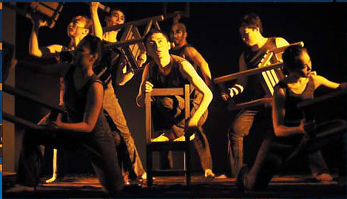
musicals and non-verbal performances geared for foreign consumption: For example, the large-scale musical The Last Empress was produced as a strategic plan for local and global markets from its inception. PMC’s non-verbal performance Cookin’ (Nanta) has had remarkable success at home and abroad since its 1999 run in the Edinburgh Festival Fringe and being customized for New York by Broadway Asia. It has spawned competition in the form of the other non-verbal drama Goblin Storm and the martial arts performance Jump.
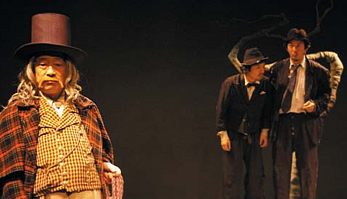
Overseas performances by medium-size groups also enjoyed remarkable runs. The small-theater musical Subway Line 1 staged its 1,000th performance in 1994 and since 2001 has toured Berlin, Beijing, Shanghai, Tokyo, Osaka, and Fukuoka. Other significant performances include Mokwha’s Romeo and Juliet (2001, Bremen Int’l Shakespeare Festival and the 2006 Barbican Center). Shakespeare expert John Russell Brown praised Street Theatre Troupe’s Hamlet after its debut in the Hoam Art Hall in the mid 1990s, and the Korean-language production toured Japan for two months in 2000. In 2002, Lady Macbeth became the first Korean-produced drama to appear at the acclaimed Kontakt International Theater Festival of avant-garde works held in Torun, Poland, and Changpa’s Hamlet Machine, Hamlet, and Duduri Duduri have appeared in a number of international theater festivals held in Romania, the Czech Republic, Moldova, and Germany following the troupe’s 2002 appearance at the Ganajawa World Theater Festival in Japan.
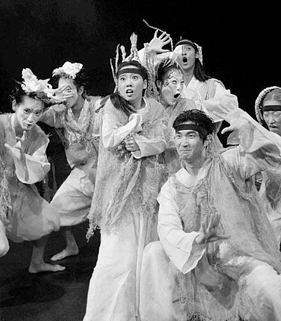
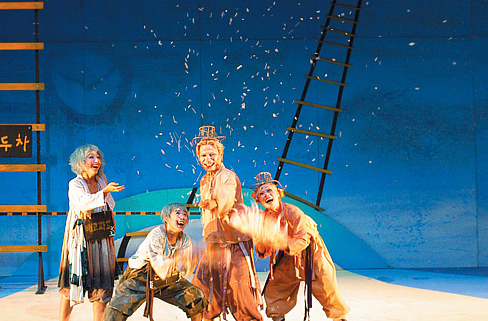
Since the start of the new millennium, a significant number of young Korean theater artists have earned fans worldwide thanks to their strong desire to perform flawlessly. Nottel has produced several fine works (Hamlet of the East, Return) and presented these or workshops to audiences in Monaco, Adelaide, Beijing, Hong Kong, and Taipei since its visit to Avignon in 1994. Choin (Train, A Fairy and A Woodcutter) regularly participates in Avignon Off and the Edinburgh Festival Fringe, and a new-generation creative performance group Dduida (A Tale of Haruk and A Sweet Story in a Big Book) has attracted fans throughout festivals in neighboring countries in Asia and many European nations with its unexpected subjects and fresh ideas.
Experts have taken over the responsibility of planning overseas performances, relieving the group or individuals from the responsibility for these desired goals and creating more diversified forms of global exchanges such as guest directing and joint-ventures. Typical examples are presenter AsiaNow (CHOI Seok Gyu), who estimates newly formed groups’ probability of success in global markets and provides related information and guidance and ‘alpha woman’ CHUNG Myung Joo who has played a key role by helping Korean artists manage their performances in London. We also remember the achievements of Traveler’s A Midsummer Night’s Dream and the Sadari Movement Institute’s Woyzeck , which have had a series of successes on major global stages since their respective 2005 and 2007 appearances at the Edinburgh Festival Fringe with the full support of AsiaNow. In addition, female planner KIMURA Noriko, who lives in Seoul and is committed to the exchange of theater between Korea and Japan, arranged opportunities for Korean directors, including KIM Gwang Bo (A Midsummer Night’s Dream) and PARK Geun Hyung (Ode to Youth) to bring their works to stages in Japan. Other examples are A Portrait of 400 Years (2001), directed by SON Jin Chaek as a Korean-Japanese joint project between Michoo and Subaroo, arranged by Michoo’s planner PARK Hyun Sook, a Japanese theater expert, and the world premiere of The Other Side (2003), guest directed by Ariel DORFMAN at Tokyo’s New National Theater. Two works produced jointly by the New National Theater and Seoul Arts Center won major theater prizes in Japan and Korea for their breathtaking aesthetic achievements -- Over the River (2002, 2005) written by KIM Myung Wha and HIRATA Oriza and directed by LEE Byung Hoon and HIRATA Oriza and Yakiniku Dragon (2008) written by JEONG Eui Shin and directed by JEONG Eui Shin and YANG Jeong Woong.
Improvements in Korean troupes’ securing and preparing for overseas performance are closely related to the foundation of the Korean Arts Management Service (KAMS) in 2006. Progressing in tandem with the 2005 launch of PAMS, KAMS assesses performances, publishes industry promotional material and supports excellent dramatic, musical, dance, or integrated genre performances for the annual market in the form of PAMS Choice awards. KAMS provides performance artists and stakeholders considerable assistance through networking-related information, seminars, dialogues, data collection, records, publications, and financial and administrative service during the event, as well as showcase and booth counseling services. Even though it will take some time for KAMS to win public recognition for providing quality services, the organization is already seen as providing more than the usual pattern of global exchange, given that it focuses on boosting local performing arts’ exposure overseas by assisting the Edinburgh Festival Fringe or other international arts markets and proactively inviting experts from around the world to Korea. For example, The Edinburgh Festival Fringe Seoul Road Show first held in Seoul back in March was a KAMS promotional venture.
IV.
Over the past 40 years, local troupes have made effort to promote global exchanges by performing in foreign countries. They have learned a lot about a previously unknown world from their journeys and now have some expectations about the reactions they will meet from audiences abroad, but they have had to go through many trials and errors due to lack of information and experience or aesthetic weaknesses. Now it is apparent that successful global exchange ultimately depends on information, networking, and planning. A thorough review of the mission; the realization of identity; careful planning; an understanding of other cultures; open-mindedness; strategic, flexible thinking and responses; and sustainable relationships based on trust and respect are integral to the success of an overseas performance.
『Global Exchange』, Seoul Foundation Arts and Culture, 2005, p.16.
 PREV
PREV
.JPG)
.jpg)
.jpg)
.jpg)
.jpg)












 2009 is..');)


