





White Bird Vitalizes the Portland Community
[People] White Bird Co-founder Paul King
White Bird is a dance company that was jointly founded by Paul King and Walter Jaffe in Portland, Oregon, in 1997. In the U.S. West Coast region, the not-for-profit business has a made a name for itself as the only company whose full season is entirely composed of contemporary dance pieces. We met with King during his visit to Performing Arts Market in Seoul(PAMS) and learned more about the nearly two-decade-old company and its unique relationship with its patrons and community.
Q. Paik Jong-kwan: I understand that you are not from Portland originally. How did you come to start White Bird in Portland?
Paul King: Walter and I are originally from New York. I was a pastry chef and Walter was in the publishing business after earning a PhD in German literature. We wanted to leave New York and have a different life, so we moved around to several cities to find a place that worked for us. And then we settled in Portland. When we came here in 1996, a Western Arts Alliance conference was held in the city. After receiving an invitation from one of Walter’s acquaintances, we attended the event. We had no idea what would happen there, but we thought it would be fun to hang out with the group as we love arts regardless of genre. Then, by chance, we bumped into the manager of the Paul Taylor Dance Company, whom we used to know back in New York. He said, “We want to perform in Portland, but there is no one who will put us on stage,” and asked us to “present” a show. We did not exactly understand what it was to “present” a show, but we jumped at the offer. That is how White Bird was born. In the following year, we put the dance company’s show on stage, which attracted an audience of 1,400 the first day.
Q. Were there many dance lovers in Portland to begin with? It must have been difficult to attract audiences.
Paul: There was an association of art organizations operating in Portland, and through them we were able to inform their members about our show. In the beginning, we also ran a kind of a giveaway for promotion in that we planned a free reception after the Paul Taylor Dance Company’s show. As we mailed out the invitations, we thought it would be great to have 70 percent of them [the invitees] to come. But then every single person turned up at the reception! As soon as they arrived, everyone asked us where Paul was. As it turned out, Paul Taylor couldn’t make it to the event, but people took my signature—“Paul”—on the invitation to be choreographer Paul Taylor’s [laughs].
The second show we brought to Portland was a piece by Stephen Petronio, who mainly works in New York. This time, we once again sold special promotional tickets that included a meal with the choreographer. It was a huge success, and we donated all of the profits from the event to a local AIDS organization.
|
|
|
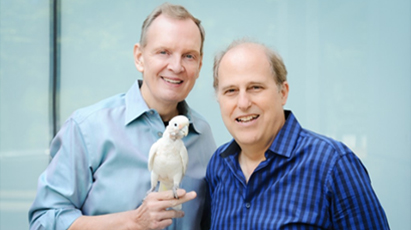
| Paul King and Walter Jaffe with Barney, the white bird ©Jennifer Alyse | |
Q. Based on how you started donating proceeds right from the start, it seems as though White Bird has developed its own distinct management philosophy.
Paul: White Bird believes it is very important to grow along with the local community of Portland where we live. We currently have a program called NEST, which stands for “no empty seats today.” The system allows season ticket holders to donate their tickets if they cannot make it to the show. NEST is connected to some 20 local organizations in Portland and, through them, the donated tickets are passed to low-income people who find it tough to afford such shows. We hope the show culture is shared by as many people as possible, and we believe that this could bring some kind of change. When pricing tickets, we try to ensure that it is reasonable, not exorbitant.
Q. Then what kinds of shows does White Bird want to bring to audiences? I’m curious about the selection process and criteria. How do you program a season?
Paul: White Bird is the only company on the West Coast that exclusively presents contemporary dance. I want to say that we focus on modern dance rather than classical genres like ballet. As demonstrated by us coming to PAMS this year, we’d like to check out as many contemporary dance works as possible by participating in various festivals and markets around the world. And there is a West Coast performing arts festival network dubbed West Moves, so we share information regarding dance performances through that. We need to exchange ideas with regional organizations because, when we bring in a show by an overseas dance troupe, it’s economically easier to pursue the project alongside a couple of other organizations rather doing it alone. Such a setup is beneficial for the troupe as well, since it guarantees that they can perform at three or four different venues instead of at a single theater. This year, White Bird is preparing for its 18th season. Since we have become quite well known through our previous projects, it has become easier to find information on quality shows.
What matters most to us when selecting a show is whether it helps us maintain White Bird’s unique brand. For us, branding is an issue of trust. Both Walter and I have individual preferences, but when we choose what to put on stage, we approach it from the perspective of our audiences who have been with the White Bird brand rather than our personal tastes. Plotting a season is like planning a tour; we are inviting our audiences to travel with us. Thus, we not only place weight on introducing famous artists but we also try to develop and bring new shows that would contribute to making the “trip” successful.
Q. You mentioned trust. Is there anything else you pay special attention to when it comes to branding?
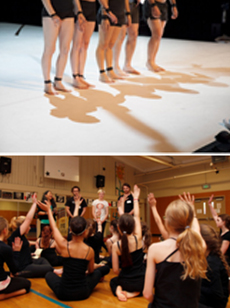
Paul: White Bird’s program does not end at just putting a show on stage. As we prepare for a season and first start making contact with dance companies, we talk about services that exist outside the theater—other programs offered by the Portland community. Up until now, we’ve operated a wide range of community programs. For example, we’ve worked with dance companies to run dance classes at schools. We’ve also done a movement workshop for children. Such community programs and the NEST are as important as putting a show on stage. Our goal is not simply selling tickets; we should be giving back to the community as well.
Besides the ticket revenue, we also operate with the help of donations and organization subsidies, and a portion of that goes to a survey on what the local community thinks of White Bird. We wonder what brings audiences to the theater. A lot of people from all walks of life live in Portland, and we’re trying to build a program by analyzing how they feel about White Bird and which shows or services please them and make them feel happy.
|
|
|
| Arlene Schnitzer Hall, home of White Bird ©White Bird White Bird logo ©White Bird / White Bird’s NEST program logo ©White Bird | |


Q. I understand that you not only invite fully established shows but also produce them. How is producing going?
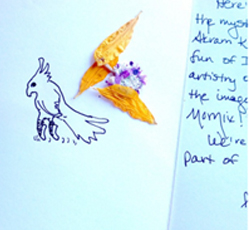
Paul: We’ve commissioned 34 new works so far. Among the 2014–15 programs, ODC/Dance was the one we produced. Every year, we select an outstanding choreographer and award the “Barney” Creative Prize, named after our “CEO” Barney, the white cockatoo. Last year, the prize went to Kate Weare, the choreographer for ODC/Dance. We gave her 15,000 dollars in prize money i to cover production costs, and the outcome will be unveiled on stage during the current season.
Q. White Bird’s current season has a section called Uncaged. What are the shows in that category?
Paul: There is a story behind the name Uncaged. There are three different venues we use over the course of a single season, and one of them is Lincoln Hall at Portland State University (PSU). The place used to be a high school building. White Bird Uncaged used to take place in Lincoln Hall under a title of the White Bird/PSU Dance Series, but due to some construction work that happened to fix the hall’s decrepit facilities, dance troupes that were scheduled to perform there had to go elsewhere. At first we used an abandoned amusement park, and then a big storage space and an arcade lobby. Once the renovation was completed, our shows were back on stage—and within the confines of a “cage.” So we came up with a new title, Uncaged, to remember the energy that unfolded outside the theater. Like the name itself, Uncaged is a section that introduces works by innovative choreographers who are still relatively unknown.
|
|
|
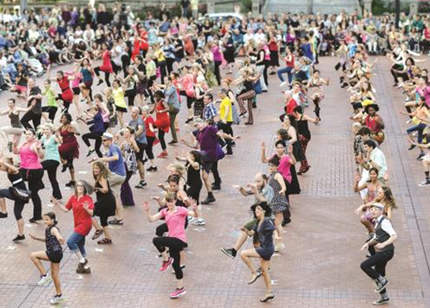
| Le Grand Continental directed by Sylvain Émard ©White Bird |
White Bird’s shows and programs ©White Bird |
Q. I wonder if you have any special plans for the future direction of White Bird.
Paul: This is our 18th year, and our 20th anniversary is just around the corner. As the date approaches, we’ve been thinking about what to do for the occasion. For the 15th anniversary, we presented Le Grand Continental, directed by Sylvain Émard, a choreographer from Quebec, in Portland Square. It was an amazing work done by 164 nonprofessional dancers after practicing for 10 weeks. I understand the show has been presented in Korea as well [for the closing of the Ansan Street Arts Festival in 2015]. When I run into residents who participated in the program, they ask me when it will return. Maybe in 2017 for the 20th anniversary? I’m not sure yet.
There’s no special plan. I don’t want to add anything deliberately. Instead, I want to continue what we are already doing and do it better. I also want to solidify our relationship with the community in which White Bird is rooted. And I want to keep helping young Portland residents to develop an interest in the community and create new works.
Those who only care about increasing profits and getting bigger may think we’re crazy. Americans have this expression that says, “What doesn’t kill you makes you stronger.” In Portland, we say, “What doesn’t kill you makes you weird.” We’d like to stay weird.
©KAMS
 PREV
PREV
.JPG)
.jpg)
.jpg)
.jpg)
.jpg)












.jpg','White Bird is a dance company that was jointly fou..');)


