





[People] A Message of Humor, Reached through Freewheeling Deviation
[PAMS Choice] JJbro
JJbro was established by two dancers who sought to use raw movement as a means of reexamining dance itself. Rather than wearing masks onstage, their “materials” are very everyday, personal movements, and they came together to create pieces that pose questions about the gaze of the world. Their first piece, Jimmy and Jack, humorously interprets these neglected movements—a dynamic work that has been selected for PAMS Choice 2015. I recently had the opportunity to meet with Jeon Heung-ryeol and Pyo Sang-man to talk about their work, curious about the messages hidden within their natural movements.
The Duo Brought Together by Freewheeling Personalities
Q. Hyeongbin Cho: Congratulations on your PAMS Choice selection. How do you feel?
Jeon Heung-ryeol (Henceforth "Jeon") : First, I was happy we were selected at all. It’s not easy to make it through the evaluations to become selected, so the first thought was, "Yes, we’ve been recognized." That was followed by the thought that PAMS Choice could be a foothold to overseas connections and other new opportunities, and the thought that we wanted to create more opportunities like that.
Q. Please give us a short introduction to your group.
Jeon : We are Jeon Heung-ryeol and Pyo Sang-man, currently performing under the team name JJbro. Pyo Sang-man was a younger underclassman at the same university I went to, and we started to connect at the end of last year. We had similar aspirations and similar characteristics, so we ended up creating a team together. We usually perform as a pair and currently work just the two of us, without any other new members. Our team name JJbro comes from "Jimmy" and "Jack," our nicknames.
Q. I’ve heard that you’ve performed domestically and overseas with your piece Jimmy and Jack. Please elaborate on some of your performances.
Jeon : We initially started to create our first piece last year to enter a dance competition called the Seoul Dance Collection, at the Seoul Performing Arts Festival. We debuted there and received a prize, and then were invited to the Fukuoka Dance Fringe Festival in Fukuoka, Japan, which we performed at in February of this year. Then there’s also a festival called the Potsdamer Tanztage in Germany, which we went to in May of this year to perform Jimmy and Jack. As soon as we came back home to Korea we were invited to perform at the International Comic Dance Festival in Nowon (CoDance) in June, and we performed the same piece. Most recently, we performed Jimmy and Jack at the Chuncheon Art Festival in August.
|
|
|
| Stills from a performance of Jimmy and Jack ©JJbro | Stills from a performance of Jimmy and Jack ©JJbro |
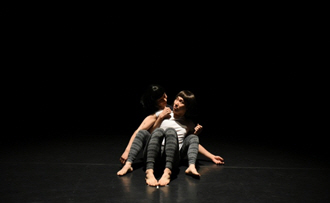
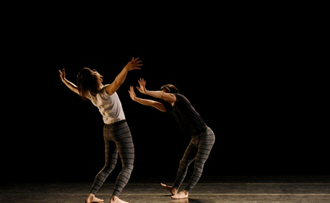
Q. With dance performances, it’s difficult to perform for a long time, and multiple times, with one piece, but you two seem to have succeeded. In the case of your overseas performances, especially, I presume the reactions must have been quite different from the reactions here in Korea.
Jeon : The responses overseas were very positive. It’s in the nature of a performance that it must happen in a variety of environments, which depend on the location and the situation, but even with all that happening we still received a fairly enthusiastic response. Perhaps it has to do with the liveliness of the piece—regardless of the reason, we were amused by the fact that our piece was so popular with children. Regarding CoDance, which was in June, the organizers invited us after they saw us in Japan in February. You can see it as an example of how overseas performances can lead to domestic performances.
Incorrectness and Difference: Humor that Unravels Diversity
Q. Let’s move on to the development of your pieces. Did you have a particular direction or goal in mind when you were structuring Jimmy and Jack?
Jeon : In the case of Jimmy and Jack, it was a piece that was created after a long hiatus from dancing. So you can see it as an example of caring less about the imagined audience. We were able to work with a lot of the playful gestures we used with each other in everyday situations, and to express our unique feelings within the work. Frankly, it’s difficult, whatever the piece, to produce art without some regard to what others might think about it. But our goal at the moment is to liberate ourselves from that, and to attempt to perfect our distinctive character.
Pyo Sang-man : Before I co-founded this team with Jeon Heung-ryeol, I did traditional Korean dance, and dance in that sense was about showing, onstage, the sort of movements that are different from your everyday movements. So I think that before all this I was very used to that aspect of traditional Korean dance. It was inevitable that my everyday movements and my onstage movements were very different. In the case of Heung-ryeol, I think he yearned for that sort of freedom—the ability to break down the barrier between the two—since he was in college. But Heung-ryeol believed in me, and as we began dancing together as a team, we discovered these new dimensions withinourselves. Dimensions that converged in a way different from the way we used to dance up until now—a more freewheeling style that could show, onstage, even parts that one might want to hide. I think that all came through with Jimmy and Jack.
Q. I get the feeling that your desire to express freedom was embodied onstage, in stage language. When you look at the movements that appear in Jimmy and Jack, they seem primitive in a sense, exuding a childlike artlessness. What were you trying to convey through this artlessness and humor in your piece?
Jeon : You could call it the message of the piece, or in another sense, you could say it was the driving force behind the piece. To be honest, there are many instances when I’m alone in my room and I imagine things alone and move alone. When others see this, they could very well say, "What, how strange. Why is he acting like that?" I’ve always hidden this side of me, and hidden it onstage as well, but one day I had a thought: These unique and in some ways very out of the ordinary actions aren’t actually wrong, they’re just different in nature. So why must I try to hide them? I want to try bringing them to the stage. The idea is that we’re not wrong, we’re just different.
Pyo : We receive a variety of responses following our performances from those who’ve seen our piece, and there was this one comment that came up regarding Jimmy and Jack: that these two men, playfully fooling around, can be seen to represent homosexuality. This is something that we definitely did not intend when creating the piece, but in a sense, when you consider our actual message, there’s definitely a common element. You can see it as yet another excellent interpretation of our piece. In any case, these things were very interesting to me.
Q. I can see how some people might see it that way. When you look at the piece there are many movements that involve the two of you touching each other’s lower bodies. It’s very comical, but also reminded me of children playing.
Jeon : When you think back to childhood, don’t little boys touch each other’s private parts in a playful way? The movement is derived from that kind of playfulness, and the audience interpreted it in various ways. When you watch the performance, there’s a female narrator. We tried to, with this friendly narration at the beginning of the piece, to give off the feel of a storybook or animation. The message of the entire piece isn’t light, but it’s a device we included to help the audience members immerse themselves into the piece more easily, and more comfortably. But in the latter half of the piece, the voice is surprised, and it changes into a voice that attempts to constrain the deviating behaviors of Jimmy and Jack. Embarrassing behaviors, things that you shouldn’t do—these things start to become rejected. In actuality, there’s nothing wrong with this sort of thing when you’re doing them by yourself at home, but the voice starts to constrain, saying, "Jack, you shouldn’t do that, that’s bad." It’s not unethical or immoral, but I wanted to depict a situation where the fact that it’s weird, in and of itself, is enough to have people pointing fingers.
Pyo : Actually, when we were choreographing the piece we did give the matter of touching below the belt a great deal of consideration. We’re comfortable with each other so we had no problem with including it in the piece, but because we were competing with the piece. We agonized over whether the panel of judges or the audience members might feel uncomfortable, but eventually Heung-ryeol just went, "Oh, I don’t know. Let’s just do it!" And so we just pushed forth and went on with it. Under Heung-ryeol’s influence, I became even more careless and carefree, and strange, and that was when we were working on Jimmy and Jack.
Jeon : The thought occurred to me that in some ways, the message of this piece is a message that I’m sending to myself. To Pyo Sang-man, I might seem carefree, but in other situations I find myself shrinking. In such situations I always tell myself, this isn’t ethnically or legally wrong, it’s just a matter of me being different, so why can’t I express myself? So you can see it as something I tell myself. I wanted to deliver the message to stop hiding and to be confident in oneself.
|
|
|
| Still from a performance of Jimmy and Jack ©JJbro | Still from a performance of Jimmy and Jack ©JJbro |
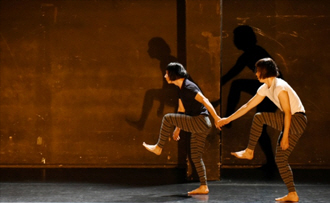
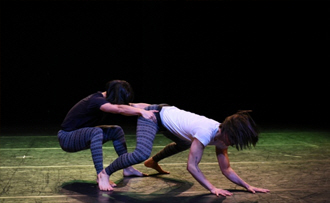
Q. I heard that you were preparing for your next piece, after the Performing Arts Market Seoul in early October. What are some things you want to try in your next piece?
Jeon : We’re preparing a new piece for our performance at the Seoul Performing Arts Festival. We were invited back following last year’s win, and we’re thinking of trying something different for this year’s new piece. Jimmy and Jack contains a lot of theatrical elements, but for this new piece, I have the ambition to stick purely to dance. I want to abandon a lot of the characterization, and am currently envisioning a piece where the character is created organically through the dance itself. If Jimmy and Jack was a piece that openly showed who our characters were, in the next piece I want to include more dance.
Q. Please tell me a bit about your future plans, or the direction of your group.
Jeon : First, the plan is to create more opportunities for overseas exposure through PAMS Choice. It might sound like a childlike ambition, but we have a lot of desire to expand overseas. We don’t have any specific plans set in stone, but this is mainly because we haven’t performed overseas very much yet. We hope that our next piece will be successful, and that we’ll be able to perform it many more times here in Korea as well. When we first created this team the driving idea was to examine the message sent to the audience from the perspective of a child, and then show them our interpretation. Now, we want to take it a step further and find a definite aesthetic of our own in addition to that. These days we’re thinking a lot about how we can distinguish ourselves, something definite enough that people, even at a glance, can say "Yes, that’s JJbro." We want to show the world more things, with this as a foundation.
©Cho Hyeongbin
|
2015 PAMS Choice Selection (Piece) : "Jimmy and Jack" "For that moment when one can be more honest with oneself, and admit one’s true character to oneself." Jimmy and Jack is a piece created for those who hide their identities for the sole reason that they’re different from others, and those who hide and cannot show themselves. After winning the prize for choreography at the 2014 Seoul Dance Collection, it was showcased at Japan’s Fukuoka Dance Fringe Festival in February 2015 and at the International Comic Dance Festival in Nowon (CoDance) this past June. 2015 PAMS Choice Selection (Group) : JJbro JJbro is a contemporary dance duo consisting of Jeon Heung-ryeol and Pyo Sang-man. The group aspires to observe and interpret the diverse phenomena of modern life with the heart of a young boy and to share these conclusions. |
 PREV
PREV
.JPG)
.jpg)
.jpg)
.jpg)
.jpg)












.jpg','JJbro was established by two dancers who sought to..');)


