





[People] A Space Drawn with Sound
[PAMS Choice] 박박(park park) by Park Minhee
Last spring, I saw No Longer Gagok: Room 5 ↻, a piece that offers a reinterpretation of gagok, an age-old, traditional vocal art form where poetry is sung. The performance was staged at the Common Center, an exhibition hall in Yeongdeung-po that consists of small rooms divided by a hallway. Following the performance, one writer for an art magazine wrote that they "wanted to convey how one performance could so quietly cut into one’s body and deliver such a thrilling experience." This type of reaction is better described as a confession than a review.
We give up our evenings and weekends and choose to visit art galleries and performance venues because of the sensual stimulation that the pieces give us and the intellectual stimulation that echoes like a refrain have the potency of a drug. Even now, when I recall No Longer Gagok: Room 5 ↻ once more, I see it as the sort of performance that prolongs the life of an addict. A few days ago I was able to meet with performer Park Minhee and hear her responses to my detailed questions regarding the performance. As I look back on our conversation, I wonder if I will be able to convey the texture of our discussion. Park, speaking of the materiality of sound, used the expression, "to draw an image within a space with sound." On the other hand, it is also my hope that the readers of the following piece will be able to, through these words, imagine the thin but firm voice of the artist.
Kim Haeju: Is Let’s Let Go of Form to Try Something Different No Longer Gagok: Room 5 ↻ the third piece under the umbrella of the No Longer Gagok title?
Park Minhee: Actually, I had more projects for which I used the title No Longer Gagok. The titles differ according to whether I’m trying out a test performance or whether it’s a complete piece. You can see No Longer Gagok: LLLonely and No Longer Gagok: 27:00AM as experiments that resulted in No Longer Gagok: Four Nights. I’d also say that No Longer Gagok: Room 5 ↻ is a complete piece, a place where aspects that were missing in the performances that preceded it are taken care of gagok.
I’m curious about the significance of the phrase "No Longer Gagok."
I first came across in my second year of middle school and really started to get to know it in third grade. There were huge gaps between when I first discovered gagok and when I first started singing it, and then when I started performing. When learning about gagok I learned that it wasn’t just the musical form that was important but that the form of the actions themselves, such as "not moving or smiling," also contributed to the unique sense of beauty in gagok. But witnessing how this sense of beauty is not properly conveyed in gagok performances today, and how the significance also seems to be waning, I started to question whether it was always this mediocre. I started to wonder: If the performance of gagok in a theater is in some senses an error of the era, then should there not be a way in which gagok can be better performed in a non-theater space, or performed in a theater but in a different manner? All of this began with the question of authenticity, whether the performance of gagok that we believe in today is authentic. "No Longer Gagok" (Gagok Shilgyeok in Korean) references a voluntarily loss, or shil (失), of this form. In other words, it contains a determination to abandon an existing form to try something different.
"No Longer Gagok" sounds like a declaration of sorts. Did you begin production with this title in mind?
There were several studies before that. Previously, the primary questions were about questions were about the instrument—the body—rather than gagok itself.. I believe that the energy expended when using your body in various ways is equal for each of these ways, including with singing. I think I was curious about whether there was a drawing that one could create with one’s body or by using the motility of one’s voice. In a sense, a sound that came out of the throat would represent a line. I felt that the body and the voice were not things that disappeared in time but that overlapped, lying on top of one another like matter. And I was also dissatisfied with the format of the stage, a place where the performer is always divided from the audience. All of the uninteresting performances I have seen since I was in my teens were on stages where the audience was separated from the performance. I think I lost faith in the standard of a proscenium. That led me to think about a more level stage where there weren’t separate seats for the audience and where the performers could spend time with the audience as they completed the performance.
I think that the idea of this level space was excellently realized in your project where the audience member faced the performer, person to person, in a small room. At the same time, because the bodies of both the audience and the performer faced different directions, as did their gazes, it was possible to maintain an appropriate distance between performer and audience member.
People can often feel bewildered when suddenly faced with something strange, but by dividing the performance into parts, where the audience member can spend four minutes in a room and then rotate, my hope is that as time passes the audience can grow more and more comfortable with the situation.
|
|
|
|
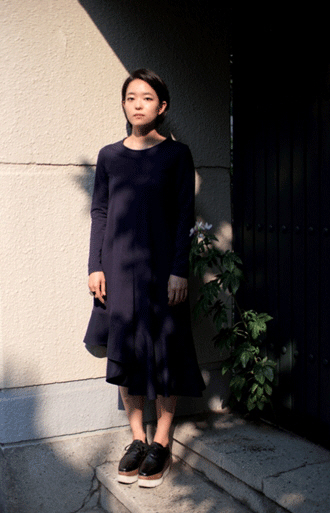
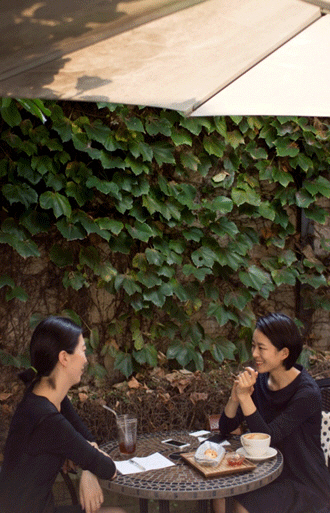
Park Minhee of 박박(park park) ©Kanghyuk Lee | |
A Wish to Deliver the Performance Intimately and Well, Without Misunderstandings
How did No Longer Gagok: Room 5 ↻ begin?
While studying traditional music, there was a principle that I could not doubt, that I had to protect. It had to do with how gagok had to be elegant, and that to protect this elegance one could not sing it anywhere. There was a moment in my mid-twenties when all that came crashing down. It was when I started to think that elegance came not from form, but from the beliefs and philosophies, and intellectual depth of the performer. One day I was at a cafe with my friends and someone requested that I sing for them. It wasn’t a standard stage performance, but I really enjoyed singing for my friends, who were curious about my music, putting every ounce of strength I had into the song. Given how much I love gagok, it shouldn’t be surprising that I’m passionate about having it heard properly, and so this was when I began to think that the best way for this to happen was if it was performed closer to the audience. To be more precise, I think I can say that I wanted to see the music heard without any misunderstandings; there are so many misunderstandings on a stage. Whenever I would hear from my teachers that "gagok is good, and it is something that must not disappear," I could never wholly understand, because you can’t convey how good it is simply on the strength of authority; I felt the need to find another way of conveying how good it was.
I’m curious about the structure of the piece and how that came about.
I finished this project very quickly. There weren’t many practices, and I met the performers separately in each of their rooms and gave them specific instructions. I sketched out the structure in a similar way to how one might write a book, placing the temporal flow of the music in space. In its totality, the piece consists of an intro, five chapters (jang), and an outro. Each of the chapters was placed in a space of its own, and as people travel through these chapters in increments of four minutes, they feel the passage of time. The part I agonized over the most was the issue of how to ensure that the listener would be able to understand the musical structure of each room for his or herself, and how, through this, I could present a simpler version of the gagok hanbatang form, which is how gagok is traditionally performed.
Do you think you could say that the functions of the chapters in gagok are reflected in this piece?
Yes. They (the different parts) are our interpretations. I’m not a theorist, but as long as the expression of Korean culture is embedded within me, as someone who was born and raised in Korea, I believe that, as a Korean musician, I’m also a performer, composer and theorist too. Earlier I said that I feel music like it’s a material, like it’s matter. There are moments when the song feels like myself, like my mother, like my teacher, and like my friends. And when I feel like the song is a ghost that pierces time. Theorists are people that observe. But there’s a theory of my own body that theorists do not know. You cannot ignore the emotional aspect, that which only those who have “eaten” music themselves can understand. This piece contains an interpretation of gagok that is grasped at through such a material, in a physical sense, and I believe firmly that it is right.
Depending on the room, in some moments there are whispers that you cannot make out while in others there is only one kind of sound.
In the first and second rooms you’re hearing the singing of gagok. In the beginning we start with a slow song, called isudaeyeop. As a very old song that can be seen as marking the beginning of gagok as an art form, it involves the repetition of five songs that have the sakgdaeyeop form as the frame. And in the second room you hear "Nong (농[弄])," "Rak (락[樂])," and "Pyeon (편[編])" from the 17th and 18th centuries. Once again, five songs make a set. This kind of structure meant that as a single audience member passed through all of the spaces of the seven chapters, they would continuously hear different combinations of songs, and that each of the audience members would have a different experience of the performance. The sounds coming out of the first and second rooms are supposed to recall being alone, but you cannot really hear the words. In the third room, because the words are spoken in the narrative aniri (아니리) style of pansori music, it’s relatively easy to hear. There was a time in the past when a magazine asked me to write them a poem and I sent them a modified selection from my diary. The title of the piece was "Room" and it was about the state of being half asleep and half awake. I asked performer Ahn I-ho to rewrite this piece from his point of view, and I liked one of the pieces he came up with so much that I decided to use it in that very form.
And the reason you asked the performer to rewrite the text for that particular chapter was because you needed a distinctive approach to writing the aniri lyrics?
It’s always best when the performer writes his or her own words. As you can see in all traditional music, there is language and there are sounds that one’s own body is accustomed to. In some of the pansori highlights there are parts where, by using sijo and changjo songs for contrast, the sound of the pansori is further emphasized. In this project I tried to achieve that contrast by using the aniri in the context of a gagok. I think that Ahn I-ho did an excellent job of interpreting the words in this way and creating an appropriate texture. But because the essence of gagok is the way the songs are sung, you can’t always hear the words. When I was younger I wasn’t happy about the fact that people couldn’t make out the lyrics, but if you think about it, who can understand the words in a poem, anyway? On the other hand, however, if you like a poem, it stays with you for life. It made me consider whether one refines their voice and approaches sound geometrically in gagok, done in order to really emphasize the inner life of a poem in a significant and abstract way.
|
|
|
|
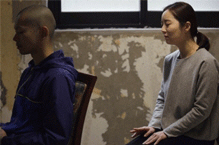
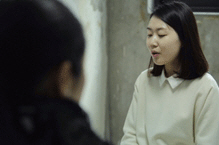
| No Longer Gagok: Room 5↻ performance ©박박(park park) | ||
‘Gagok Hanbatang’: Where One Feels a Strange Sense of Space
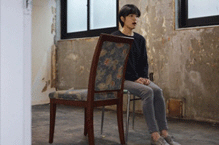
Lastly, in the fifth room you yourself sang. I remember hearing only one note. As that one sound traveled up the wall and flowed and then reached me once more, I felt a strange sense of the space, where the first sound met with the sound that followed.
The performers in each of the rooms listened to each other’ sounds and only tried to match their keys. For my part, in a composition that changes every time, I stayed with a key that would not clash with any note. That’s the significance of the fourth and fifth chapters of the gagok, and also the significance of the last song of the Gagok Hanbatang.
The insides and outsides of each room came together, and the sound that came forth and combined in different ways led to the variation of seven different chapters. The last space in particular, which featured the outro, was the staircase, halfway between the inside and the outside of the building. Looking out at the streets of Yeongdeung-po while at the same time feeling the union of the remaining sounds, it felt as though the present and the past were flowing together in unison. In that sense I feel like I could understand the symbol (↻) placed next to word "Room" in the title.
It represents a cycle, and I’ve worked with this concept for many years. It also refers to how, in the Gagok Hanbatang, all of the songs come together to create a cycle within a musical form. In gagok there is no one unique creator, and everyone can be an owner, so in that sense each song essentially travels with a life of its own. I was amused by the idea that, as time passes, and through the acts of the performance and the life of the performer, a certain type of content leads to different forms and falls into another cycle at some other time.
Please tell us a bit about the special movements in this project, as well from your previous project, "Four Nights."
In the case of this project, the basis of the movements is in time; I think I was thinking about the journey of gagok through time. I positioned moments of silence with the thought of a "quiet climax." But if you simply stay still, silence doesn’t come across as silence, so I thought of a way to enable silence to be felt. I tried to switch the differently flowing concept of time of two different people. One person’s gaze moves very slowly, while another person blinks. Like the , which has passed through both slow and fast time, I believe that we have all passed a weird time of our own, just as the layers of Yeongdeung-po, the building of a department store, and the lights of the prostitution district are piled atop each other on layers. I thought of the movement as a variation on the music rather than as any particular choreography. In Four Nights, also, the movement was a visualization of the rhythmical structure of the music.
Are there any other questions you want to try and answer through gagok?
My previous stubbornness regarding gagok wasn’t just because I simply liked gagok. It was also because I believed that, given that gagok was something that contained the essence of an era, even by asking questions about it I could achieve a lot. The modern history of our country is about moving forward rather than asking questions about the past. As a result of this history there are so many people, spaces and regions that, like gagok, haven’t quite found a place. Gagok seems to me like the crystallized remains of everything abandoned and disregarded after the period of Japanese colonial rule in Korea. So, in that sense, I believe that questions about gagok can also be questions about our society today and questions about capitalism. And in the 21st century, when capital has become both religion and god, and when personal tastes are becoming annihilated by a lack of individual personality, actively creating small-scale performances is, for me, a way of asking questions about what’s happening.
Is there anything else would you like to add?
From time to time I think about the state of being amused. I want my piece to be fun for those with both remarkably developed minds and remarkably developed senses. I like the concept of visual art and I like the performers who have developed senses, like shamans (mudang), and I think about conditions where these things coalesce in an ingenious way. That’s why, even if there’s an audience member for whom sense is more resonant, they can still experience pleasure in their skin, and an audience member for whom the piece’s core concepts are more important, they can feel pleasure, too. I used to enjoy art pieces where the concepts came first, but things are a bit different these days. I’m not very good at the technical aspects of things; that’s something that large conglomerates with capital do. I think that performing fulfills a very human need, and I believe that, through performances, humans can convey the beauty of humanity. The desire to discover the beauty of the body and to compel a return to that desire—this is something that performance can still do in a world filled with technology.
©Kim Haeju
|
2015 PAMS Choice Selection: No Longer Gagok: Room 5↻ No Longer Gagok: Room 5↻ is a piece structured in such a way that the audience member can experience, with the senses, traditional gagok, an art form from the pungryubang [풍류방], or the musical salons of 18th-century Korea. This piece interprets the musical form of the gagok in a three-dimensional, spatial way, and by representing the musical form with the location of the rooms, lets this spatiality show. The positioning of the voices and the use of texture all contribute to 박박(park park)’s interpretation of traditional gagok. Room 5↻, which progresses like a one-person show, actively demonstrates how the musical form has its foundations in poetry. The unique spatial devices of Room 5↻ affect the inner depths of the listener and reveal the unique musical characteristics of the gagok genre and its secret poetic language. At the same time, it takes the origins of gagok—a play only available to a small group of people—and recreates these characteristics in a more inclusive setting. As part of 박박(park park)’s No Longer Gagok series, which places traditional culture in a contemporary context, Room 5↻ is the second in the series, preceded by Four Nights, and its formation is completed by the audience’s act of viewing. 2015 PAMS Choice Selection (Group): 박박(park park) 박박(park park) is a group led by artist Park Minhee, who has consistently worked to realign traditional culture within a contemporary context. The group explores traditional gagok and lyrics, sijo, or traditional Korean poetry, and vocal styles that retain traces of their regional characteristics. Through their performances, the members present some of the minor conclusions they have drawn as a result of their musical exploration. The performances are structured around the inside and outside of a musical format that emphasizes vocalization, and this method of construction ensures that the format allows for interpretation among the audience, stage, and performance. Major pieces include Four Nights and Room 5↻ from the No Longer Gagok series, and these pieces demonstrate the "act of doing gagok" method that Park Minhee has explored over the years. |
 PREV
PREV
.JPG)
.jpg)
.jpg)
.jpg)
.jpg)












 by Park Minhee','http://www.theapro.kr/eng/now/now_view.asp?idx=1242','http://www.theapro.kr/DATA/BBS1/150914_img1_.jpg','Last spring, I saw No Longer Gagok: Room 5 ↻, a pi..');)


