





[People] Above All the Other Modifiers, We’re a ‘Band’
[PAMS Choice] TANEMOTION
If you think about it, there’s a certain level of caution required when delving into gugak, or Korean traditional music. Still more caution is required when discussing music made at the meeting point between gugak and contemporary popular music with a foundation in Western culture. This is, of course, the responsibility of those who write about music. What caution is needed when simply enjoying the music? A slight unfamiliarity with the outward trappings of music is cause for enjoyment rather than anything else. Tanemotion is one such band that can be enjoyed in this way. I recently had the chance to meet with three members of the band—Yeon Ri-mok, who plays accordion and keyboard; Kim So-yeop, who plays saenghwang (a mouth organ), piri (a double reed instrument), and taepyeongso (a reed wind instrument); and Kim Seul-ji, who plays ajaeng (a zither-like stringed instrument)—in the Daehangno neighborhood of Seoul.
A Feel for the Contemporary
Han Myoungryun: Congratulations on your PAMS CHOICE selection. What is the personal significance of such a selection to you?
Kim Seul-ji: PAMS CHOICE doesn’t just select music but also theater, dance, and artists working in a variety of fields. This surely applies to other art genres, of course, but in music, a sense of the contemporary is the most important thing. I imagine the panel must have questioned what kind of Korean music could best make an impact on the era we live in now. In that sense, the fact that Tanemotion was selected as the team to answer that question is deeply meaningful to us.
In fact, I can’t help but feel a bit careful about the language I use to describe the sort of music that Tanemotion makes—music that shares both the form of Korean traditional music and Western music. "Fusion gugak" has already been pointed out as lacking in validity and in its sense of identity.
Yeon Ri-mok: Frankly, we’re also as worried about that issue. We have been using relatively descriptive phrases such as "a hybrid band with Korean traditional instruments," but it’s not easy to come up with a phrase for the media, where expressions are often abridged. It’s a problem we’ll have to continue grappling with.
Kim Seul-ji: There have been consistent attempts to fuse gugak and popular music with a foundation in Western music, and this problem [with defining our genre] is something that has cropped up repeatedly throughout the ages. If we were to divide this into different eras, then you could say that the first generation of such an attempt focused on harmonizing the forms of gugak and Western music, and the second generation emphasized a contemporary sound. The third generation is the generation that attempts to place, in both the form and sound of a piece, the sensibilities of popular—that is, contemporary—music and to resonate with popular audiences. Of course, in the process you’ll come across ambiguous and sometimes dangerous definitions and concepts that add an element of confusion, but I do see it all progressing. To be honest, there’s a need to recognize the fact that such problems fundamentally arise from the fact that Korean traditional music experienced a rupture, historically speaking.
Kim So-yeop: Even when you consider the saenghwang, you can see that. The saenghwang was originally a Chinese instrument. It came into the Korean peninsula at the beginning of the 20th century, or perhaps a bit before that. But with the annihilation of Korean culture during the period of Japanese colonial rule, the saenghwang also died out, along with its technique. Even today, if my reed became damaged somehow, there would be no way to repair it in this country.
The Identity of Korean Instruments
While preparing for the interview, I ended up listening to your first album, Tanemotion—Cheonchamanbyeol Concert Album, again. In fact, the sound was more "Western" than that of Tan-Emotion (2014).
Yeon: Can you specify what kind of sound felt that way?
I want to be a bit careful about how I word this, but in the elements of world music or classic music, I was reminded of romanticism. Especially the sound of the ajaeng in "Hwangweol"—it felt almost like some mid-point between the viola and the cello. It also seemed to have a waltz-like structure, filled with sorrow.
Kim Seul-ji: To be honest, I feel a lot of complex emotions when I hear an appraisal like that. Of course, it’s true that at the time we were trying for that. I’m speaking of an ambition to create Western-like sounds with gugak instruments, and to reach a relatively wider audience with this method. It was successful, but looking back there is a twinge of regret as well. If the performer of an instrument has any sort of duty, it is to bring the fundamental essence of the instrument to life and have that recognized, rather than to have that instrument imitate other instruments. We’re planning to record "Hwangweol" again for our next album. I want to bring to life, 100 percent, the uniquely rough timber of the ajaeng, which is so different from the viola or cello it was compared to.
It’s possible that the mastering is actually the most important factor in the timber.
Kim So-yeop: We can’t ignore that fact. The taepyeongso and pipe are powerful enough in a performance to rise above the beat of the drums. And when learning an instrument, we’re taught to put everything into it. But in a recording, sometimes I’ll find that it sounds a lot weaker than I imagined, despite the fact that the taepyeongso is an incredibly sonorous instrument! I’m joking a bit here, but the player of an instrument does sort of grow to resemble the instrument. So female students who major in wind instruments tend to have a rather frank and open-hearted aspect to them. And they can handle their liquor [laughs].
Yeon: Of course, getting the tone right in production is a very important part. But more than that, it’s also important to structure it properly so that at the composition and arrangement stages, the various instruments can properly express their tones.
|
|
|
|
|
|
| Kim So-hyeon –Saenghwang Kim So-jin – Vocals, Guitar |
Kim Seul-ji – Ajaeng Yeon Ri-mok – Keyboard |

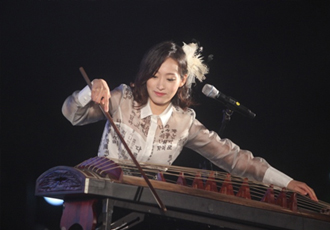
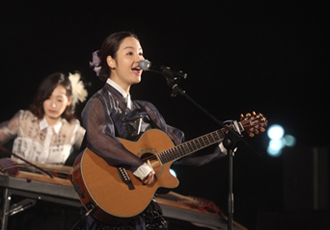
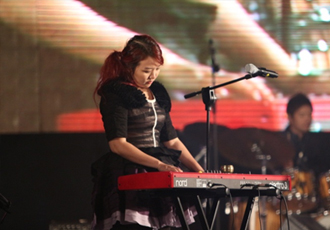
PAMS Selection: ‘Tan+Emotion’
When you look at the first piece and the line-up of members who worked on Tan+Emotion, it feels like the first and second generations.
Yeon: Actually, in terms of member changes, there were only changes to two positions, with Kim So-jin replacing Kwon Song-hi as vocalist, and Kim So-yeop replacing Kim Tae-gyeong on the pipe and saenghwang. But because these members were each with us for two years, I can see why it might feel that way.
Compared to your previous piece, the traditional theme in this album leaves a strong impression. Particularly the gut (Korean traditional shamanistic exorcism), which is not something that younger listeners these days are familiar with.
Kim Seul-ji: That’s possible. Not even those who major in gugak are necessarily familiar [with the Shamanistic tradition]. But we do have the opportunity to learn a gut for the stage, and the flow of the gut.
And on the other hand, there are also rock music–like characteristics. "Pado [Wave]," in particular, has a strong bluesy feel. Yeon is also a member of indie rock band Nuntteugo Cobain, but I’m wondering how the other two members feel about this sensibility.
Kim Seul-ji: Of course, I have an infinite affection for traditional music and that’s why I began to study gugak, which helped focus the musical references of my younger years. But while working with Tanemotion I have been listening to a broader range of music. Of course, there’s also the influence of my older brother, who is also a gugak musician and was also a fan of hardcore bands and bands with a groove, like System of a Down. I also enjoy listening to the music of Nuntteugo Cobain [laughs].
Kim So-yeop: It’s a bit different for me. I believe that there’s a certain compatibility in the thick, smooth ringing of the gugak-style elements of the pipe with blues music. Actually, "Pado" also borrows in part from the "Chilmeoridang Gut" of Jeju Island. I’m wondering if the "rock" sound came naturally from the part where we express these intense emotions where we express these complex ideas in the heat of the moment.
Yeon: Many listeners who like our music talk about the attraction of "Pado." Director Lim Dae-jin also likes it [laughs]. I believe that that’s why he loves it—because of how big the impact of the piece is.
Setting Their Sights Overseas
Through PAMS CHOICE you had the opportunity to participate in a showcase for overseas professionals in the industry. What were some of your experiences performing overseas before this?
Yeon: Unfortunately, we have none. Even in 2013, when we received the Sound Frontier Grand Prize at the Jeonju International Sori Festival, there was no opportunity to perform overseas.
Kim Seul-ji: But the winning teams in the subsequent years did receive, as part of their win, an opportunity to go abroad. I hope that we can use this opportunity to be even more active.
Lim Dae-jin: Frankly, the aim of performing overseas isn’t to make a lot of money or to be wildly successful, and it can’t be that way. We [Korean musicians] have to find the significance the opportunity of having a lot more people listen to our music. It seems obvious, but because that also implies that there aren’t so many opportunities to have a lot of people listen to our music in Korea, it’s also why I sometimes feel like it’s a pity.
Where do you think you’ll find the most positive response overseas?
Tanemotion: It’s hard to say at this point. There are no guarantees, and we have a lot of internal anxiety. More than anything, if we could garner a positive response overseas with Tanemotion, we can definitely say that we’ll be happy about that. But our identity is as a Korean band, so we want to be the sort of band that can connect with Korean audiences and to the Korean market.
|
|
What are your plans for the future?
Yeon: As a composer, I do have contemporary inclinations. It is a dream of mine from my years as a student, and I want to try composing a gugak wind and string instrumental piece.
Kim So-yeop: Please give that piece to me [laughs]. Right now I’m focusing on Tanemotion. I want to explore the possibilities of gugak instruments to the fullest.
Kim Seul-ji: My love for the tone of the ajaeng is unchanging. My goal, however, isn’t merely to uphold tradition but to continue with new attempts.
|
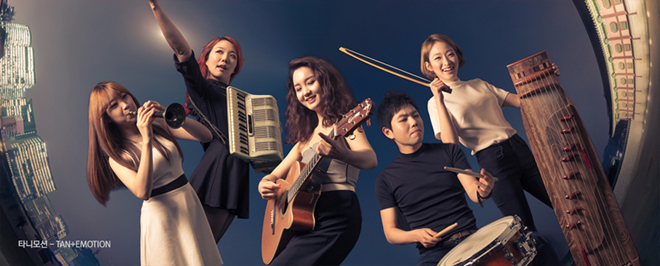
2015 PAMS Choice Selection: ‘TAN+EMOTION’ TAN+EMOTION represents a new tone in popular music, with the organic harmonization of gugak instruments and Western instruments. Traveling freely between pansori and jazz, the Sahara Desert and Jeju Island, the album is boundless, and in it one can hear a sound unique to Tanemotion. The piece "Four Four" features a fusion of jazz’s scat singing with pansori, and incorporates the Irish whistle and accordion. The collaborative piece "Nae-rye-onda [Comes Down]" is inspired by gut, a core element of Korean shamanism. The group’s repertoire also includes other pieces such as "Pado," "Tanda-Ta," and "Bu-jung-guri." Tanemotion has been featured at the Ulsan World Music Festival, the Jeonju International Sori Festival, and the Seoul Jazz Festival, and has the ability to fit in with a variety of genres while also continuing to show off its unique appeal. 2015 PAMS Choice Selection (Group): TANEMOTION "Tanemotion" is a portmanteau of tangeum, meaning to play the gayageum or geomungo, and emotion, and signifies the aim of "playing, and playing a person’s emotions." It is a six-member musical group that has both a thorough knowledge of Korean traditional music and the accessibility of popular music. With its unique sound and refreshing lyrics that satisfy the soul, its witty interpretation of Korean traditional culture is part of its appeal. After forming in 2010, with concerts including "Playing the Mind [Maeumeul Tada]," "New Gut Project [Sae Gut Project]," "Bingeul Bangeul," and "Tanda-Ta," the group has demonstrated continued growth with each coming year, and has been acknowledged with prizes such as the Sound Frontier Grand Prize at the 2013 Jeonju International Sori Festival, a prize for excellence at the 2011 Cheonchamanbyeol Concert, and the silver medal at the 2011 21st Century Korean Music Project. |
 PREV
PREV
.JPG)
.jpg)
.jpg)
.jpg)
.jpg)












.jpg','If you think about it, there’s a certain level of ..');)


