





[People] The Rhythm of Korea: Embracing the Music of the World
[PAMS Choice] SE:UM
The music of SE:UM is unfettered by any sort of mold. It is liberated and gets at the essence—and is, they say, very loyal to the emotions. Gugak (traditional Korean music) artists and Western musicians who specialize in improvisation come together, and the rhythm of their breaths bond in a chemical reaction, resulting in a solid ensemble.
With their piece "Korean Breath," which was selected for PAMS Choice in 2015, SE:UM takes their first step towards embracing the music of the world, and one cannot help but anticipate what‘s to come.
Where Artists Take Center Stage: The Culture Factory SE:UM
Q (Kang Yena): Last year, you participated in the Performing Arts Market in Seoul (Henceforth PAMS) for the first time, and now this year you’ve been selected for PAMS Choice. How do you feel?
A : (YOO Se-Woom) Last year, at the close of the PAMS, I said my farewells and expressed my desire to meet everyone again next year. But I had no great expectations, and no idea that I would be selected for PAMS Choice this quickly—so when I found out, I was actually very surprised and happy. There was a long period of time between the establishment of the group SE:UM, and its debut, and we asked ourselves multiple times whether or not we were ready. But through the booth exhibition and the open stage performance at PAMS last year, we gained the courage to aim for something new, and this became a foothold. Perhaps because of this experience, this year’s PAMS and PAMS Choice strike me on another personal level.
Q : The name SE:UM is used in both The Culture Factory SE:UM and SE:UM. Tell us a bit about your organization.
A : The Culture Factory SE:UM can be seen as a foundation, which acts as a womb where artists can establish their own creative base, collaborate systemically, build new relationships, and actually share the process of their fusion. When artists act as members of an association, the environment is not conducive to creating their own art, and artists often edit and alter their work under the gaze of others. The Culture Factory SE:UM was created with the idea of preventing such situations, and to provide a space where artists can create what they want to, a space where artists are at the center. The Culture Factory SE:UM deals not only in music but in various other genres as well, and we also work to nurture the many teams that are part of our organization. In other words, you can see us as a production company that’s structured like an artists’ union.
Q : I know that SE:UM consists of musicians, with saxophone players, trumpet players, and contrabass players, as well as traditional percussionists and gayageum musicians at the center. I am also aware that the performers also compose all the pieces, and I’m wondering how you came to create a team like this.
A : SE:UM was established in 2012, and back then it wasn’t the same as it is today. It was formed as a fusion gugak group of sorts, but in the midst of our musical activity we hit our limit, and went on hiatus for a few months. During that time, I met our current musical director and contrabass player Kim Seong-bae, and through him learned about improvisation and jazz, which gave me the chance to think more broadly.
The most fundamental factor in establishing SE:UM was the constant methodological research, thought and experimentation devoted to "Koreanizing" Western music. We emphasize the jangdan, or rhythm, sum, or breath, and hoheup, or breathing of Korean music, and give concrete form to these elements through music.
|
|
|
| Fantasia performance (2014) | Fantasia @Gwanghwamun Square |
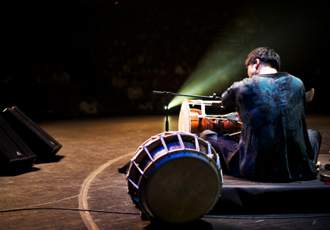
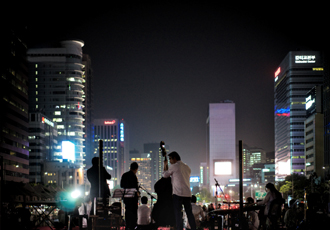
Korean Breath: Natural Unions Between People and Among Genres
Q : The PAMS Choice piece ”Korean Breath” is also about hoheup, or the "breathing” of Korean music. Please tell us more about this piece.
A : Briefly, ”Korean Breath” can be described as a piece that is more liberated, more fundamental and more focused on origins. The understanding that only performers of Korean music have of the term hoheup, which literally means breath, is different from the understanding Western musicians have of breathing. But our aim was not simply to put it all together and have the artists perform together; rather, we gave a lot of thought to how we could bring the two types of music together into a union of chemistry.
You’re not just taking the Western saxophone, contrabass, and trumpet and have them play Korean music. Rather, the goal is to view these instruments as being on the same plane, and letting the "breath" inherently found in these instruments, and the "breath" that the performers intuitively have, reveal itself. Ultimately, what we support is cross-genre collaboration and creation that remains true to the instincts, We want to pioneer in new genres through new unions.
Q : Hearing about ”Korean Breath” piques my curiosity about the creative processes at SE:UM and how you come up with your ideas.
A : To do what comes naturally, to do what interests us is what has defined SE:UM thus far. It’s not so much that we pay particular attention to our surroundings in the search for ideas about our music. Rather, when we are naturally curious about our environment, we discover our subject matter naturally through the creative process. Production also differs enormously depending on which performers play with whom. Collaborations with non-members will often lead to new ways of playing. Sometimes, the sudden appearance of an unfamiliar rhythm leads to improvisation and an entirely new track. So imagination plays a very significant role, and this is yet another defining characteristic of SE:UM.
Q : I’ve heard about recent efforts to expand the idea of what a performance is through collaborations with video media projects. I’m curious about how SE:UM approaches collaborations with video/media projects.
A (Bang Yeong-mun) : It’s difficult to clearly define the music of SE:UM, whether it’s from the perspective of the work itself, or from the perspective of the listener. To say nothing of the creative process itself, when you approach the more abstract parts of music from a solely musical perspective, it can alienate the audience. So we thought, what if we expressed the music visually, and articulated the energy felt in during a live performance, and we put that thought into action. First, we began with photos, and now we’re always on the spot with SE:UM, observing and listening to the creative process, and constantly thinking of ways to express the music in different ways, and then doing just that. In our performances of "Korean Breath," we showed elements of both video and alternative media with the music, and we plan to continue doing so in the future.
|
|
| YOO Se-Woom, Director of SE:UM (Left); Bang Yeong-mun, Art Director (Right) |
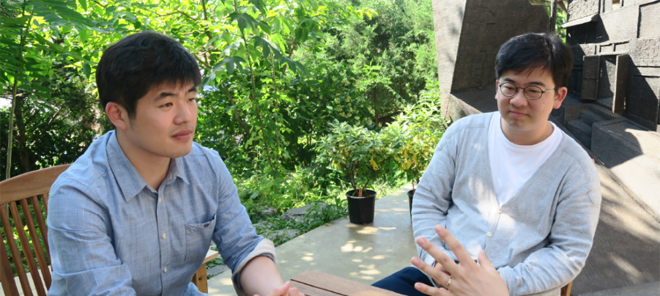
We Want to Stimulate the Intrinsic Imagination of the Audience
Q : What hopes do you have for SE:UM regarding the PAMS?
A : Last year, we participated in the PAMS with the aim of promoting SE:UM to the public and industry professionals. As SE:UM projects usually gravitate towards the experimental, and are focused on the artists, they are sometimes viewed as unapproachable to the public. But we aim to maintain our essence and to seek places that need our music. Whether it’s here in Korea or abroad, I hope that SE:UM, its music, and musical style will find those who can appreciate them, and I intend to actively seek out new markets for such audiences at PAMS.
Q : How would you like the audience to respond to the music of SE:UM?
A : I hope that visual shapes manifest naturally when they hear the music. Because there are many forms of art involved, it’s possible that you might feel a sense of disorder, but in another sense, everything is part of a consistent theme that we’re continue to pursue. As a musical tool, we’re using the sounds of SE:UM, but the hope is that this music provokes emotions already inherent in the audience.
Bang: Even when hearing the same music, depending on who the listener is, the pictures it evokes are different. So I hope that the music itself is something that enables the audience to imagine. Music should be faithful to the emotions!
|
|
| KOREAN BREATH Edinburgh Fringe performance poster |
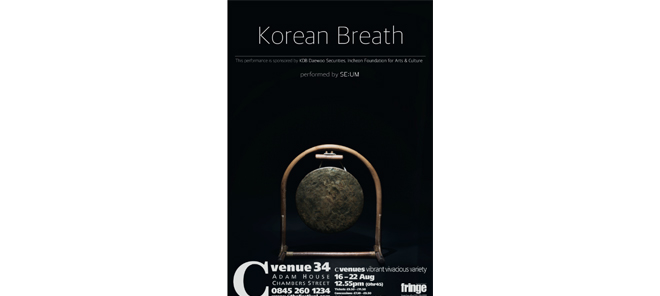
Q : What are your performance plans for the future?
A : Last year, we played in a lot of clubs in the Itaewon area. This year, we’ll continue to play in clubs, but also have a lot of pieces planned for bigger stages. For overseas performances, we have a slot at the Edinburgh Fringe Festival, and will be performing at the Adam House C (-1) Venue from August 16 to 22. We’ll be performing the 2015 PAMS Choice selection, "Korean Breath." After that, we have performances scheduled at the Gwangyang Arts and Culture Center and the big theater at the Incheon Culture and Arts Center. Also, we’ll release our ep “The Abyss” before the PAMS.
ⒸKAMS
|
2015 PAMS Choice : "Korean Breath" was composed with the breath of Korean music as its foundation, through musical experimentation and research. Drawing its inspiration from the unique breathing techniques hoheup and sum) of traditional Korean performing arts (pungmul, yeonhui, pansori, musok and others), "Korean Breath" incorporates the improvisation techniques and of jazz that elaborate on the foundation of traditional Korean rhythms. Through an exploration of the texture of music, and a chemical union between genres, it’s a piece that aspires to a Korean version of trance music. "Korean Breath" was selected as the official performance for the Incheon Asian Games in 2014, which led to a more widespread awareness of SE:UM both domestically and abroad. The album SE:UM, which contains "Korean Breath," was nominated in two categories at the Korean Music Awards in 2015 (best crossover and best performance), which provided another occasion for the piece to receive recognition for its musical experimentation and artistic value SE:UM www.seum.or.kr SE:UM was established with the goal of helping artists establish a foundation upon which they could create independently. The group continues to express its artistic inspiration in liberated ways with this goal in mind. With music remaining as their primary focus, the group is stretching the character of what a performance can be through collaborations with video, photography and other forms of media, and continues to develop and exhibit various content. Ultimately, the goal is to develop a new genre through collaboration and creation between different forms. |
 PREV
PREV
.JPG)
.jpg)
.jpg)
.jpg)
.jpg)











.jpg','The music of SE:UM is unfettered by any sort of mo..');)


