





[People] An Intense Step Taken amid Tranquility
[PAMS Choice] Performance Group Tuida
June 2015, marks a full five years since the Performance Group Tuida left Seoul’s Daehangno district behind to settle in Hwacheon, Gangwon-do. As soldiers comprise more than half of Hwacheon’s some 26,000 inhabitants, the county naturally welcomed the group, which normally employs around 15 young artists. Having signed an agreement to promote the arts and culture of Hwacheon, the group relocated with the next 10 years in mind. They are currently exactly at the halfway mark. Now, in 2015, Tuida is seeking yet another opportunity to expand its international network, having been selected as a PAMS Choice artist for the fourth time with their performance Quartet on Pain. Tuida’s real vision, however, is still a long-standing concern.
Five Years in Hwacheon, Performance Group Tuida
Q (Lee Youn Kyung): Before moving to Hwacheon, you signed an agreement to promote the county’s arts and culture. What have you done to fulfill this agreement, and how you are cooperating with the county?
A (Bae Yo-seop): Hwacheon County helped us a great deal by letting us use the art space A Country Village’s Art Garden, which was built by remodeling a closed school. Last year, by the county’s request, we performed a piece titled Nangcheon Byeolgok, a traditional courtyard play that’s performed on water, thanks to the cooperation of about 130 county residents. To ensure a proper performance of a 90-minute play, the residents collaborated with us for around a month and a half. Of all the projects we undertook in Hwacheon, we considered this one to be the most ideal. All the participants, including ourselves, as well as the important county people, were highly satisfied, as we didn’t simply show an already produced play, but cooperated with the locals to offer an original play based on their real lives, an artistically honorable process with favorable results. If the opportunity to partake in such a project presents itself again, we intend to participate, as we value working with local residents, and view art as a medium of interaction. Yet as Hwacheon County has to worry about a lot more than we do, we believe that we’ve already established a good cooperative relationship, and thank the county for their efforts to help maintain it.
|
|
| Performance Group Tuida |
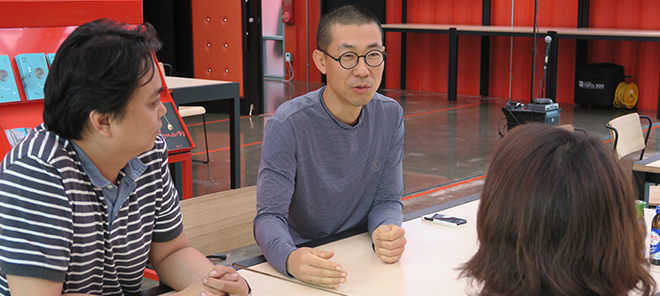
Q : Tuida’s journey can be divided into three phases: the Daehangno days in Seoul, relocating and resettling, and the third and present phase, five years after leaving Seoul. Now, in 2015, what’s on the agenda for Tuida?
A : Although we had vaguely considered relocating to this region, our move was not based on a concrete plan. That is why, after settling in Hwacheon, we started to contemplate on what we can do in the present, rather than look into the distant future.
We’re currently focusing on the issue of how to properly utilize space. We have space, and we use it well according to scheduled programs, but play production consumes three months at most, out of the whole year. Excluding the time consumed by random work, there are vacant periods, so we want to efficiently utilize the space we already have. On top of that, we’re also taking time to ponder the concept behind the space we use. How to properly utilize a space, and under what concept – that is our current focus.
At A Country Village’s Art Garden, we are preparing for the venue’s fifth art festival. Actually, we started the festival to network with organizations that we wanted to meet, but as time went by, we felt that the festival was too beneficial to be enjoyed by just us. So we invited other young artists, offering room and board, and expanded our arena of exchange. As we maintained this system throughout the third and fourth festivals, the event was reborn into a vigorous celebration, where artists, installation artists, dancers, musicians, and actors from all over the world gathered to both perform and network. Such a festival led to another interesting result. The artists who came to know each other at our festival continued to work together even after leaving Hwacheon. It was a great pleasure to hear that independent artists from Thailand and Korea in a previous festival collaborated on projects in Thailand and procured funding to work at Seoul Art Space Mullae in Seoul.
Although our current platform of Hwacheon is a remote region, we tried to approach it in a positive light. This optimistic approach has resulted in a therapeutic and beneficial program and platform for artists, and we are trying to further develop such efforts.
|
|
|
| Whale ⒸTuida | |
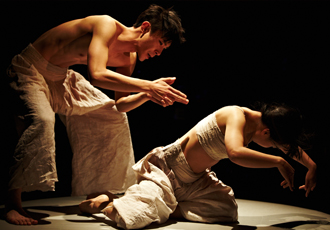
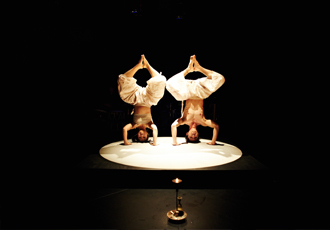
Quartet on Pain: A Short Yet Long Trip
Q : Based on your remarkable track record thus far, Tuida has attained a degree of self-sustainability in the realm of international exchange. Quartet on Pain is said to have been inspired by years of personal experience. Can you elaborate on this play?
A : It was very interesting to see how this play was created. Ironically, Tuida’s international network was suddenly expanded upon moving to Hwacheon. We relocated to Hwacheon at a time when we were putting much thought into the meaning of true international exchange and its sustainability, rather than focusing on a single performance. Since we continue to think in this light, it seems that our move to a new space has exerted substantial influence on the way we think.
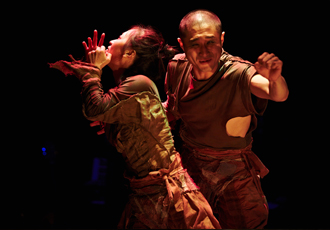
This play went through multiple stages of creation after we met our partners in India, the first country in our international network. We did not plan this play before then, but actually encountered the original source while conducting an exchange workshop with an Indian theater company named Adshati. What was gained from the workshop was the chance to witness a traditional performance art genre of India called kutiyattam. Two of the youngest and two of the oldest members of the theater each formed a team to organize a storyline and craft a performance, and within a space of two square meters, the music and flowed according to the actors’ unique breathing methods as required by kutiyattam. After the production, two plays titled Neokson and Whale were performed under one encompassing event, since both shared the common theme of pain. Yet after taking out the common trait in their storylines, it is hard to find similarities between the two. Whereas Neokson unfolds a narrative on pain in a very fierce and detailed manner, Whale is quite poetic. Although the latter is poetic and ambiguous based on a message conveyed by images rather than narration, it offers the audience another way to ruminate on suffering.
Q : PAMS Choice has to adopt a showcase format. How do you plan to present this play when its two stories are parallel?
A : Showcasing a play seems to be the most difficult part. Since there is an overall context of the play, and picking out a few scenes can lead to unintentional gaps and oversight by the director. This is our fourth attempt, and we don’t consider any of our previous attempts to be successes. They all had parts that we regret. Therefore, in this play, instead of trying to show both completely, we will focus on one, highlight its music, minimalist style, and other unique features.
|
|
|
| Neokson ⒸTuida | |
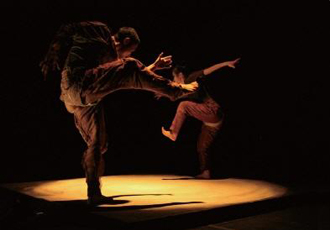
Collaborations for Discovering New Possibilities
Q : They say preparations for the performance of Beyond Binary took four years. Creating a play through international exchange is extremely difficult and time-consuming, and Quartet on Pain, which was produced exactly in such a manner, was selected for PAMS Choice this year. When you consider it from a variety of angles, what do you expect from the Performing Arts Market in Seoul or from PAMS Choice?
A : Actually, we cannot say that our plays are that popular. Korean audiences find our plays unfamiliar, and it seems that they interpret unfamiliarity as something difficult. On the contrary, when performing overseas, audiences demonstrate good communication and respond really well. We don’t know if any direct results will come about through PAMS Choice, but think it is very encouraging to think that we can satisfy a demand not fulfilled in Korea by going overseas, and thus expand the realm of possibilities for our next play.
In this respect, productions like Nangcheon Byeogok take on their own special meaning. We sink into contemplation when a difficulty arises in making a connection between our performance and the audience, and we believe that we cannot give up on this connection, because there are those who actively support what we strive to achieve. As we are clearly aware that changing the overall direction of the group can produce ambiguous results, our plan is to gain energy through direct communication with our audiences through projects such as Nangcheon Byeolgok, and keep searching for new projects.
Q : What are Tuida’s plans for the future?
A : Our plan is to collaborate with Torino Gekijo, N.P.O. of Japan, who’s been having working with us since 2009. The theme will be war, and we’ve both been on the same wavelength since 2013, when we started discussions on the performance. As our partner is a Japanese artistic company, those around us are deeply concerned when they hear that war will be the theme. The most controversial issue that comes to mind is the concept of perpetrator and victim, but I personally believe that our theme of war should transcend such concept. In particular, when artists come together, discussion concerning meaningful results usually produces a greater artistic value. As a matter of course, since this will be no easy task, we are expecting a lot of hard work. We project about one year of research, which is currently ongoing. Either at the end of this year or early next year, we will meet again in Japan to review our research together, and see how we’ve both changed.
Q : This time, the Performing Arts Market in Seoul has selected Vietnam, Singapore, and Cambodia as the countries of focus among the ASEAN states. What is your perspective on cooperation and exchange with these countries?
A : Our exchange is not limited to particular countries, and we intend to network with artists in any country that can inspire us. In this way, our options for future networking at present are France and New Zealand, but the countries we’re focusing on right now, other than Singapore, are interesting in that they boast original forms of performance art.
However, in the case of Vietnam and Cambodia, as there are many variables in the process of modernizing a traditional performance art that is an intangible cultural heritage or close to being one, we should keep an eye out for such variables. Even for Japan, a neighboring country, a whole year needs to be invested for research, and Vietnam and Cambodia are basically uncharted waters. That is why, for the sake of exploring new possibilities for our plays, we would like to go on a performance tour throughout neighboring countries –funds or circumstances permitting.
ⒸKAMS
|
2015 PAMS Choice : How do we prove that a person is alive? Pain felt in the skin when cut; the scream produced when bones shatter; the agony felt when the heart is being ripped apart—all paradoxically prove that a person is alive. Inspired by the traditional Indian performance genre of kutiyattam, the production Quartet on Pain is a play that is set on an extremely restricted circular stage, and explores a life in which words are excised, one that is accompanied by pain that expressed solely through bodily suffering.. The story is structured around a dying whale that is trapped in endless suffering because of the words it has said, and Neokson, who grew up on the sounds of its agony now wanders in a search for the grueling sounds of pain. The play illustrates a cycle as it shows that suffering, which is evidence of life, becomes sound, that sound later becomes words, and those words again invoke suffering. Performance Group TUIDA www.tuida.com www.producergroupdot.kr The Performance Group Tuida is a performance group that formed in 2001. Aiming to create an open, environmentally friendly form of theater that constantly evolves, they release new plays every year. Through acting that combines the traditions of both Eastern and Western clowns, their plays are interfused with fantastic and creative puppets, masks and music. Their unique style is crafted through continuous experimentation in each play, and their Korean-yet-cosmopolitan style has earned high acclaim through international festivals in Japan, China, Hong Kong, Taiwan, the United States, and Ireland. In June 2010, members of the group and their families moved their creative space and living space to an abandoned school in Hwacheon, Gangwon-do, and are in the process of exploring new possibilities of theater in a remote area. |
 PREV
PREV
.JPG)
.jpg)
.jpg)
.jpg)
.jpg)












(0).jpg','June 2015, marks a full five years since the Perfo..');)


