





A Producer Who Embodies the New Local Contemporary Trend
[People] June Tan, Five Arts Centre Malaysia
Following Festival Bo:m’s Myanmar-focused program in 2014, which helped provide the audience with a new perspective on Asia, this year’s Malaysia-themed event was an equally resounding success. The 2015 exhibition featured a retrospective of past projects by three Malaysian artists—a showcase of the talent and trends seen in contemporary Malaysian art. This performance, executed with the assistance Five Arts Centre producer June Tan, was performed this past April 17 at Seoul Art Space_Seogyo. For 30 years, Five Arts Centre has functioned as a major axis of theMalaysian independent art scene. Artists and producers join together and share their own tastes and roles, practicing alternative and experimental approaches that blur the boundaries between drama, dance, and visual arts. KAMS recently had the pleasure of interviewing Tan, who attended KAMS’ Performing Arts Market in Seoul X Festival Bo:m Symposium, to discuss the arts scene in Malaysia and her work with the Five Arts Centre.
Five Arts Centre, Malaysian Creative Platform
Ryu Sounghyo: I heard that this year marks the 30th anniversary of the Five Arts Centre. Can you please give us a brief description of the center?
June Tan: It was in 1984 that the Five Arts Centre was started. To help you understand the motivation for starting it, let me briefly explain the situation at that time. Malaysia was colonized by Britain and gained independence in 1957; this is one of the reasons I speak English. With everything from education, ballet, visual arts, and even Shakespeare, we were influenced byEngland in various fields. By the time the country entered the 1980s, a movement broke out to focus on specifically Malaysian arts, with each region focusing on its own creative culture. The goal was to place emphasis on the Malaysian tradition instead of the Western-influenced style.
Five Arts Centre was established in a response to finding and developing Malaysian creativity and included genres such as theatre, dance, local writing, visual arts and a fifth genre which was left open for experimentation. Through this process, the Five Arts Centre was made. In 1980s Malaysia, collaboration across genres was very popular. Visual artists would dance and dancers would perform in musicals, breaking down walls between the diverse genres.
Even today, the Five Arts Centre members are always open to collaboration. Though the members belong to their respective genres, we are very interested in collaborated performances with people from other fields. Because we are open-minded about this, we have an open structure wherein anybody can team up with anybody, depending on the project.
|
|
| Five Arts Centre “Ten Ten Ten” Celebrating 30 Years ⓒ fiveartscentre |
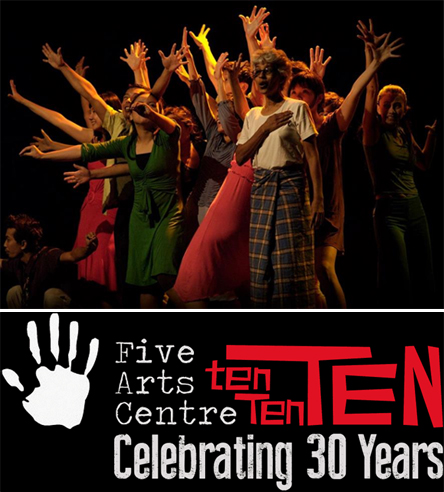
What is the meaning behind the name?
It means establishing and approaching theatre, local writing, dance, visual arts, and other fields as five units. But now, it’s more accurate to say that we operate these five disciplines more as platforms.
How do you secure the budgets?
Five Arts Centre has a lot of performing arts activities, and we apply to different sources - government and corporates. This is because the image of the production, the expected size of audiencethese elements that we can show are clear. The government andarts organizations have been rather cooperative when it comes to funding and helping operate programs.
When it comes to securing budgets, it seems that the Five Arts Centre is a special case compared to other cultural organizations or spaces in Malaysia.
In addition to its five main members, Five Arts Centre draws from a large group of talented contributors. Because we have a significant number of members, it is possible to divide responsibilities, with some of us working on projects while others run around to secure budgets. I am very grateful that we have support from the government and various companiesthrough thenetworks and projects we’ve been able to build up together.
|
|
|
| Malaysia Day @ Festival Bo:m | |
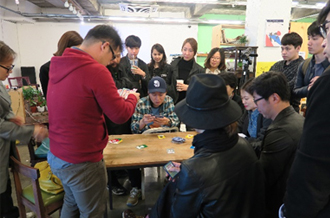
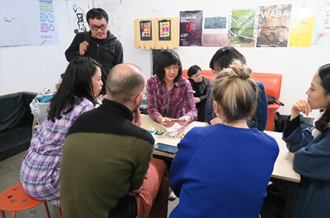
Considering Extended Audience Development
How did you become involved with the Five Arts Centre?
In college, I majored in biology and also worked in finance. I got involved in Five Arts Centre activities in my evenings after work, and over time I became more and more interested in the arts. I gradually decided that I wanted to concentrate on developing and producing projects, and I moved the focus of my work to the Five Arts Centre. I first worked as a stage manager and eventually got involved in production, too.
I’m quite interested in the work that Five Arts Centre has done in terms ofencouraging collaboration between artists from different countries. Can you explain how your team approaches this?
There are normally two types of collaboration. The first is collaboration between artists, and the second is collaboration betweenproducers. We recently carried out a joint project with a team in Seoul, and now, I am preparing to bring a Five Arts Centre performance, directed by Mark Teh to Gwangju, South Korea in co-production with Asian Arts Theatre and TPAM. I am also attracted to international collaboration. For instance, when working betweencountries, you have to explain your own country’s work culture. I like how this makes me think more about how I appear and act, and I think that I can learn through the instances where I feel differences and similarities.
Even though performing arts comprises a very small part of Malaysian society, there has recently been an increasing amount of investment in small theaters as a result of both residential and commercial development. In light of such trends, it is a good time to consider researching audience characteristics as a means of cultivating a larger following. Even if you experiment with something new and create a great performance, it can be considered a failure if no one shows up to see it.
From talking to producers in Malaysia, I’ve heard that it is very hard to attract audiences.
I can think of many reasons for this. First, it is important that those who are involved with the performance promote the performance among their own networks,, but the responsibility of selling tickets should not fall on them alone; it is also necessary to develop specific means for other institutions or organizations to join in advertising the performances. Another thing to consider is language difference. In the case of multiracial countries such as Malaysia, there exists a limitation in communicating in different languages—Malay, Chinese, Tamil. Using English is a bit more helpful in overcoming these boundaries for urban audiences, but we still have to develop audiences with this in mind: More Chinese people attend Chinese-language performances, and more Indians attend performances in Tamil.
I heard that a great deal of effort is being made to overcome the limitations Malaysia faces as a multiracial country. What is the Five Arts Centre doing in this regard?
In considering Malaysia’s identity and focusing on telling the story of Malaysia, we naturally consider the role of language. The process of producing a performance in the language most effective for a particular situation and role is also a part of such effort. Until now, because we have been focusing on discovering artists, we haven’t been focusing enough on developing a larger audience base. I think we have to respect diversity and recognize the character of each culture and sustainably enhance the strategy to develop audiences through educational programs, for example, by visiting schoolsand reaching out to students.
|
|
| Ryu Sounghyo and June Tan |
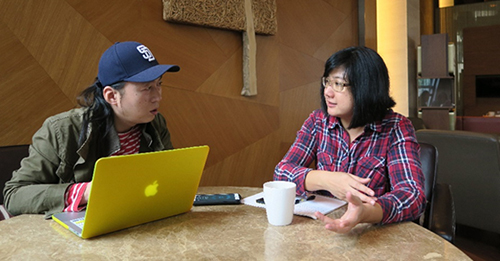
Finally, I’m curious about the plan for this year.
In celebration of the 30th anniversary of the Five Arts Centre, we have the “Ten Ten Ten” project that is continuing from last year. In 2014 we produced a series of small projects in collaboration with several organizations, and this year, we have slightly bigger plans. We have a performance-related conference, and this coming August we plan to publish a book of selected playscripts from Five Arts Centre 30-year production history. There are plans to visit Gwangju in South Korea, as well as projects with our network of Asian producers, which are currently in the conceptualization stage. If the opportunity arises, I want to work with Korea on more projects.
ⒸKAMS
 PREV
PREV
.JPG)
.jpg)
.jpg)
.jpg)
.jpg)












(0).jpg','Following Festival Bo:m’s Myanmar-focused program ..');)


