





Dedicating Herself to Bringing New Works to the International Stage
[People] Linda Crooks, Executive Producer for Traverse Theatre in Scotland
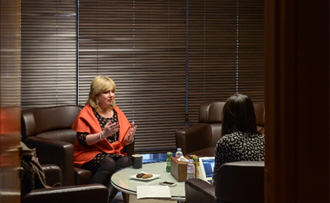
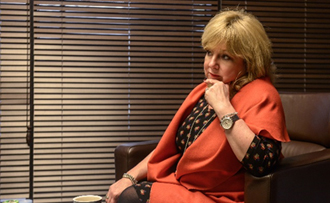
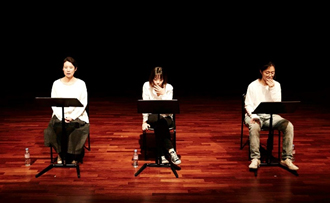
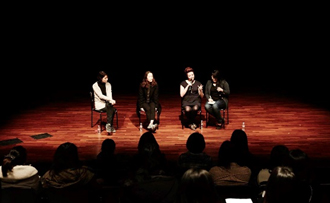
On February 27, I visited Space 111 at the Doosan Art Center to watch a rehearsed reading of Swallow by Stef Smith, the first production of the play. The fact that a new play by this young Scottish writer was premiering in Korea had piqued my interest, and my curiosity was satisfied when I learned about a collaborative project between the Doosan Art Center and Traverse Theatre. During the performance, a blonde woman in the audience caught my eye. She turned out to be Linda Crooks, executive producer for Traverse Theatre, who was playing a key role in linking the two theaters. Below is my interview with this Scottish woman, who seemed to be greatly enjoying the lack of rain in Korea.
|
|
|
| Linda Crooks ⓒChad Park |
Discovering young artists whose talents can shine on the international stage
Lee Dan-bi: Traverse Theatre is one of England’s best-known production theaters. Why don’t you start by telling us about it?
Linda Crooks : Traverse Theatre began in Edinburgh 52 years ago. The founders were an American, a Scot of Italian descent, and a Brit, reflecting the theater’s international origins. While Traverse Theatre is famous for producing new Scottish plays, we don’t limit ourselves to Scottish plays. As I just mentioned, Traverse Theatre has international origins, so we’ve been working with international partners for years now and are bringing overseas performances to stages around the world.
The theater is composed of two performance spaces. The larger space has 280 movable seats and the smaller space has 115 movable seats. While we work on a variety of programs, our own productions are where we put our focus and passion. Along with this, we have a festival for puppet shows and cartoons and the Imaginate Festival for younger audiences, and we are connected with the Edinburgh International Film Festival. In August, we showcase works that we have produced in our own independent festival, and we also move outside the walls of the theater with site-specific performances held at city parks and other spaces.
In addition, we produce breakfast shows and have something called Lunchtime Theatre in an effort to satisfy the demands of our spectators by presenting as many shows as possible. Some audience members prefer coming early to see a breakfast show. Lunchtime Theatre is also ideal for staging short performances. Occasionally, the breakfast shows are moved to Lunchtime Theatre, and if the audience likes them they are sometimes moved to our evening slot. Recently, shows that have started in this fashion have been wowing audiences and are being staged in other countries. Some have even gained a following in New York.
One of the things that stands out about Traverse Theatre is how it incubates young artists. The theater is perhaps most famous for its “new writing” incubation program. Is there any special reason why you put your focus on programs such as this? I’d love to hear more about these programs.
Traverse Theatre has programs connected with new writing. The object of these programs is to provide stimulus to and draw out interest from participants to encourage writing from a very young age. To achieve this, we have programs that are designed for a variety of ages. One of them, just to give an example, is called Class Act. In this program, professional writers meet directly with students to write with them. Six writers work on writing with students from several schools and then perform the resulting pieces over two days. Since professional actors are involved as well, the children have an opportunity to see what they wrote being performed. We also solicit plays on the theater’s homepage at a number of points throughout the year. After reading all of the plays that are submitted, we give feedback to all the writers.
Two years ago, on the theater’s 50th birthday, we solicited plays about Edinburgh from writers all around the world through a program called Traverse 50. Altogether, 640 plays were submitted. After reading all of the submissions three or four times, we narrowed them down to 50 pieces and had them read by professional acting troupes over the course of two days. Finally we selected seven writers and produced plays with them. Some of them were produced as breakfast shows, and three of the writers took part in Lunchtime Theatre. We also asked one of these writers, John McCann, to write something about the controversial referendum on Scottish independence that took place last year. A reading of a piece by Lachlan Philpott, another writer that we got to know through Traverse 50, is scheduled for this year, and we are planning to present it in Australia in 2016 with our production partners there.
Through our 50th anniversary program, we were able to feature seven new writers and, over the course of the program’s three-year selection process, we have identified a number of writers who we would like to work with in the future. . Our goals are to encourage writers around the world, to identify new talent, and to produce good shows. We are making an effort to bring the works produced in this way to a wide range of audiences. Fortunately, the Edinburgh Festival in August draws people to this city from around the world; the local population nearly doubles during the festival, filled to the brim with all kinds of cultural consumers. Traverse Theatre serves as a key location for people who are looking for new and innovative works.
The main objective of international cooperation is producing excellent plays
When it comes to bringing new and innovative plays to the world, your connection with the Edinburgh Festival Fringe seems to be serving as an important liaison.
Of course. However, Traverse Theatre can be seen as occupying the middle ground between the Edinburgh Festival Fringe and the Edinburgh International Festival. While we are linked to some programs at Festival Fringe, the fact is that we have more in common with the Edinburgh International Festival—I’m speaking in terms of the artistic priority of the programs that we host. Recently, the Edinburgh International Festival recruited a new artistic director, Fergus Linehan. Linehan tends to put more weight on drama than his predecessors, meaning the genre will play a bigger role in the Edinburgh International Festival held this August. For this reason, I expect the spotlight to return to drama, which has not received much attention for the past few years, and that planners who are interested in the area will flock to the festival.
|
|
|
Swallow Reading Performance, an exchange project between the Doosan Art Center and Traverse Theatre ⓒDoosan Art Center |

Traverse Theatre’s various international exchange programs are also worth discussing. Can you tell us a little about your approach to international exchange and what you have done in that area so far? What has exchange with the Doosan Art Center been like?
Traverse Theatre has always placed importance on international cooperation. As I already noted, the very establishment of our theater had international roots. In the plays we’ve produced over the past few years, we’ve worked closely with France, Germany, and Canada. In the case of our relationship with Quebec City in Canada, I think that similarities in our political views probably had a major impact. In 2014, Jean-Denis Leduc, who was the artistic director at Théâtre La Licorne in Montreal at the time—which is similar to Traverse Theatre in the sense that it finds and produces new plays from the region—had four Scottish plays translated into French and then presented them to audiences in Montreal.
Conversely, Théâtre La Licorne arranged for three plays by Quebecois writers to be performed at Traverse Theatre. In the next phase of the project, a Quebecois writer will come to Edinburgh for the festival this year, and Orla O’Loughlin, artistic director at Traverse Theatre, will go to Quebec to lead a production. Next year, a Scottish writer will go to Montreal and go through the same process—this is what I mean by cooperation. In addition, we are also talking with Dot Theatre in Istanbul and are pursuing projects with Brazilian writers working in Rio de Janeiro and São Paulo.
In Korea, we are doing an international exchange project that is being organized by Kim Yoahen, a producer at the Doosan Art Center. I first met Kim Yo-an at Traverse Theatre three years ago, and in 2013 we had an exchange project involving writers and producers from the Doosan Art Center and Traverse Theatre. I visited the Doosan Art Center on this trip for the rehearsed reading of Swallow, the play by Stef Smith—the play’s world premiere. Currently, we are talking about how an exchange will work and what we can do together. When it comes to international exchange, the key is always bringing the best plays to audiences; it represents an attempt at a kind of international dialogue. Through the process of exchange, I have come to learn that our similarities outnumber our differences. I believe that there is plenty of potential to create plays for an international audience.
|
|
|
| a rehearsed reading of Swallow ⓒDoosan Art Center |
Cooperation begins with relationships built on trust
Both Traverse Theatre and the Doosan Art Center have shown a great deal of interest in incubating young artists. Has it been interesting to work with a theater that has the same interests, despite the different cultural background?
I have been greatly inspired through exchange projects with the Doosan Art Center. I was impressed with how smooth and efficient work has been with our Korean partners. It was much more efficient than when I worked with our theater back in Scotland (laughing). The proposals we’ve gotten from the Doosan Art Center have been very clear—I mean that they have clear strategies for achieving their goals. I’ve been most impressed by their concentration and their drive. Our relationship with them has been formed on the trust that we have built over time. Ultimately, I think that cooperation is also something that is built up through human relationships. The better we get to know each other, the more we learn we have so much in common. In that sense, international exchange must also be grounded in personal relationships. To be sure, it’s also important to look at what each theater needs. If there’s one thing that I’ve come to realize through working with the Doosan Art Center, it’s that our theater, which has been serving as a hub for several cooperative relationships, needs to focus even more on what it really hopes to achieve. It has also been a time for me to take a good look at myself. In the end, we’re trying to find new plays to bring to the world stage.
Yesterday, a rehearsed reading of Swallow was held at the Doosan Art Center. What did you think about the performance?
It was a lively and very inspirational performance. I was also quite impressed by the outstanding ability of the actors. It was very interesting to see how the director teased out the nuances of the play. They also seemed to have found quite a few more comedic moments. I was also interested to see that the seats were full of young women. I was surprised and pleased to see that so many people came to see a play by a young female writer.
Orla and I may not be that young, but we are working moms, so we have to balance our families and our jobs. In England, women who make plays and women who do hard work have been a hot topic for some time. Orla and I are convinced that everything we do is ultimately for the future. Of course, our future is our children (laughing). We work even harder for those children, and for that future.
Do you have any plans to work with Korea in the future?
At the moment, I’m thinking about what approach we should take. For example, Park Ji-hye, who directed Swallow, could come to Edinburgh to work with us. The rehearsed reading that I saw yesterday made such an impact on me that I suddenly got that idea: We could also bring a number of artists to Edinburgh for some kind of workshop. But the thing to bear in mind is that this kind of exchange can only take place when it is based on an ongoing relationship that has lasted for several years at least.
 PREV
PREV
.JPG)
.jpg)
.jpg)
.jpg)
.jpg)












.jpg','On February 27, I visited Space 111 at the Doosan ..');)


