





Music Does Not Require Any Boundaries
[People] Brahim El Mazned, Founding Director of Visa for Music
Good Music? No, There’s just Music
The world music market is changing. And the meaning of “world music,” a term that has provoked constant debate since the moment of its inception, is also changing. What does this all signify? World music began as a marketing term, from the aim of introducing non-Western music to the West. Seen from the perspective of such abstract concepts, production and consumption, the term world music itself has a very different feel from the literal “music of the world.” But whatever its beginnings, observing the recent showcases at the world’s largest world music market, WOMEX, it seems as though the original meaning has ‘fortunately’ receded.
The showcases covered performances not just from the so-called non-Western countries, but from a variety of countries and regions. And in the case of Asian music, besides the showcase stages of the early 2000s (from Asian-born, overseas residents in English-speaking countries or Asian music bands active in Europe) there are now an increasing number of cases where musical groups are actively and directly being introduced to the world, supported by their respective countries (Korea, India, Malaysia). As world music becomes more “global,” the boundaries between nations are beginning to fade. And so while the international political significance of world music is waning, it’s also a suggestion that each nation, or region, stands on increasingly equal footing, poised for mutual exchange.
But recently, as though to prove the aforementioned movement, it was announced that there would be a new music market launched to introduce the music of Africa and the Middle East. The name of this festival is Visa for Music (VFM), and it was held for the first time from November 12–15 in Rabat, Morocco. On the one hand we have WOMEX, in its 20th year this year, busier than ever. What significance does VFM have in this context? I visited the WOMEX booths this year, situated in the Cidade da Cultura, at the heart of the city of Santiago de Compostela, famed for its pilgrimage. Between the varied booths from around the world, I was finally able to catch up with Brahim El Mazned, the director of VFM.
El Mazned is a veteran festival planner with over 20 years of experience under his belt, including his time as director of the Timitar Festival, a world music festival featuring music from Morocco and Africa. El Mazned, who was also one of the official showcase jury members for this year’s WOMEX (one of the “Seven Samurai” of WOMEX), along with his involvement with VFM, was one of the busiest figures during the event. Yet despite the difficulty of getting in touch with him, when I finally did, his face was bursting with vitality, and it was relaxed. We sat face-to-face in a corner of the Moroccan booth and talked about new markets and various aspects of the world music industry.
|
|
|
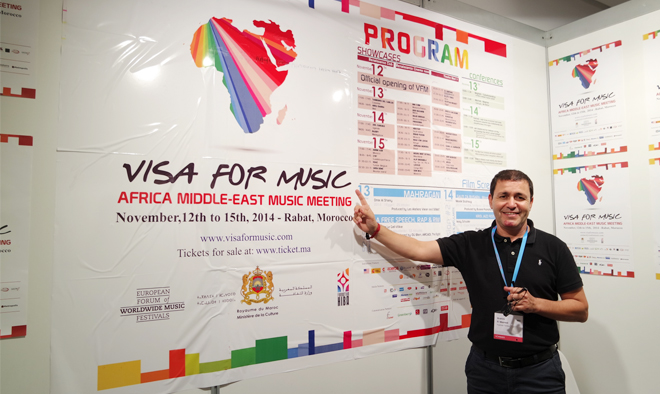
| VISA FOR MUSIC poster | The Timitar Festival booth at WOMEX 2014 |
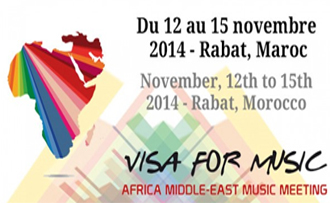
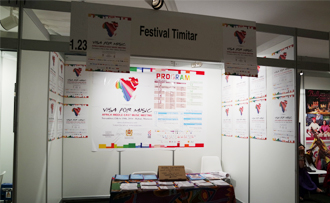
World Music and Visa For Music
Q(Lee Soo-jin): The news that VFM would be launching was very welcomed. The African and Middle Eastern markets are geographically situated so as to be an excellent bridge between Europe and Asia and other regions, wouldn’t you say? How did this launch come about?
A(Brahim El Mazned) : I have been doing this kind of work for 20 years. And doing this kind of work, I’ve been around the world’s markets and festivals. Besides WOMEX, I’ve been to PAMS(Performing Arts Market Seoul), APaMM, Shanghai China International Arts Festival and more. Visiting these diverse markets, what I discovered was the lack of a platform in the Middle East and Africa for sharing networks.
Q : As a director and planner in the field of Korean music, I am well aware of the need for a working relationship and a network between countries in Asia. This is because the younger generation in Korea is not interested in Korean music. They have preconceived notions about traditional music, and see it as unapproachable and boring. On the other hand, when traditional Korean music is introduced to the international world music market, they view it differently, and they see it in a new way. Even though it’s all the same Korean music. How is the situation in the Middle East and Africa?
A : The situation is comparable in the Middle East and Africa. This is why it’s so important that the Middle East and Africa are aggressive in initiating exchanges, and why we need to aggressively create a platform introducing Middle Eastern and African music.
Q : The meaning of the term world music itself is changing within the world music market. Departing from the previous definition of world music as non-Western music, past boundaries in world music are beginning to fade. What do you see as world music? You can’t find this term in the name of your festival, VFM, nor in the introductory booklets—is there any particular reason for this?
A : I think the definition of world music changes depending on where you live. For those who live in the West, the music of places that are not the West—that is, our music (African music, Middle Eastern music)—is world music. But because we do not live in the West, we can’t exactly call our own music world music. And for that reason, we don’t use the term at VFM. In my personal opinion, there are no categories in music. Rather, there are only two types—good music and bad music. And we also do differentiate by genre to an extent, such as between jazz and classical.
Q : But those who aren’t from Africa or the Middle East might see the music introduced at VFM and simply think of it as world music. Does VFM have any unique approaches of its own to this?
A : We have two goals, and the first is that from our perspective, we don’t just want to show off music that is exotic to us, or music that only focuses on tradition. What motivates us is probably what motivates the organizers of PAMS to showcase Korean contemporary pieces as well as other pieces. The main thing is that I want to show African and Middle Eastern music of “today.” To continue, musically, is not Korea the same way? For example, if you take a group like Jambinai, they have tradition as the foundation for both their music and their instruments, but at the same time their music has developed beyond tradition. It’s not that music has the role of connecting a country with the world. It’s that music also has the role of connecting tradition with the contemporary. And I anticipate that VFM will play this role also.
The second goal is establishing a network of countries in the Middle East and Africa. 100 million live in Africa’s 50 countries. Excluding foreigners, the number of native Africans is 70–80 million strong. The focus of VFM this year is the Middle East, and the reason is that war and famine have driven many Africans out of their countries, to the Middle East and overseas. The Middle East also includes wealthier places such as Dubai and Qatar, which can form the basis of a good market. Language also plays a role, and most North African countries speak Arabic. It will hopefully form the basis of a good platform for creating a network for exchange between Africa’s northern and southern countries, and between Africa and the Middle East.
Q : As you said, there is a lot of variety among the countries in Africa alone, and I expect the music is also as diverse. Do you have any plans to focus on a certain region for every event, like WOMEX does, and have a different host country for every event?
A : It’s certainly a good idea. But until we’re more established as an event, we don’t have any plans to host outside of our first location. As a long-term idea, I’m very much in favor of it. Africa alone has more than 50 countries, and as much diversity in music and culture.
|
|
|
| Brahim El Mazned |
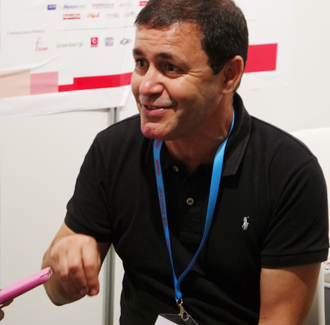
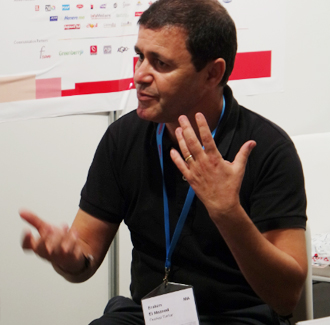
Music from Africa and the Middle East
Q : Do citizens of Buenos Aires love going to the theater? What genre do they particularly like? And if you can, please tell us about some popular productions that the audience has loved so far.
A : I operate two separate teams. The Timitar office is in Agadir, Morocco and in the case of VFM, the plan is to host it in Rabat, Morocco. Both festivals are run by institutions that are sponsored by the government (the Moroccan Ministry of Culture). We’re also looking for sponsors to supplement the government funding, and receiving help through various arts and culture networks worldwide, and media partnerships.
Q : Do you find your work very challenging or difficult at times?
A : Frequently, yes. It’s not easy. Financial difficulties, government issues, visa problems… for example, one of the teams had trouble working because their application for a visa was not accepted. But I’m working ceaselessly to solve these problems.
Q : I’d like to talk about music. When you look at the musical projects of many of the musicians introduced in the world music market, including Korean groups, there are a lot of teams demonstrating a great interest in creativity, with traditional elements as the foundation, and you actually see these teams on many stages. Would you say you see the same interest in this kind of creation in Africa and the Middle East?
A : Certainly. And we definitely need elements of mass appeal in the creation process. Because mass appeal means money. Young musicians are constantly working to develop fusion, rap, hip-hop and electronic music from traditional music. At the same time they are striving to remember the traditions. Because there’s also a sense of completion in the traditional form itself.
Q : Are these values reflected in the judging process for the showcases?
A : We’re looking for a variety of elements, with appropriate attention to the best of each quality. We try to balance, and attempt to divide the selections equally, with 13 percent of each of the following: regional elements, African music, Middle Eastern music, traditional music, fusion, acoustic and jazz music.
Q : I want to continue chatting about the younger generation. In the case of Africa and the Middle East, how are they educated on music, and how is tradition passed down?
A : There are two cases. There are cases where the traditions are passed down through the generations of a single family. This is most frequently the case for deeper traditions. And in the 21st century, students also learn music in middle school and high school. There’s no system in place for university degrees on this material; the lives they lead outside of what they learn in school and from their families depends on them. They themselves must become music educators or musicians, or travel throughout Africa learning music, exchanging ideas, and living their lives. Africa alone has more than 50 countries, and the music of north, east, south, and west of Africa differs dramatically, so there are hundreds of varieties of African music. So their lives cannot be anything but variegated, and it’s almost inevitable that they produce new music. I’m proud of the fact that I’m from a country that’s musically rich. In a capital-sized city, the musical performances in a single night come to more than 200. Clubs, pubs, outdoor halls and a variety of locations are all fair game for a liberated music performance scene, and I think it’s because a love of music is in the blood of the African people. There is a lot of demand for music in the Middle East, as well, although the atmosphere is different. There are more indoor salons and much of that has to do with a differing social atmosphere and different governments.
|
|
|
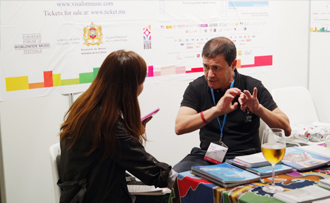
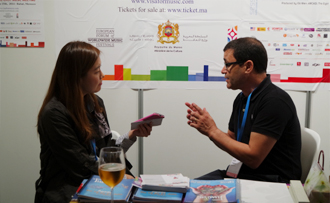
| Two people being interviewed |
Visa for Music and Korean Music
Q : What is your long-term vision?
A : Right now my first, primary goal is to introduce African and Middle Eastern music to the rest of the world, and establish a stable network within Africa and the Middle East. But in the long term, I don’t want to stop at merely introducing it. I want to create a place that will bring in Asian, South American, and European music, and music from a variety of regions. In fact, many of the African teams in this year’s program are groups that have had experience in Europe. And historically we’ve always had frequent exchanges with South America. When you consider the people of the Caribbean, did they not originally come from Africa? It’s also true that many musical genres owe their roots to African music. There’s a fundamental network spread out over a broad expanse. I want to breathe new life into the significance of this, and create a genuine network —that’s my vision. Next year my plan is to invite more guests from Asia. I also plan to increase the number of overseas showcases by degrees. I want VMF to play the role of at true market, where we can all buy and sell — that’s also part of my vision.
Q : This year [the new wave Korean music group] Noreum Machi was selected at WOMEX, making it the fourth Korean group to debut at the event. I believe that Korean music needs a network like this, not only in Europe’s world music market, but also in Asia, and I’m hoping that Visa for Music can set a good example. Do you have any advice for the future direction of Korean music, or a network in Asia?
A : I think Korean teams being introduced at WOMEX is a very good start. The European market is huge but there’s a limit. In the near future, I hope that Korea music will be introduced to other markets, including in Africa, the Middle East, and South America. From a financial perspective too, Africa and the Middle East can be a good opportunity for Korea. We already have Korean companies such as Samsung and Hyundai. Using culture only adds to the influence. And Korean cultural content is, bit by bit, carving out a place for itself in Africa and the Middle East. Korean dramas and K-Pop are examples. I do hope that Korean music will be able to debut to the Middle East in a Middle Eastern market. To speak of an Asia-wide network, I see Korea as playing the role of a bridge within Asia. It has done this consistently through PAMS, and APaMM, and many overseas delegates can observe Asia through Korea. I hope Korea continues in its role as a bridge, and link, to the rest of Asia.
|
|
| Brahim El Mazned |
ⓒ《Weekly@예술경영》 editorial team
 PREV
PREV
.JPG)
.jpg)
.jpg)
.jpg)
.jpg)












.jpg','The world music market is changing. And the meanin..');)


