





Everyday yet Extraordinary: Buenos Aires’ Performing Arts Culture
[People] Alberto Ligaluppi, Director of the Buenos Aires Theater Complex
Argentina. A distant country, located at the opposite end of the earth. I’ve never been there. Not even once. When I was given the task of interviewing Alberto Ligaluppi, the director of Buenos Aires’ biggest performing arts venue, I didn’t know where to start. I suddenly thought of South American writers or novels and poem that seamlessly and effortlessly went from reality to fantasy in their works, with what appeared to be total disregard for barriers between both worlds. I like works by Gabriel Garcia Marquez, Pablo Neruda, and Jorge Luis Borges, and daydream about the day that I am able to produce and showcase some of their works on the stage. But I’m never able to find a way to interpret and display this vast imagination, and it always ends up as a fantastic fantasy. But what about Argentina. Perhaps they had brave artists, successors of those famous writers, who were able to bring these works to life? I started the interview with Alberto with this hope.
|
|
|
| Teatro San Martin (above), Teatro Presidente Alvear (below) | Teatro de la Ribera (above), Teatro San Martin (below) |
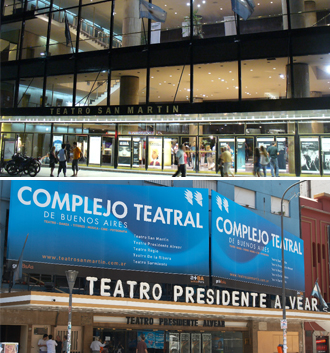
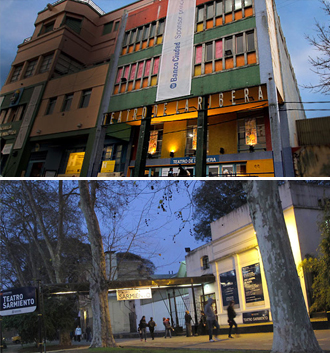
The Largest Culture Complex for Spanish Culture: The Buenos Aires Theater Complex
Q(Shin Min-kyung): Is this your first time in Korea?
A(Alberto Ligaluppi): No, this isn’t my first time. But it is my first time in five years. When I was working as the director of the Festival International de Buenos Aires(FIBA1)), I was invited to come to Korea by the 2008 Performing Arts Market in Seoul(PAMS). Before then, I didn’t really have an opportunity to come across Korean cultural arts, but thanks to them, I was able to see various works and productions. I saw
Q : I understand that you were appointed as the director of the Complejo Teatral de Buenos Aires(CTBA2)) in 2010. Would you be able to give us a brief introduction to the center and what it does?
A : The CTBA is celebrating its 70th anniversary, this year. In fact, the 70th anniversary celebrations were held last week, and unfortunately, I was unable to make it here until PAMS was wrapping up. The CTBA is the biggest performing arts center for the Spanish cultural community, not only for Argentina, but for South America and Europe, as well. We currently run eight performance venues, along with a movie theater, a television and radio production studio, and a library complete with an archive. We currently have 1,200 staff working at the center, including our performing artists, and we are a public cultural organization that receives all of its funding from the regional government. In relation to the direction of our performances, we try to focus more on reinterpreting classics and producing more contemporary content.
Q : The scale of the center is so large, it’s quite difficult to imagine what it’s like. How are the programs for the eight performance venues put together?
A : Six or seven producers put forward recommendations for works that can be planned, invited, and produced for the venues. Three programmers, who are referred to as the jury, review the productions that have been put forward, and then submit a program outline or proposal to the finance, technical and managing directors. As the general director, I then get to choose the final proposal. Argentina’s peak performing arts season is between March and December. Of these months, June, July and August are known as the “theater season,” and October is the festival season. To come up with ideas to fill the halls and venues of such a large center like the CTBA, all on our own, is impossible. So, we have endeavored to maintain strong ties with seven or eight festivals with which we organize productions. This includes FIBA and other movie related festivals.
|
|
|
| Musicians performing in the lobby of the theater | Theatergoers waiting for the performance |
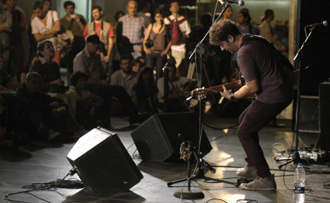
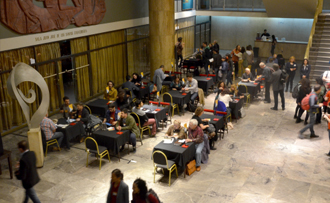
1) The Buenos Aires International Performing Arts Festival (FIBA, or Festival Internacional de Buenos Aires) was first held in 1997, and has been held every second October in the years since then. The festival invites performance groups from Argentina and around the world from all different genres, including theater, dance, visual arts, sound art and contemporary art. Dario Loperfido is the current artistic director of the festival.
2) The Theater Complex of Buenos Aires (CTBA) was formed in the year 2000 by bringing together seven public performance venues run by the city government to create one large complex. The aim was to ensure that these theaters were run efficiently, by bringing them under the management of a sole organization. The complex currently has eight performance venues, and the oldest theater is the Teatro San Martin, which has an overall seating capacity if 1,200. The CTBA’s 70th Anniversary celebrations are focused on this theater’s history. The complex also has stage production, prop and costume design facilities, as well as a 400-seat movie theater, broadcast production studio, small galleries and live clubs for music concerts and experimental performances.
Astounding 500 Performances Every Week–Buenos Aires’ Special Love of Theater
Q : Do citizens of Buenos Aires love going to the theater? What genre do they particularly like? And if you can, please tell us about some popular productions that the audience has loved so far.
A : The most popular genre is theater or plays. And I think music comes next, followed by ballet. For citizens of Buenos Aires, going to watch a performance is a way of life. Do you know how many performances or shows are run each week in the city of Buenos Aires alone? Almost 500. Every single week. And closer to the weekends, like on Thursday, Friday and then Saturday, we schedule performances for 6 p.m., 9 p.m., and midnight. The shows are all different for those individual time slots, and they are almost always a packed house. In our city, there is nothing strange about going to watch a performance at midnight. What is seen at the Edinburgh Fringe and Avignon Festivals during the summer, is just an ordinary day in Buenos Aires. We have a performance culture that equals that of London and Berlin, and of this, I am very proud.
Q : Why do you think the citizens of Buenos Aires love the theater so much? Do people of all ages love watching productions?
A : Going out to watch the theater is a part of daily life, and this new tradition was created after the Guerra Sucia (Dirty War3)). Argentina is South America’s representative country of immigration. In particular, many from Germany and Italy migrated to Argentina, and Europe’s dramatic literature and performance culture came along with them and started to spread. Watching the theater naturally became a part of life for every family in Argentina, and going to the theater at night became a family tradition. There are many theater enthusiasts among the younger generation, and also a large number of artists who wish to make a career in theater. In Bueno Aires alone, many new theater companies, that are less than two or three years old, are constantly popping up.
Q : Who is the most popular theater writer/playwright among the Buenos Aires audience? Do they also like foreign productions?
A : One of the most popular playwrights is, of course, Shakespeare. Chekhov and Moliere are also up there on the list, and works by American playwrights Eugene O’Neill and Tennessee Williams are immensely popular, too. Of the Argentine playwrights, works by Roberto Arlt, Eduardo Pavlovsky and AlbertoVaccarezza are highly sought after. The CTBA runs only about 20 to 25 foreign productions each year, and less than 10 percent of these are from Asia. Theater works from Germany are the most popular with the local audience. We invite productions that are unique to a country’s culture and have a specific storyline, such as Hotel Splendid by the Cho-In Theater Company, but the most popular productions are based on works by the international playwrights that I mentioned above, and also the unique reinterpretations of such works.
|
|
|
| Shakespeare’s Globe’s <Hamlet> ⓒBronwen Sharp | Teatro San Martin packed with audience member |
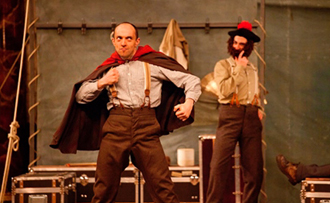
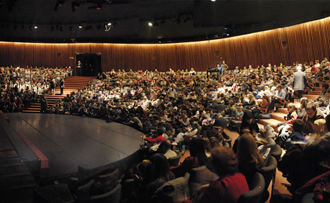
3) As the international oil crisis endangered the national economy and social tensions were at an all-time high, the Argentine military declared a state of national emergency and carried out a military coup (coup d’état). President Jorge Rafael Videla’s military regime suppressed those who opposed the government through their actions or words, and approximately 30,000 people were tortured, went missing or were executed during this time. This military dictatorship, which Argentines refer to as the “Dirty War” (Guerra Sucia), continued through to 1983, where a general election was held and democracy was established.
Q : We can see that the local audience has a particular love for the genre of theater, but I wonder, what drew you to this industry?
A : Before I became involved in business and administration, I was a theater director. But I wasn’t a very talented one. [laughs] And before that, I was an artist. I was interested in observing the appearance of people and putting my observations on canvas. When I was immersed in drawing in New York, I first came across oriental art, including Korean art. I then became interested in the Orientalism and Occidentalism of Art, and my attention shifted from paintings and drawings to the genre of theater. I returned to Buenos Aires and started directing plays, and was given the opportunity to become an arts manager. I had to choose between staying as a creative artist or embarking on a new challenge, and I eventually chose to accept the challenge and embark on a new journey as an administrative/program director.
Q : Do you ever wish to start drawing again, or directing plays?
A : I think that it’s difficult to go back and forth between being creative and being an administrator. I faced my crossroads 20 years ago, I made my choice, and I am happy with my decision. I do have hopes to start drawing again once I retire from administrative duties.
Q : How much does the Argentinian audience know about Korean culture and productions? In your opinion, what is the difference between Korean productions and those from other countries?
A : The third largest immigrant community in Buenos Aires is the Korean community. First-generation Korean immigrants opened up restaurants and supermarkets. More recently, the Korean community is making its way in the fashion industry. And many young Korean-Argentines are teachers. The percentage of Koreans in society and those who contribute to the economy is quite large, but in comparison, little is known about the Korean culture and Korean productions. There is still a long way to go in this regard.
Personally, I think Korean theater is mild, soft and pleasant. Compared to Korean theater, Japanese theater is more direct, dramatic and dark. But I don’t want to be too hasty in drawing conclusions because I haven’t seen enough productions. And I also think that the Cho-In Theater Company’s production of<Hotel Splendid>, which I invited to our festival, may have been a little easier for the audience to grasp because it had elements of both dance and music. In 2014, CTBA invited two Korean dance productions. And to me, it appears that Korean dance has been heavily influenced by European productions. Korean dancers have exceptional skills and ability, and their performances are unique in that they are able to gracefully combine elements of European tradition and Korean tradition in their productions. I look forward to seeing more exchanges between the two countries in the field of dance. Compared to theatrical plays and dance, I did not get to experience or hear a lot of Korean music, and compared to music from India and Japan, South Americans are quite unfamiliar with Korean music. Due to this, I wish to more actively introduce Korean music in South America.
|
|
|
| Alberto Ligaluppi |
|
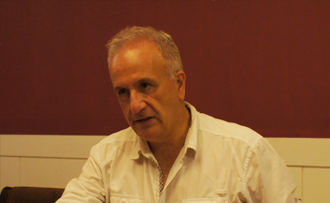
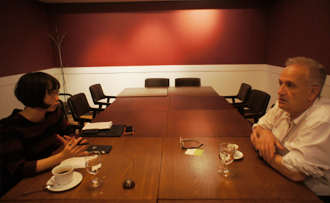
week after the interview took place, I received an email from Buenos Aires. Alberto had not forgotten my question regarding young, up-and-coming writers whom he was keeping a close eye on, and had sent me a personal list (that included not only one, but a total of 18 names.)4) I look forward to the day that the works of Borges’successors are translated and performed in Korea. And in 10 years’ time, I hope that Alberto’s email will include names and literary works by those from the Korean community, which is currently the third largest immigrant community in Argentina. I have hope, as I have often seen a diaspora, which grew up learning both cultures, create their own performing arts culture with their own sense of style, and this, in turn, becoming a new tradition.
4) The list I received (from Alberto Ligaluppi) is as follows : Mariano Tenconi Blanco, Santiago Losa, Luis Cano, Sofia Wihlemi, Nelson Valente, Patricio Abadi, Caterina Mora, Mariana Chau, Lautaro Vilo, Celina Arguello Rena, Matiaz Umpierrez, Mariano Pensoti, Eva Halac, Natalia Casielles, Andrés Gallina, Sebastián Kirszner, Agostina López, Sol Rodríguez Seoane.
ⓒCTBA Website
 PREV
PREV
.JPG)
.jpg)
.jpg)
.jpg)
.jpg)












;)


