





Changes to China’s Performing Arts Ecological System through Private and Civilian Platforms
[People] Fu Weibo, Director of the National Theater of China, and Shao Zehui, Chief Director of the Beijing Youth Theater Festival
In the past few years, factors such as system reforms and an overall increase in market size has brought about a change in China’s performing arts community, not only from an industrial point of view, but also from a creative aspect. Changes such as the corporatization of national and public theaters and performing arts groups, a boom in the construction of large performing arts venues by regional governments, the active creation and distribution of performances by civilian groups, appearances by highly competent young artists and the diversification of genres are flowing rapidly through all parts of China. Due to such changes, it is no stretch to say that information on China’s performing arts community that was released only a few years ago, are no longer valid. Many are focusing on the industry’s current state and the potential profits that can be gained from projects that are yet to be realized, but to discuss the diastrophism of the creative sector and this territory that is yet unknown, we cannot leave out a few keywords such as “small theater,” “civilian” and “rising/up and coming.”
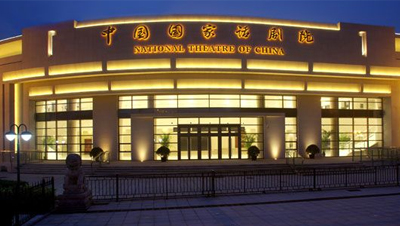
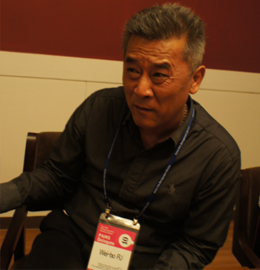
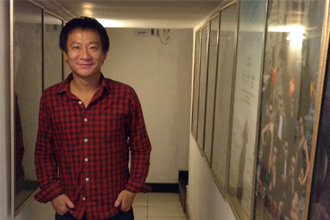
Director of the National Theater of China (NTC), Fu Weibo, oversees all venues affiliated with the NTC. But although his status or rank identifies him as being part of the national theatrical community, in China, he is known as the “Father of Small Theater.” He started life as a performing artist at the Beijing People’s Art Theater. (Founded in 1952, it has produced hundreds of contemporary Chinese “spoken plays,” and when it comes to history and tradition, it can be considered China’s representative contemporary theater group.) In the early 1990’s, he crossed over to Japan to study spatial design, and upon returning home to China, took part in opening a small theater within the People’s Art Theater, as well as managing and participating in the creative designing of projects. He then poured his own money into buying the North Theater, which was Beijing’s first civilian small theater, and then went on to create the university theater festival, and then the Beijing Fringe Festival, creating a platform for young artists who, up until then, had nowhere to perform, to show their talent.
Creative Director, Shao Zehui, who also agreed to participate in this interview with Director Fu, majored in Information Management in university, which seems a little remote from theater. But he made his theatrical debut in the early days of the university theater festival, gradually improved upon his talents by entering his works at various youth theater festivals, and is now a recognized next generation director with works entered in festivals across Asia and Europe. He also plays a central role in the Beijing Young Dramatists Association (BYDA), which is a gathering of young performing and creative artists.
|
|
|
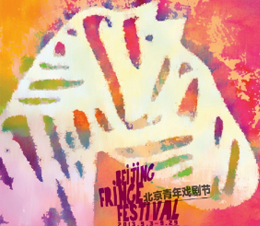
| National Theater of China | 2013 Beijing Fringe Festival’s poster |
The Founding of Small Theater and the Growth of Rising Artists
Q(Jang Hye-won) : China’s first small theater play, Absolute Signal by Gao Xingjian, was shown in the 1980’s, but even after then, people really didn’t really know about or have any idea of what small theater plays were. When it comes to the management of things, even after returning from studying abroad in the 1990’s, taking over the running of the small theater at the People’s Art Theater would have been a bit of a risky move in itself. But you continued to take over the North Theater, and then the East Pioneer Theater which is affiliated with the National Theater of China. What did you hope to achieve through all of this?
Fu Weibo(henceforth ‘Fu’) : There were many reasons for me doing so. First of all, Chinese theater was divided into two groups; the traditional and the contemporary. Traditional theater includes the likes of Peking opera, Sichuanese opera, Yueju or Shaoxing opera, and contemporary theater is casually referred to as “spoken plays.” In the case of the latter group, the works were put together and performed by the People’s Art Theater, and were very stylized or structured. If you didn’t graduate from a traditional theater institution such as The Central Academy of Drama and enter a national theater group or any troupes affiliated with them, it was impossible to even think of a career in the creative and performing arts industry. On this front, I believed that there would be a demand for performances with a different story, style, and aesthetic, and I believed that the answer to that was to get away from the mainstream and turn to new, rising artists, and give them a say and a place to show their skills. In order to do this, we needed small theaters, instead of the existing large theater venues, and I also thought that if we built a firm foundation, then we could contribute to creating an environment that could foster new talent.
Things have changed a lot now, but back in the day, civilian groups or individuals didn’t even have the right to book a venue. So, they didn’t even have the opportunity to show their work, let alone hope to have their work reviewed. At the time, I believed that environment was an obstacle in the development of performing arts. Of course, in the beginning, I had no idea where to start. I didn’t have a specific outline or plan, and there were times when I just wanted to give up and be sent to the theater library and spend the rest of my life quietly reading books. (laughs) In 1995, after I had spent 1,000 yuan on two desks and a mop for the theater office, I was broke.
Q : As a witness to the development of the theater industry from the appearance of the small theater in the late 1990’s which made way for the creation and co-existence of experimental theater and industrial theater, and the subsequent steps up until now, would you be able to give us a quick overview of what has happened so far?
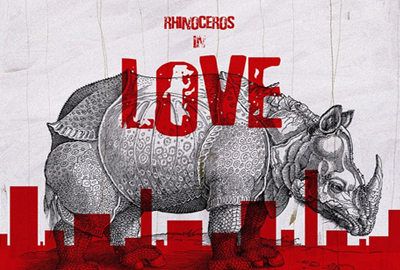
Fu : In 1999, the play <Rhinoceros in Love> (directed by Meng Jinghui) gained huge success. (It is one of Meng Jinghui studio’s three major repertoires, and is still performed today). The music for the play was written by Zhang Guangtian, and small theater plays such as <Che Guevara>, which he wrote and directed, as well as Li Liuyi’s <Fei Chang Ma Jiang> gave the audience a pleasant surprise, shocked them, and paved the way for change in the theater industry. In order to produce <Rhinoceros in Love>, Meng Jinghui had to obtain a residential mortgage loan; his house was on the line. But the play’s success turned all that around, and he later earned 150,000 in investment money. People were lined up outside the theater in order to buy a ticket to see the play, and the earnings from one play could be used to invest in the production of other plays. These plays, which received favorable reviews from fans and critics alike, went beyond the borders of pioneering and experimentation, and created a market in the industry, as well as a foundation and drive for success and improvement. While all this was happening, my takeover and subsequent management of the North Theater turned out to be a failure, but in 2005, the founding of the East Pioneer Theater (an affiliation of the National Theater of China) kicked off the second phase of our experiment and exploration, and many young creative artists, directors and planners, and audiences, came on board.
|
|
|
| Fu Weibo, Director of the National Theater of China | The poster of Meng Jinghui’s < Rhinoceros in Love> |
Shao Zehui(henceforth ‘Shao’) : That’s right. Many 30- and 40-year-old creative directors, like myself, who are active here in China and around the world, started out during that time, and I think that if those theaters mentioned earlier, along with the civilian theater festivals weren’t created, it would have been difficult for those without theater institution backgrounds like myself, Huang Ying, He Fan and many other contemporary theater directors to make our debut. And at the time, the absence of directors since Lin Zhaohua, Li Liuyi and Meng Jinghui was a hot topic of discussion and something that everyone was worried about. Before then, theatrical performances were only to be carried out by those with theater backgrounds and affiliated with a national institutions (and performers and directors were ranked as a national level 1 (A level) performer, level 2 (B level) performer and so on), but the weakening of professional authority and the blossoming of the idea that anyone could write and have their play performed on stage, was the beginning of some important changes.
The hosting of the 2008 Beijing Olympics saw a massive increase in the number of venues and theaters, and this also served as an opportunity for the theater industry to expand. Of course, it was good that the Shanghai Expo and the Beijing Olympics saw the coverage of a variety of genres, but getting an audience for the 20,000 performance runs gave us the biggest headache. For those on the creative side, there are definitely more opportunities out there, now. And we finally have a three-tier system where you have the university theater festival, the youth fringe festival, and then the winning performances being displayed at small theaters.
The Expansion of Exchange and Cooperation, Beyond Mainland China to the World
Q : For both of you, I guess that we should focus more on topics related to the small theater works that you have participated in, and the creative platform for young artists, rather than the professional titles stated on your business cards that connect you to national institutions and organizations (i.e. the National Theater of China and the Beijing Institute Of Technology Art Education Center). Would you mind telling us about the Federation of Small Theater in Beijing that was founded last year, and the Beijing Fringe Festival that has been running since 2007?
Fu : We had been planning to create the federation since 2012. Last Spring, the civilian theater group, venues and theater writers association got together to officially form the Federation of Small Theater in Beijing, and at the end of last year, we hosted an exhibition for excellent small theater works by artists within the theater federation. We also hosted a fair right after the exhibition, and the number of participating groups increased within just a small period of time. Of course, in the beginning, the provincial cultural bureaus organized the venues for such cultural exchanges, but the federation itself was open only to groups and individuals in civilian or small theater, and thus maintained its independence. Combining groups and individuals, we currently have a little over 60 members in total, and although it is a long way from government run associations which boast over 10,000 and 20,000 members, we can proudly say that when comparing the works that have come out, our association has produced more unique, original and interesting works. We’ve seen progress in many areas, but our members are cooperating on many different fronts, and I am looking forward to seeing the results of such exchanges expand in a positive direction.
Shao : The Beijing Fringe Festival was first held in 2008. Before then, the only official stage where young artists could perform or display their works were at university theater festivals, but when these artists graduated and moved on to the next level, they needed a new platform on which to work off. During the first year, the English working title for the festival was the Youth Theater Festival, but we’ve seen changed it to the Beijing Fringe Festival. The government also told us to get rid of the word international in the title. Currently, a lot of civilian commercial performances are free to do what they want, but we still rely on funding, and are thus subject to a few minor regulations that can be found here and there.
During the past seven years, 326 works from China and from abroad have been shown at the Fringe festival, with the number of participating artists reaching 5,500. And these days, so many works are submitted that the Fringe runs for almost a month to show them all. The Beijing Fringe Festival also has an exchange agreement in place with the Avignon Festival and sends some of its best works off every year, and this year, 15 Chinese productions were sent to the Festival OFF d’Avignon, while 15 French productions were brought to China and showcased to the Chinese audience. We are also in talks to secure a similar agreement with Australia’s Adelaide Festival, as well as the Edinburgh Festival Fringe. And when it comes to a variation of works, we’re seeing a fusion of performances which cross genres, as well as sound theater, physical theater and musicals, which is a big step from the spoken only or text based performances seen in our early days, which is very exciting.
|
|
|
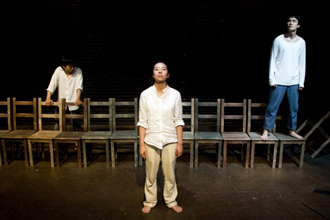
| Shao Zehui, Chief Director of the Beijing Youth Theater Festival | Yang Son Project’s work, <The Dog Is A Wild Beast> |
Q : Many small theaters, such as the Beijing People Art’s Theater, the East Pioneer Theater, the Feng Chao theater (which is the main venue for the youth theater festival) and the Chaoyang Cultural Center Nine Theater have all had theatrical work exchanges with Korea at a civilian level, and I am sure that you have come across a large number of Korean works. What was your most memorable Korean production?
Fu : I’ve seen many productions, so it’s difficult to choose just one, but the Nottle Theatre Company’s <Hamlet from the East> that was a participant in the 2002 BeSeTo Theatre Festival is one production that I can never forget. The small theater of the People’s Art Theater, of which I was director, did not have enough curtains or a dance floor, and we had to borrow materials from other theaters to finish setting up the stage. We had a difficult time setting up. But the audience response to the production was so great that I remember seeing people who hadn’t been able to see the play, lining up outside the theater in order to catch a glimpse of the directors and the performers. I also remember the production of <My Classroom> by the JookJook Theater Company whom we had invited to perform at the opening of the East Pioneer Theater. The production dealt with the subject of hardships faced by students, such as college entrance examinations, bullying or social outcasts, and problems with the education system, and this really struck home and was well received by the Chinese audience, especially by Chinese youths who were also experiencing similar problems. Many Korean productions have been shown here in China, but what I observe every single time, is that they all deal with different subjects, have a different way of displaying their topic, and have very distinct and individual directing styles. The directing is also extremely detailed, and I always feel that the performers show an incredible amount of concentration.
Shao : At the invitation of the Director’s Association, I was given the chance to direct and produce Bertolt Brecht’s <Frights and Poverties of the 3rd Empire> with Korean performers, and I’ve seen many Korean shows; from non-verbal performances like Nanta and Jump, along with a host of other plays at Daehangno. I particularly agree with Director Fu where he talks about the performers, in saying that compared to Chinese actors, Korean actors have a higher degree of concentration and are devoted entirely to their work. I witnessed this air of sincerity and devotion, especially during rehearsals, and have a good impression of Korean performers. As one of the organizers of the foreign programs at the Beijing Fringe Festival, I was able to oversee the invitation of productions like <Macbeth> by the JookJook Theater Company and Yang Son Project’s <The Dog Is a Wild Beast> right through to the setting up of the stages, and both productions are still talked about in China. We were able to help the Chinese audience understand a part of Korean contemporary theater by showing at least two productions, instead of making it a one-off show, and by holding workshops or Q&A sessions with the audience. In Beijing and Shanghai alone, there are so many productions being brought in from around the world, so continuous efforts need to be made to bring these works closer to and engage the audience. Overall, the diversity seen in Korean productions, and the passion shown by Korean actors, has given their Chinese colleagues, and the Chinese audience, a much needed push in the right direction. Being in charge of making the program at the Fringe festival, I always face difficulties in trying to invite foreign theater companies to come and perform, as the Chinese government and companies are funding less, but I hope we find more opportunities, and that more and more of these exchanges are made.
|
|
|
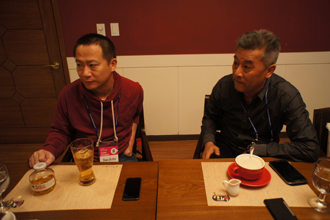
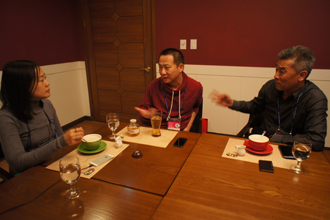
| Shao Zehui (left) and Fu Weibo (right) during the interview |
|
Civilian theater groups and young creative artists have, for some time, been on the outskirts of China’s performing arts industry. But it’s no exaggeration to say that, these days, they are going beyond what the national theater companies are producing, and are playing an increasingly central and important role with their creativity and size. For a long time, audiences have been the propaganda tools of cultural art and have played a passive role, but with the rise of people’s theater, the audience is growing and developing with them. The success of China’s large theater productions, whether they are produced and run by governmental organizations or not, are overrated. Excluding the Beijing People’s Art Theater, which has a long, rich history and repertoire and a respect for its performers, many productions include a ‘star cast’, and find it difficult to produce more than 10 runs of the show. These small theaters and a series of theater festivals in which they communicate have burst the bubble, and have opened a new paradigm. They are still lacking funds, need policy assistance, and are thirsty for fresh and exciting new productions, but we must acknowledge the fact that that they have opened up a new pace and platform for meaningful and valuable change which will only continue to grow, and we must pay attention to this fact when looking at China’s performing arts industry.
ⓒNational Theater of China Website
 PREV
PREV
.JPG)
.jpg)
.jpg)
.jpg)
.jpg)












(0).jpg','In the past few years, factors such as system refo..');)


