





Any Project Without a Response to ‘Why?’ Is Reckless
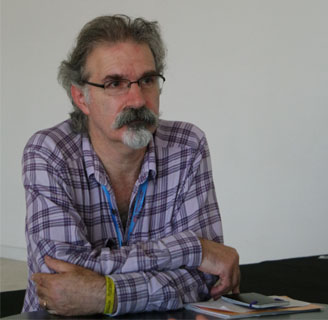
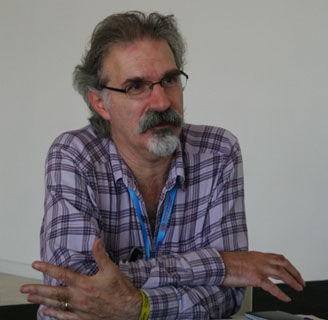
[People] Ben Mandelson, Founding Director of WOMEX
WOMEX, the World Music Expo held annually at the end of October, is an event that anyone involved in the world music industry is bound to have visited at least once. This year was the 20th anniversary of the Expo, also one of the largest year-end music festivals. In commemoration of the occasion, I talked with Ben Mandelson, one of the founding members of WOMEX in 1994, both about past achievements and his plans for the future.
The Handiwork of 20 Years, and a Pause at Santiago de Compostela
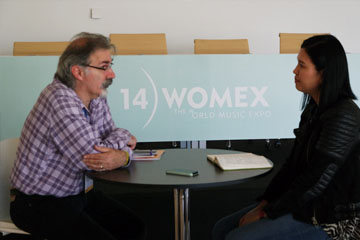
On Wednesday, October 22, the opening day of WOMEX, Ben Mandelson, whom I met in Cidade da Cultura, a name that means a “city of culture of Galicia,” was naturally the busiest person there. Our interview had been agreed upon in advance, but actually finding a time to chat at leisure was no easy feat. On Saturday afternoon we were finally able to sit down for our interview—although there were still people clamoring to talk to him—directly after Mandelson’s press conference about WOMEX 2015, scheduled to be hosted in Hungary.
The first sentiment he expressed regarding the 20th anniversary was one of joy—“Happy Birthday to us; it was a very long but meaningful journey.” But because there was still the evening showcase and the finale of Sunday evening’s WOMEX awards ahead, Mandelson confessed that it was difficult to say, in a word, what he thought of WOMEX in its 20th year. Already preparing for WOMEX 2015, it was presumably difficult for him to pause and, with his staff, really let the realization of the 20th anniversary sink in. Mandelson began to speak of the significance of Santiago de Compostela (henceforth Santiago) as the host city of the festival for its 20th anniversary.
Ben Mandelson : Santiago is traditionally known as the place where pilgrims end their pilgrimage, so there’s a lot of meaning in the fact that it is the host city for WOMEX in its 20th year. “Wouldn’t you say that a pilgrimage is a personal and spiritual journey undertaken by a variety of individuals? Because of this, there’s a special significance to the fact that we had this 20-year-old journey and ended up in Santiago. I’m very grateful.”
An interesting aspect to all this is that because Santiago is a small town in the northeast of Spain, there were some who said that it would be difficult to access. But according to my understanding of a pilgrimage, the path can be nothing but difficult. You don’t get to the end until you have reached the pinnacle of your suffering, and naturally this only follows a long journey. Without this, it’s possible that there isn’t much meaning to going on a pilgrimage. I liked the idea of arriving at a place by way of a difficult journey. I am very happy about the fact that WOMEX was able to share this journey with many people. And although it’s not over, I’m happy about how far WOMEX has come thus far. But because you never know what’s just around the corner, and because there are always bound to be surprises, it’s not over yet. I’m a Brit, and I’m someone who works in music, and we don’t say it’s over until the curtain actually falls.
|
|
|
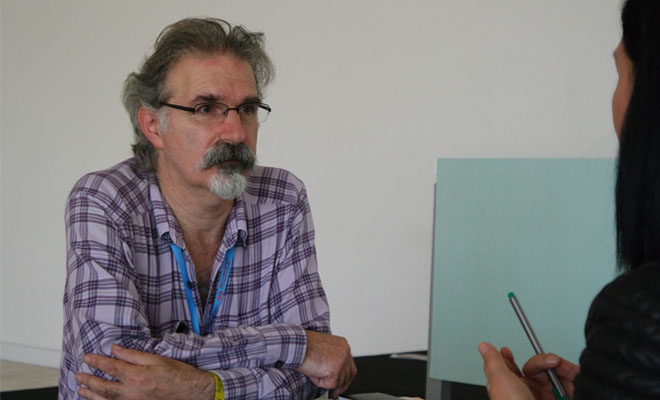
| Ben Mandelson, Founding Director of WOMEX |
The Same Questions Continue, But Are Shared in New Ways
Prior to the conference session for the 20th anniversary of WOMEX, I discovered that Mandelson had been discussing concerns about the fact that the program of the first edition of WOMEX did not particularly differ from the program now. He confessed that he’d gone back and looked at the first program and thought, “Wow, absolutely nothing has changed. Nothing changes. People are still asking simple questions in different ways.”
Mandelson : These questions cover issues such as how we can communicate, who we’ll communicate with, and our means of communication. And are followed by questions of whether we’re doing something of artistic value, and whether audiences will like me (and my music). But although our world has been transformed by technology, our concerns still involve such questions, and our concerns today overlap with our concerns of yesterday, and we consistently ask the same questions. I feel that this demonstrates how, despite the changing generations, the essence of our concerns remain the same.
There was definitely change in the realm of technological advancement. I was curious about what other musical and cultural changes Mandelson observed following that first edition of WOMEX, 10 years later, and 20 years later, today. Initially, he answered frankly that he did not know. “Because WOMEX is a process,” he continued, adding, “WOMEX is not about defining that this is this, and that is that, and how this differs from that.” Rather, “Differences are not a problem, and it’s far more important that we recognize this ‘process’.”
Mandelson : For example, if we consider whether the showcase teams we selected in 2014 would have been able to manage a showcase 20 years ago, we see how it speaks to the changes WOMEX has undergone for 20 years. The reason we would not have been able to include the music we listen to today in a program from 20 years ago is that music of that kind simply may not have existed artistically back then, or perhaps audiences may not have been as open and receptive to that kind of music.
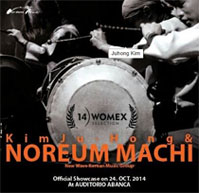
Personally, my first WOMEX experience was by way of Dulsori in 2005. Dulsori was the first arts organization in South Korea that aggressively pursued overseas ventures through WOMEX; it was also selected as part of an official showcase. The Korea Arts Management Service also began hosting the Performing Arts Market Seoul in 2005, and in 2010 hosted the opening performance of WOMEX in Copenhagen, Denmark — all of which factored into important changes leading to the greater involvement of Korean music in the global world music market.
Even at that point, it was difficult to hear Korean music on an official stage, but part of the changes brought about by WOMEX was the emergence and inclusion of Korean music. This result is also partially due to the cultural and political decisions of the Korean government. South Korea was also held up as a model country, demonstrating passion about its national culture, as well as determination and dedication towards venturing overseas. This is a well-known success story, and the result of this dedication and passion transformed into a spreading awareness of Korean culture, its values, and intangible cultural properties in the world market and began to communicate it, rather than letting it remain something valuable only within Korea.
|
|
|
| 2014 WOMEX |
Noreum Machi invited to 2014 WOMEX |

World Music — The Best Decision, with a Generous Ability to Accept
During a presentation titled the “Future Prospects and Vision of WOMEX,” in commemoration of the festival’s 20th anniversary, Marc Benaïche (Head of Atelier 144) brought up such issues as “How much do we value musical and cultural roots or nationality in music, compared to other genres of art?” and how the emphasis on dividing music by its roots and nationality before defining ‘good’ music is considerably different from identifying ‘good’ movies and ‘good’ books to watch and read.” I was naturally curious about Mandelson’s thoughts on the issue, and the concerns raised about the categorical expression of “World Music” itself. His explanation was unexpectedly simple.
Mandelson : Let’s consider sports. There are many different categories of sports, and of these, there are types that I particularly like. World music as a genre is relatively more open than any other genre, and the expression itself is admittedly ambiguous. But I don’t think the term itself is problematic. It’s just a container. This container, called ‘world music,’ may not be the best container, but it’s certain that it’s the only container that we have.
What I worry about is a rigidity in attitudes towards this container, or label, provoking categorizations such as “This is world music” or “this is not world music.” When we start differentiating in such a way, the inclusion and exclusion that arises from such differentiation creates a wall. And that is not a positive thing. Because I want to live in a world that embraces everyone. Perfect inclusion may not be possible, but I do believe that at the very least, we need flexibility. Therefore, to say that because your world and my world are different, something must be excluded—this is the cause behind geopolitical problems from a cultural perspective. In that sense, the ambiguous and yet simultaneous openness of the term world music can be helpful. And can we not embrace the idea of multiple identities being possible? People both like and dislike labels. And from a demographic perspective also, it’s possible that there’s music that for some can never be world music, while for others it most definitely can be.
The Future of WOMEX—A Response to the Needs of a Generation
Piranha, the company behind the planning and direction of WOMEX, leads in consultations for regional events hosted in all the corners of the world. Our conversation moved to talk of Piranha, and Mandelson discussed how the Piranha Company had been involved in a variety of projects over a long period of time, how it through subsidiary companies such as Piranha Events and Piranha Culture it directed festivals such as WOMEX and Classical: NEXT, and how it continued to grow and expand in the field of culture industry consulting through its advisory role in events such as Brazil’s Porto Musical, China’s Sound of the Xity, and Cabo Verde’s . Atlantic Music Expo. As an expert in this particular field, director of consulting Christine Semba oversees all of the consulting projects. With 20 years of expert knowledge and experience as a foundation, Semba is able to provide advice on hosting culture industry expositions of this kind. These consultations include not only how to plan for and organize such an event, but also information on what kinds of industry professionals participate, and on their respective fields of expertise.
Recently expo hosting has taken a turn in a new direction. In Korea also, with events such as the Performing Arts Market Seoul and the Asia Pacific Music Meeting, it’s been put forth that inviting the best of the best among the experts is a more prudent decision, and that inviting about 20 overseas experts to meet with domestic artists and industry professionals would be most effective. Inviting overseas industry professionals would naturally stimulate active and focused networking with the artists and professionals in that region, through the mentoring sessions, one-to-one meetings and showcases. As these tendencies rise to the forefront, he observed that new trends were emerging and transformations beginning to take root in the field of event planning.
According to Mandelson, “Among the business areas that we (the Piranha Company) focus on, the field of consulting for regional event direction is definitely at the top, and through the support of the local governments, we are guiding projects so that the direction of the event fits the goal, and are also inviting the appropriate industry professionals.” He added, “And in fact, 20 or 30 years ago, the ranks of all of the personages, and the scale—are these were very important.”
The world’s largest, the first in the world—indeed, these titles alone are enough to attract the participation of many. Mandelson himself has also been to events described in such superlatives. However, he noted that not all of these events were able to hold fast to their goals and aims. “Moreover, you realize that the exchange of information, and the expansion and establishment of networks, are much more effective and efficient in smaller groups,” said Mandelson.“From the perspective of the government that is sponsoring the event, naturally the status of being the best in a certain area is very important, but it’s also important to acknowledge that when 20 or so major overseas industry professionals gather together and engage in mutual exchange with domestic industry professionals, you get relationships that are deeper, less simple, and less about one-off meetings,”he said. I was also curious about what their primary considerations were, when they were entrusted with an advisory role. Mandelson responded that it was perhaps “Why are we planning this event?” In other words, the question that should come even before “Can we do this?” is the question one must ask oneself—“Why are we doing this, and what are we trying to do with this?”
|
|
|
Just WOMEX Is Not the Answer
WOMEX is now a hugely influential market, involving anyone who is anyone in the world music industry. But as previously mentioned, the event was recently reshuffled so that market trends and tendencies were divided by region in the organization of the expo. And along with the Australasian World Music Expo(AWME), held seven weeks ago, and Sounds Aotearoa from New Zealand, Asia Pacific Music Meeting(APaMM), the Borneo World Music Expo (BWME), and IndiEarth Exchange, this year we also have a new event, the India Music Expo (IMEX). I couldn’t help but ask what impact this tendency might have on WOMEX.
Mandelson : During the WOMEX period, we conduct a survey asking visitors what other events they visit other than WOMEX. The results are always interesting. They participate, in addition to WOMEX, in about 90 events, and the events that participants deemed important in the survey come to about 90. Among these events there are government-sponsored events with a scale to rival that of WOMEX, but there are also small, city-sized events.
Ultimately Mandelson questioned whether it wouldn’t be terrible if other events could not exist. He said that WOMEX alone is not the answer—WOMEX staff also participate in other festivals and learn from them.
Mandelson : It’s important that these regional events coexist. We sometimes receive requests from those who want to license WOMEX. But our recommendation is that they plan their own event, appropriate to their area of the world and their market. In truth, fundamentally WOMEX is an event that’s built around Europe. Because 75 percent of the participants are European, this is something you can’t change. And it’s an unchangeable fact, that even if you cloned WOMEX exactly and directed the clone, you can’t attract the same visitors. And unless there is a strong market and infrastructure within the region, it’s not just difficult to have an international-scale festival—it’s imprudent.
Directing Led By Necessity and a Consistent Struggle For Growth
WOMEX, traversing along the same path for 20 years, repeatedly sees success through its encounters with new generations, new culture, new music and new technologies. I wondered what new plans they had, with the 20th anniversary as a potential turning point. Mandelson responded, “Even while I think, ‘Can there be any more new things?’ I know that there will be new projects that crop up, in response to the demands of a new generation,” but there was some hesitation in his reply.
Mandelson : To begin something new, it’s like when you’re trying to construct a new building, it’s hard to destroy it, and so when you add something new the newly-created thing won’t easily disappear. I wonder if it wasn’t direction guided by necessity, and a consistent effort towards ways to grow, that brought us to this celebratory 20th anniversary. It’s because we’re looking forward to the new world music that the following generations will create that we look forward to the next 20, 30 years of WOMEX. Santiago de Compostela faces the Atlantic Ocean and is famous for being rainy. This year the weather was good enough to the point where I felt truly lucky.
The Cidade da Cultura where WOMEX was held is an edifice with a stunning contemporary design. Sitting below that building, in the warm sunlight, and chatting to Ben Mandelson, my interview wasn’t a self-congratulatory celebration for WOMEX’s 20th year, or an attempt to discover how WOMEX lasted for long. Rather, it was a richly inspiring, valuable meeting that provoked important thoughts on how WOMEX itself was still a process, and ongoing at that, and on the fundamental question of “why?”
|
|
ⓒ[Weekly@예술경영] editorial team
 PREV
PREV
.JPG)
.jpg)
.jpg)
.jpg)
.jpg)












.jpg','WOMEX, the World Music Expo held annually at the e..');)


