





Ambiguous Dance Company, Distinct Dance Worlds of Two Men
[PAMS Choice] Ambiguous Dance Company
Ever since making the transition from K-pop backup dancer to the world of contemporary dance, two members of the impish Ambiguous Dance Company have been presenting refreshingly stimulating performances with distinctive dance styles and unique choreography, capturing the attention of audiences and critics alike. They have been playing an active role on various productions and expanding their presence abroad. In this interview, the two men tell their stories about dance and their ambitions for the world stage.
>> The following is a group interview with choreographer Kim Bo-ram and dancer Jang Kyeong-min of <Rhythm of Human>. The two interviewees are jointly heading Ambiguous Dance Company.
Q(Kim Seo-ryoung): You seem to be quite busy lately. First, please talk about what you have been doing.
Kim Bo-ram(Choreographer henceforth "Kim") : From July 28 to August 11, Jang Kyeong-min, my fellow company member, and I participated in France’s Paris quartier d’été as dancers in N(own)ow, choreographed by Ye Hyo-seung. We gave four performances, all of which sold out, and received positive reactions from the audience. A False Worship, choreographed by Lee Eun-kyung and myself and performed by Gada Project, premiered and ran until last weekend as part of Tradition Re-invented, a special performance put on by the Korea National Contemporary Dance Company. Jang Kyeong-min and I performed the duet piece <Coexistenceon> August 19 at the Comedy Arts Festival in Daejeon, and on August 27 as part of the Art Platform 3: Taking the World by Storm, a seasonal program at Station Seoul 284.
Q : Kim, in the last month alone, you were engaged in various projects as a choreographer, co-choreographer, and dancer. Jang, you are a busy dancer sought by choreographers. How did the two of you first encounter contemporary dance?
Kim : Backup dancers do not have job security in Korea. I decided to go to the United States to find a more stable dancing career on a bigger stage. One of the ways that I could get a visa was to become a student, so I enrolled at a college. Studying dance was fun, but I was more interested in K-pop dance, and I went straight back to K-pop as soon as I graduated. Most students, including Kim Seol-jin, who graduated before me, found contemporary dance more interesting and went on to Korea National University of Arts after graduating from college. I studied contemporary dance at college, but I felt challenged in many ways. It was not easy to understand what the choreographer wanted. Then one day, Prof. Kim Ki-in, who had been my teacher in college, gave me an opportunity to choreograph. I tried again to answer the question, “Why am I uninterested in contemporary dance?” Determined to create a dance that was fun for me as well as for the audience, I set to work. The result was <Everybody Season 3>, which won the grand prize at the CJ Young Festival. Through this event, I suddenly became a choreographer of contemporary dance. Having been introduced by Kim Seol-jin, I joined Sungsoo Ahn Pick-up Group. Ahn Sung-soo’s work was different from the dances I had seen before. The feeling he exuded as a choreographer and as a dancer was undeniable, and even I could understand it clearly. I felt something I had never felt dancing. My connection to Ahn was lasting, and I continued to dance.
Jang Kyeong-min(Dancer henceforth "Jang") : I also started as a K-pop dancer. I entered the contemporary dance world in a similar way to Kim: I was in the same class as Kim Bo-ram at the Seoul Institute of the Arts, where I first encountered contemporary dance. I am one of the founding members of Ambiguous Dance Company, and have appeared in every performance by the company since the first piece in 2008. I have been dancing with Sungsoo Ahn Pick-up Group since 2010.
|
| |
| <Coexistence> Jang Kyeong-min(L), Kim Bo-ram(R) | |
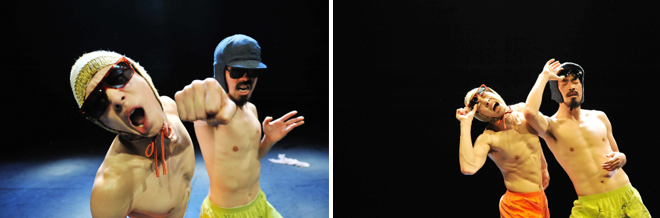
Catching Their Breath after a Long Dash
Q : How was Ambiguous Dance Company born? I understand that there was a big change in the company. Please elaborate.
Kim : After creating the piece introduced at the CJ Young Festival, I needed a name for the dance company. I formed Ambiguous Dance Company with the members who performed that piece. Being neither contemporary dance nor K-pop dance, our style was ambiguous; our identity was ambiguous; the contemporary dance world at the time probably thought that our dance company was ambiguous. I named the dance company casually, but we are still using that name. Jang Kyeong-min and a few other members have been with Ambiguous for six to seven years. We faced many challenges entering the dance world without connections. Luckily, after the CJ Young Festival, I won recognition from the dance world as a choreographer, and was invited to work on various projects. For the first three years, I created new pieces indiscriminately at every request. When I stopped to think, I felt as though I was not gaining anything by working in that way. I wanted to try for the overseas stage and began entering contests abroad, but without systematic planning, I became physically drained. It was significantly more challenging than working in Korea. So far, I have paid for overseas performances and tours with my personal funds. It has been financially taxing, and it dampened my creative will for a time. I thought seriously about whether I would be able to continue working. Last year, I produced a documentary, thinking that I would stop working as a choreographer.
Jang : We met planner Kang Eun-young while presenting <Coexistence> at the Forum for Independent Performing Arts Creation during the Mullae Arts Festival. She met us as a fan. We began collaborating with Kang, who was studying in Germany at the time, after getting in touch through Facebook. Kang is now working as the managing director of the dance company.
Q : Why did you think about quitting dance then? From an outsider’s point of view, it must have appeared that Ambiguous was doing remarkable work.
Kim : Not counting two years of break, we created 17 dance numbers in four to five years. However, we lacked the wherewithal to refine and complete our creations. I found myself exhausted in various situations, and thought about quitting. That was when I met our managing director. We are still getting to know each other, so the situation is a little bit confusing and unfamiliar. For a while, rather than working on new projects, we are going to take the time to reexamine old projects and go through the process of refining them.
Mad About Practice, Dancing Wherever They Can
Q : Your dance numbers tend to address universal themes with light, familiar expressions that delight the audience, but they have the power to move the heart. What message do you intend to deliver through your work?
Kim : I have no choice but to reflect reality. But I do not think that facing reality is sad. I think that when expressed through art, reality can encompass excitement or sorrow. I do not try to deliver a specific emotion; I compose as if I am unraveling words. I think about creating language when I work.
Q : Many people have said that you have a unique way of interpreting music. Could you explain the method of your choreography?
Kim : Music is the first thing that I think about when I choreograph. It may be presumptuous of me to say so, but I personally think that music is more highly developed than dance. I focus not on the music for the creation of my language but on the sounds; as sounds are connected to create music, the movements that express those sounds appear as dance.
Jang : Kim often tells his dancers to focus on the music. Moving to the sounds in the music, movement transforms into sound. This was the focus of much of our training.
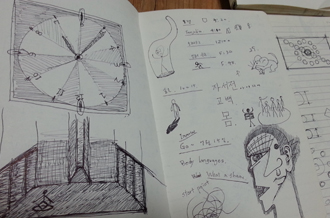
Kim : At first, I tried to express everything I heard. I would analyze a piece of music, draw a picture, and express the picture in movement. I formed a methodology for expressing music and communicated it to the dancers. I tried to train for the qualities of the body that create the movement that most resembles sound. Both music and dance exist in time; that time is interspersed with pauses, which are silence. In order to express this perfectly, a dancer sometimes practices a 10-second movement all day long. One’s attitude toward expressing music is like a genre. Just as people assume that they are living right, we often think that we are dancing right. But I realized that we are often wrong if we do not concentrate. We have to be aware in every moment. When we think we know and take expression lightly, we end up making mistakes. I regard being present with the body on stage as important. Rather than simply expressing beauty, I can say that I pay attention to communication, temporal and spatial elements. I am slightly displeased by the fact that my work is simply regarded as “musical.” In actuality, I think that I am telling a story about language rather than about music. I hope to create art that is not boxed in that way. When I started doing choreography, I also began to draw. At first, I filled pages with drawings, wanting to know what it was like to concentrate [on one subject] and fill the page without leaving any blank space. This practice helped my choreography. Drawing is very useful for expressing the images in my head.
|
|
|
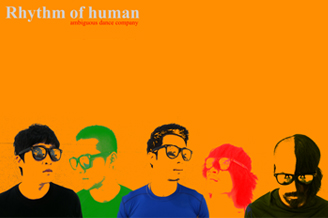
| <Rhythm of Human> performance Poster | The Creative Notes of choreographer Kim Bo-ram |
Q : How much time is spent on the choreography of any given dance number?
Kim : For most new pieces, I generally work with the dancers for about six to seven months. I like to practice a lot, but because I have been accepting many new pieces, I work on production for somewhere between a week and half a year, depending on the piece and the situation. Most new pieces are performed only one or two times, but I feel like I practice all year round.
Q : I heard that when you did not have a studio space, you practiced outside, in the empty lot by the Seoul Arts Center, at Hangang Park, and other places.
Kim : We have even practiced in my flat. Because of the small rooms, we separated and practiced solo or in pairs. When the studio of the National Contemporary Dance Company behind Seoul Arts Center was under construction, we often practiced at the construction site. My shy personality kept us from practicing on the street. Ahn Sung-soo later told me that he saw us practicing on his commute. We practiced in public parks and whatever spaces we could find. Last year, we were selected as artists in residence at Seoul Art Space Hongeun and were finally able to practice freely in a studio. But because we had outside activities and could not focus wholly on the residency, we left the space. Recently we have been practicing in a rented studio space.
Dreaming of a Wider Stage, a Wider World
Q : Please briefly introduce Rhythm of Human, which was selected for PAMS Choice.
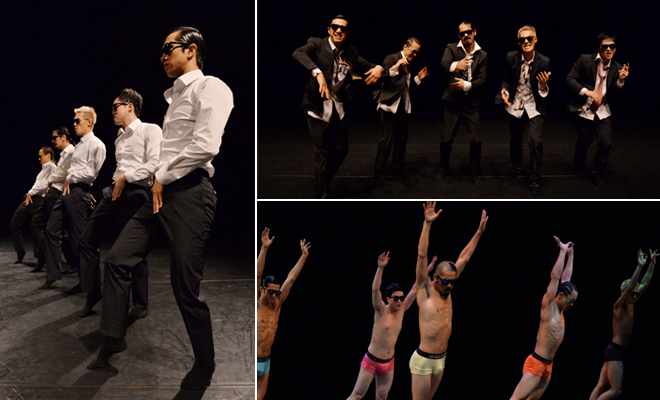
Kim : <Rhythm of Human> premiered at the 2013 Seoul Performing Arts Festival. All of the dancers happened to be male, and it seems to have become the <Rhythm of Men>. If I have the opportunity, I hope to recreate the piece with only female dancers. I think that human life has its own rhythm. I think that temporal and spatial changes to repetitive events create rhythm. What kind of dances do we dance in life? Free or not, everyone has rhythm within him or her. I wanted to understand that rhythm accurately and ride it freely. In my interpretation, a person is born naked and lives according to free rhythm until every aspect of his or her life becomes systemized through education. I think that even a person working at a company, competing with others in a formal setting, might find rhythm in his life.
Q : PAMS Choice will mark the beginning of much overseas activity for Ambiguous. What do you think is the greatest appeal of Ambiguous Dance Company to a foreign audience?
Kim : Our work is more communication than art, and is often described as having popular appeal. I think that the audience is responsive to the energy focused on movement and sound. It is art you can feel upon seeing, rather than seeing it with your head. I think that our performances are enjoyable even if we cannot convey everything I have in mind. I believe that the most important element of a stage performance is the audience. The same elements that appeal to a Korean audience seem to appeal to an overseas audience. Ambiguous’s current repertoire includes three pieces:<Rhythm of Human>,<Coexistence>,<Rhythm of Human>and<Mistake>.
|
| |
| <Rhythm of Human> on stage | |
Q : What are some of your plans for the future?
Jang : We will perform Rhythm of Human from November 25 to 29 at the 2014 International Dance Festival in Thailand. We will put on two performances, in Bangkok and Chiang Mai, and run a workshop. <Mistake> is scheduled to be performed at the Budapest Dance Festival from September 21 to 27, 2015. We are negotiating performances in Poland, Slovakia, Czech Republic, Lithuania, and Romania to make a tour. Independently, Kim Bo-ram will perform in A False Worship with Gada Project on September 13 at the Bukchon Music Festival, and I will participate as a guest in the performance of Tournament by the National Dance Company from September 17 to 20.
Kim : I am preparing for the presentation of Rhythm of Human on October 9 for the PAMS Choice showcase program. For the time being, we plan to assemble a repertoire by refining existing pieces, and focus on creating opportunities to perform them steadily. For a long time, we have been planning an event where we would be immersed in nature for two to three months and work with five or six visual and dance artists on creative projects.
ⒸAmbiguous Dance Company
|
2014 PAMS Choice <Rhythm of Human> - Choreography: Kim Bo-ram - Dancers: Jang Kyeong-min, Nam Hyun-woo, Park Si-ha, Koo Kyo-woo, Kim Bo-ram In every relationship between the body and dance there exists a specific rhythm. In every person’s life, there exists a personal rhythm, though one might not feel it. This piece expresses the sorrow of the modern individual, who has lost his or her own rhythm within the confines of society, and rides only the rhythm set by the world. A person belongs to society the moment he or she is born and must compete in order to survive. Reality dictates that a human must follow the systemized rhythm of society rather than dance to his or her own drum. He or she will agonize endlessly, seeking his or her own rhythm. The flow of human life forms a rhythm, and the moments of dance express the vicissitudes of life. Thus, dance transforms simple movements into expressions of life’s rhythm. Dancing is not only for dancers, for we all live as though dancing. Ambiguous Dance Company Ambiguous Dance Company was founded by choreographer Kim Bo-ram and dancer Jang Kyeong-min in 2008. The name of the group describes the “undefinable and ambiguous” characteristics of their dance style. Escaping from genres and preconceptions, the group expresses what is in their hearts through bodily movement and music. Rather than focusing on delivering an artistic message or meaning, they intend to convey the true nature and purity of humanity, believing that the bodily expression of music and dance form the most accurate and truest language. |
 PREV
PREV
.JPG)
.jpg)
.jpg)
.jpg)
.jpg)












;)


