





Sharing a Neatly Aligned Modernism
[PAMS Choice] Ground Zero Project Choreographer, Geon Hyauk-jin
A discussion with a young choreographer—who did not falsely believe that modernism was the opposite of classicism—went much deeper than anticipated. The conversation was refreshingly substantial, with more weight than what first met the eye. My belief is that the more deeply and broadly that classic styles develop, the more that modernism can shine freely. Choreographer Geon Hyauk-jin was well aware of this.
Q(Choi Jae-hun): Let’s start with the 2014 PAMS Choice selection, 〈Agape〉. PAMS Choice is targeted not at domestic audiences, but rather at market experts. What do you plan to tell them?
A(Geon Hyauk-jin) : Agape is about the seven sins in the Christian Bible. I always thought that, generally, people lose something fundamental in their ability to love through the sins they commit. But I also believe that a fundamentally supportive love is also what comes to mind at the end, when you’ve lost everything. So the first half of the piece features that which people generally forget about in their daily lives, and the last half is about absolute love.
Q : Your stage props aren’t particularly elaborate, but the symbols in your piece have so many varied meanings that I can imagine it must have been difficult to condense them all into a "showcase."
A : The painterly elements, music and various objects are classical, but I also wanted to keep everything naked and raw. I was motivated not by a desire to promulgate contemporary dance or to popularize it; rather, I wanted to create a story that I could be emotionally invested in, and to share that. I believed that I wouldn’t be able to properly share this if even a single element were missing, so I decided to use almost all of the symbols and stage props. Without the whole, I felt like none of it would be worth showing. When you’re talking about something like love, doesn’t it follow that you shouldn’t lie?
Q : Following the project’s admission to ’theDOT(Dance Off Theater)’ program, awarded to promising artists from the Seoul Foundation for Arts for 〈New World〉, 〈Agape〉 has a more religious feel. Is the nature of your projects undergoing an evolution?
A : I grew up in a Catholic household, and I expect that the influences of my upbringing must have naturally trickled into my work. But my intention wasn’t to talk about God or salvation through religion. Rather than intentionally inserting critical social commentary or religious elements, I tackled my own reality—my own lonely and difficult situations—and these chaotic conditions must have made their way into my work.
|
| |
Q : I presume the PAMS Choice will lead to overseas performances in the future. Tell me about the performances you’ve had outside Korea thus far.
A : Last year I went to Sofia Dance Week with Companionship, a piece I did with Han Seon-cheon. I’m also preparing for performances in Japan and France. In 2010 I won the Jury Prize at the Yokohama Dance Collection, and in 2012 I won the jury prize for the best choreography at the International Contemporary Dance Festival of the Canary Islands, MASDANZA. I also choreographed apiece called 〈Venus: A Blind Angle〉 for the Pori Dance Company(PDC) of Finland. In the latter half of 2014, I have a collaborative performance planned at Mary Hall in Sogang University with the Susanna Leionen Company of Finland, a connection that was possible through PAMS Link.
Q : It seems as though you divide your attention between assembling new pieces and recreating older pieces to add to your repertoire of performances. Can we hope for another run of 〈Agape〉?
A : In the sense that it comes from a place where I was most honest with myself, Agape is a piece that almost feels like a first piece. It’s one that I would definitely like to return to—after some time.
Geon Hyauk-jin, an artist that pivots around dance
Q : You were a track and field athlete in high school, and you’ve also done everything from modeling to acting in a musical. You’ve even studied film at the New York Film Academy. Frankly, I’ve always been curious: were these activities an attempt to escape dance, or a roundabout way to return to it?
A : All of it was for dance. The connections I made through other projects often led to collaborative opportunities in dance. Studying film was also an attempt to lay down a foundation for a future dance film, which I definitely want to pursue someday. Of course, in many ways I have far to go, but I believe that the more I know of different fields, the more material I have to work with in terms of what I can apply to my dance work. Looking back, I can say that most of these experiences were really projects to ultimately bring me closer to dance.
Q : You’ve been invited to participate in various performances, you have a corporate sponsor(JTI Korea), and, having won prizes for both your potential as an artist as well as jury prizes, it seems as though the experts, at least, have affirmed your talent as a choreographer. Would you agree that, if you also found popularity with the general public, it could lead to another huge leap forward for your career? What kinds of things are you doing to become more visible to mainstream audiences?
A : Discussions about the popularization of dance and the mainstream popularization of pure art are always difficult but important to have. I once stayed up all night in Yokohama with choreographer Ryu Jang-hyun and debated whether the answer was to bring pure art to mainstream audiences, or to bring mainstream audiences to pure art. We disagreed then, but I feel like at this point we’ve met in the middle.
|
| |
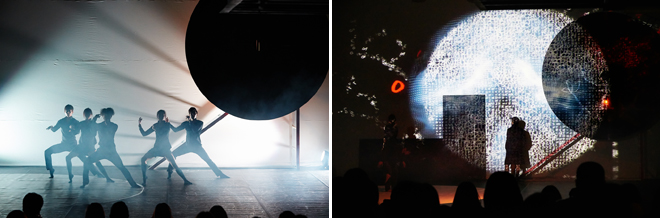
| the Seoul Foundation ’theDOT(Dance Off Theater)’ Selected works 〈New World〉 | |
Q : I have to mention the TV show Dancing 9. Would you say that widespread attention through mainstream media is more beneficial or more harmful to the choreographer?
A : I’m grateful that it did play a part in narrowing the gap between dance and the mainstream audience, but I do worry that contemporary dance will be misunderstood. I once went to the Théâtre National de l’Opéra de Paris to see William Forsythe perform. From a side seat on the third floor I watched the stage with my heart beating in anticipation. Then I saw an audience member from the VIP section stand up and leave after disparaging the performance. It turned out the audience member was a longtime fan that had been following William Forsythe for 10 years and had expressed his disappointment—for first time in all those years—in such a forceful way. Isn’t it a magnificent thing to have a fan like that? I want to be able to express the allure of dance to my audiences during such a time span. I don’t want to hurry, I don’t want my art being corrupted in the process, and I want my small audiences to grow little by little. For me, that’s what connecting with a mainstream audience means. But there’s no wrong direction. Every person simply has a different goal and a different road to travel on.
Q : You do have some pieces that seem to combine genres, but in terms of your choreography style or the development of your pieces, one gets the impression of classicism, of something neat and tidy. What is modern choreography to Geon Hyauk-jin, the choreographer?
A : This is an issue that surely every choreographer who does contemporary dance must grapple with. There are choreographers that achieve a contemporary feel and successfully experiment through a process of destruction and escape. But I do not attempt to forcibly remove what I have; I do like a well-organized stage. There are some who call me an "analog person that uses digital"—it seems that this inherent personality, these inherent choreographic methods, manifest as something classical. I always carry within me a longing for the old, the bygone.
Q : I’m also curious about how you got started. Was there a particular event that set you off on the path of dance?
A : When I was very young my dream was to be a professional baduk player, but I became a track and field athlete. This was when I was in high school. Then one day at daybreak I was training, and I was suddenly struck by the thought that I didn’t know why I was running. I felt like I was giving up too much for my training. Once, when I was dropping my girlfriend off at her dance school, the head of the dance school looked at my physical condition and recommended that I try out dance. Although I’d already decided to go to college as a track and field athlete, my curiosity was piqued. I started ballet, and it felt similar to track and field. The high jumps and frequent turns turned out to be helpful. I was ignorant about dance to the point where I wondered why dance wasn’t a category in the Olympics, but ultimately I fell for the peculiarity of contemporary dance and ended up there.
Q : Tell me about your first piece as a choreographer.
A : In college, I ambitiously wanted to create something immediately. My first work as a choreographer is a piece that ended up in the 2008 Yokohama Dance Collection. This was when I wanted to try everything, whatever it might have been. Looking back, my ambition then of wanting to do everything seems excessive. But it was all part of the process of trying to find my colors, trying to find out what I wanted to do. And, frankly, it was also a fact that there really wasn’t a stage in Korea where I could have my pieces shown.
Q : How did you come to create the Ground Zero Project?
A : I once met artists that worked in another genre for the sake of collaboration, and I noticed that each talked only about his role and his art, rather than the piece itself. I thought it was important that everyone was onboard for the process of creation from the beginning, and that the piece became smooth through this process. The Ground Zero Project began from that thought.
Q : I think of you as a choreographer that still has a lot up his sleeve. What are your plans for the latter half of 2014?
A : To be honest, I was a bit too ambitious in the first half of 2014. I heard a lot of criticism, and it has stayed with me in the form of anxiety. Through 〈Still Be Choreography〉, a performance with the Korea National Contemporary Dance Company, I began the process of conceptual research. Now I want to step back and reflect on the projects from two, three years ago, and let them ripen for a long while. I want to take plenty of time until the latter half of next year, when I begin conceptualizing my next piece.
|
| |
| Choreographer, Geon Hyauk-jin | |

ⒸGround Zero Project
|
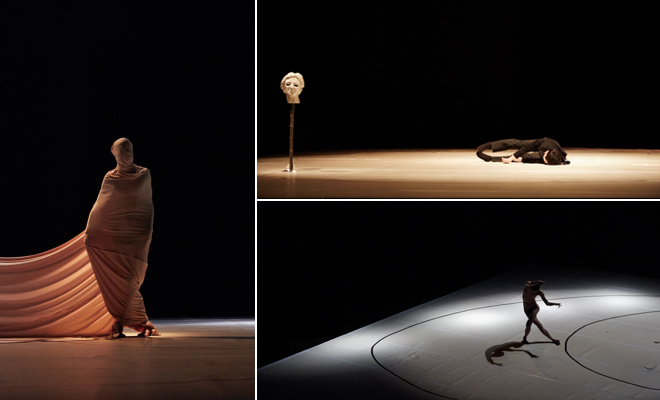
2014 PAMS Choice 〈Agape〉 This work presents the motif of “Agape,” the absolute and complete love of God toward mankind, through mise-en-scène usinga variety of objects d’art and stage art. The artist uses a language of performance that deploys the semiotic symbolism of the human body to reflect on the sinful nature of mankind and its desire for transcendence. Appropriating the iconography, symbolism, body diagrams, and images found in medieval paintings, the artist attempts to transform the planar composition of painting into a three-dimensional space. A new aesthetic is derived by converting pictorial images that used to exist in a fixed, planar frame into an eventful, temporal art form with performative and site-specific elements. The weighty themes inhering in medieval art―humanity’s desires, its fallen state, and the hope of salvation―are pursued through the meditations of the individual artist, yielding art that is both personal and representative of the yearnings of our contemporary era. The work is grounded in religious and metaphysical themes but finds a way to render these perennial themes relevant to secular life in the present, inviting contemporary reflections and reinterpretations. GROUND ZERO Project The “GROUND ZERO Project” is a multi-genre art group led by choreographer Jeon Hyeok-Jin. With a focus on contemporary dance, the project engages in collaborations with artists in various fields including interactive art, string quintets, installation art, and film and has staged successful performances in Korea, Japan, and Europe. The group presents joint projects with artists in a wide variety of genres including contemporary dance, interactive art, installation art, and film. It approaches subjects that address contemporary concerns from diverse perspectives and presents works that stimulate contemporary sensibilities through the group’s unique and witty dramatizations and use of dynamic techniques. |
 PREV
PREV
.JPG)
.jpg)
.jpg)
.jpg)
.jpg)












.jpg','A discussion with a young choreographer—who did no..');)


