





The Rich Reverberations of Humanists who put People First
[PAMS Choice] Black String
Black String is an instrumental band that has its foundations in traditional Korean music and improvisation, borrowing from jazz. The group consists of members Heo Yoon-jeong on the geomungo, Lee Aram on the daegeum and sogeum, and jazz guitarist Oh Jean. The group has been expanding its musical horizons with the occasional addition of percussionist Kang Min-su and jazz drummer Shin Dong-jin, depending on the nature of the piece. I met with the three members of the group, one that is sharing the sonorous melodies of Korean music with the world, and discussed with them the past and future of Korean music.
The Geomungo—Sounds from Outer Space
Q(Kim Gwang-hyeon) : I would first like to begin by asking about the name Black String and what it means.
Heo Yoon-jeong(Geomungo, henceforth "Heo") : The geomungo is also known as the hyeongum, with the Chinese characters for "hyeon" meaning black, and "geum" meaning a stringed instrument. Geomungo essentially means the same thing in pure Korean, and in that sense Black String also naturally refers to the geomungo. However, "black" is also a layered term in the East, a word that suggests the endlessness of space. In the same way, "string" refers to stringed instruments, but at the same time it also refers to the continuous, melodious, string-like aspect of Korean music. It suggests dynamic curves as opposed to halting lines, and a sound that wanders in unexpected directions.
Lee Aram(Daegeum, henceforth "Lee") : Unlike the geomungo or guitar, the daegeum is not a stringed instrument. But when non-Koreans listen to the sound of the daegeum, they hear more yin (shade) than yang (sunlight), and so I think it also fits in quite well with the "Black" of Black String.
Q : Your group consists of two traditional Korean musicians and a jazz musician. How did you all end up together in Black String?
Black String(henceforth "Black") : Black String was founded in 2011 as part of the UK Connection project, a cultural education and exchange program between Korea and the UK, sponsored by the KAMS. At first we met with promoters and musicians in the UK and looked for musicians that could collaborate with musicians here in Korea. At the time I was involved in the Tori Ensemble with Heo Yoon-jeong. That’s about when we started talking a lot about new kinds of sounds. Even right before going to London I had no idea if Black String would last, but somehow I was able to connect with the musicians, and all that brings us to today. We also got to participate in MosaiKOREA, a performance team with the touring program from the Korean Overseas Information Service in the Ministry of Culture, Sports and Tourism.
Q : I heard that your overseas performance was successful. I heard that your overseas performances were successful.Please talk about what you have been doing since then.
Heo : Through UK Connection, three Korean musicians and four British musicians were able to perform together at the EFG London Jazz Festival and in Poland. In 2013 we were invited to the Oslo World Music Festival and the Penang Island Jazz Festival in Malaysia. Most of the time foreign festival promoters invite us after seeing us in Korea.
|
| |
| Black String | |

Q : Black String is likely often seen as world music or crossover music due to its combination of traditional Korean music and jazz. What do you think about this, and how do you see yourselves?
Oh Jean (Guitar, henceforth "Oh") : There are many genre names, from contemporary traditional Korean music to contemporary Korean traditional music, but our basic position is not to define our genre.
Heo : The fact that the festivals we’re invited to include both world music and jazz seems to indicate that Black String is already flexible in terms of what genre it belongs to. Defining genre is important, but for us the process of arriving at a certain unity in our music is more important. As you can see at a glance, the defining aspect of our group is not in the superficial combination of jazz and traditional Korean music, or Western and traditional music, but rather in the genuine fusion of the individual musical styles of our musicians. Thus the final piece comes out differently according to how the music within me reacts to the music within others. For example, we don’t want to collaborate with Jean because he plays jazz, but rather, we want to connect with Oh Jean the musician and draw what we need from all of the musicality, musical experiences and feelings that come with working with the musician.
When You’re Looking for a Solution, You End Up Meeting a Person
Q : There have been many attempts at combining traditional music with jazz, but it’s not an easy task. What would you say are the most difficult aspects?
Oh : Conversation. And that’s important, because the most difficult thing is striking the right balance between teaching, learning and letting go, because when music meets music, it’s really about people meeting other people. And unless you find a good way to communicate through all of this, it’s difficult to get good results. In the case of Black String, our personal relationship with each other helps us to make good music together and communicate well, thus helping us to maintain a good balance. In my case, for example, because the rest of the group thinks that more bass is appropriate for traditional music, I’m planning to take some time to learn that area; I think there’s a lot of room for learning.
Heo : There have been countless collaborations and attempts at fusing these two genres. But why have they never been able to produce good music up until now? There were some good projects from time to time, but nothing that made one say, "This is it!" This can be seen as an issue of method, but I always thought the solution was in the musicians themselves, so I concentrated on people. If a certain musician has played for 30 years, then the sum of everything he has learned is the musician, himself. I’ve collaborated with Southeast Asian traditional musicians and have been involved in ensembles that combine Western and traditional Korean music. But whatever the instrument and whatever the group, what I aimed for each time was always the same. I always believed that the solution was within the musicians themselves, and aimed to identify what it was. Of course, that could just be a personal inclination of mine, and I don’t know how these projects will be judged either, but at the very least I can say that that’s how I’ve tried to approach music with Black String. I do believe that sticking to this approach will bring me the answers at some point.
Q : You were selected at PAMS Choice. Now all you have left is to perform, and perform, and perform. I suppose the key question is how much you will be able to perform overseas. Jambinai, for example, selected in 2012, remains active to this day.
Heo : I’ve seen the work that Jambinai does but I believe that their role differs from ours. Jambinai is youthful, has the attention of a certain market, and is working towards overseas success as a goal. But for us the PAMS Choice selection is simply an extension of a career of 20 years in making music, something that slightly improves our environment and increases the number of options we have. I see our mission as playing significant performances that leave a lasting impact, rather than achieving a certain number of performances. This includes playing good shows, collaborating with good musicians, performing onstage at good theaters, and creating connections with them.
|
| |
| Performing at the Penang Island Jazz Festival in 2013 | |
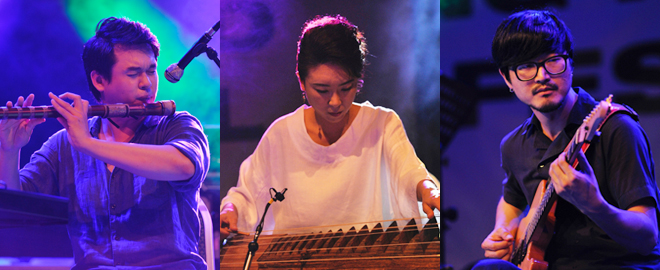
If we abandoned our prejudices and gave in to intuition
Q : I’m curious about your reception overseas. Isn’t the geomungo in particular unfamiliar to foreign audiences?
Heo : Whether it’s the haegeum, daegeum, or gayageum, most of these traditional instruments have a similar counterpart in each country. But because the geomungo is a sound that they haven’t yet experienced, audiences frequently react very intuitively to the music. And when audiences see the geomungo, they frequently assume that the music will be traditional music—historically significant music—but they are surprised when they hear an avant garde, contemporary sound instead, and we do deliberately attempt to create this twist in our performances.
Lee : The daegeum does have its counterparts, but the addition of cheong, or a buzzing membrane made of reed creates a sound unique to the daegeum, and so it inspires its own share of amazement and wonder. But even when people are amazed by a new sound, they look around for similar sounds and how the new and wondrous sound resembles that of instruments they’re already familiar with. And when you really get down to the essence of music, you also get the feeling that audiences are curious about the musician’s cultural background, and what kind of story they’re trying to tell.
Q : A continuous approach seems to be important to this kind of avant-garde music. And for that, I would imagine it’s difficult to perform abroad without the support of your own country.
Heo : It’s been the subject of debate for a while, but it’s difficult to create a domestic market for traditional Korean music. And this applies not only to traditional Korean music, but also to any niche genre. Our music isn’t audience-friendly. The moment we create music while anticipating an audience, it seems obvious that the music will go in a particular direction. Often, Korean audiences will shut off their intuition and only listen to traditional music through their preconceived filters. I believe that history and environment make that inevitable. Music is not tangible, and when the music itself is abstract, it’s true that it can be difficult for some people to appreciate. But as hard as it is to appreciate, it has that much more value which should be appreciated. In the Korean educational system or the cultural environment, creativity and uniqueness are frequently suppressed, but I believe that Black String can play a role in encouraging those values to emerge. At the theater I currently manage, the Bukchon Changwoo Theater, I aim to host a regular series of jam sessions for traditional Korean musicians. This kind of interest and a subsequent need are beginning to arise within the traditional Korean music community too.
Q : I’ve heard that head of engineering, Gwak Dong-yeop , is always involved in the work.
Heo : It was only possible to capture the sound of the geomungo because of consistent communication with the engineer. Within the industry we say that anything is possible with traditional Korean music if you solve the problem of sound for the geomungo and the janggu. This is an area that even experts in traditional music sounds have difficulty with.
Black : A performance needs to include the performers, the planners and the technicians. When domestic groups go overseas, there’s often insufficient preparation when it comes to transportation, as well as difficulties in communication. Gwak participates in all of the performances and does not spare himself in creating the best possible sounds, and he identifies with what is needed by all of the musicians.
Q : What do you have in mind for the future?
Heo : We have a collaborative project with a media creation group called the Oblique at the upcoming Jarasum International Jazz Festival in October. It’s not just us, but I think it will be a meaningful performance. With regards to Black String exclusively, in December we have a solo recital of new pieces, and next year we have a few performances overseas, including one in Germany.
|
|
|
|
| Lee Aram_Daegeum | Heo Yoon-jeong_Geomungo | Oh Jean_Guitar |
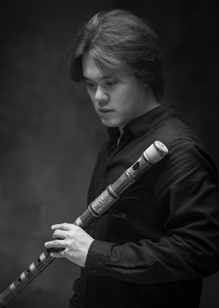
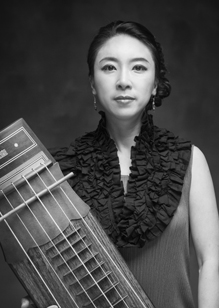

ⒸBlack String
|
2014 PAMS Choice
Black String - A New Sound full of Intensity, mystique and beauty. Black String aims to achieve a new sound that can internalize a variety of musical expressions through traditional music, as well as harmonize with other expressions in world music. Such a sound could be reinterpreted by artists who embrace traditional music along with jazz, and respond by reflecting it throughout various creations, be they composed or improvised. Black String especially focuses on improvisation as an important aspect of Korean traditional music and attempts to create a unique language through Asian intuition and musical idioms. The music of Black String is based on Korean musical traditions, and offer audiences a fresh, new sound. They also offer an experience that broadens the palate of world music audiences by presenting an “ancient” tradition within a modern setting. Black String World-music band, Black String, was founded in 2011 as part of a government sponsored Korea-UK cultural exchange program known as the "UK Connection" project. The band consists of Heo Yoon-jeong (Geomungo), Lee Aram (daegum and yanggeum) and Oh Jean (Jazz guitar). Since forming they have expanded their musical horizons by teaming up with prominent Korean artists such as Kang Min-su (Janggu and vocals) and Shin Dong-jin (drums and percussion). The music of Black String is based on Korean musical traditions, and offers a fresh, new sound. As musician Black String always seeks to lend an experience that broadens one’s appreciation of world music, presenting an ancient tradition within a modern setting. |
 PREV
PREV
.JPG)
.jpg)
.jpg)
.jpg)
.jpg)












;)


