





Extending Park Woo-jae’s Geomungo
[PAMS Choice] Beondi : Geomungo Player Park Woo-jae
〈PARK Woo-jae Geomungo Extension〉’s protagonist Park Woo-jae is a former colleague of mine, having performed with me in the Korean music ensemble Baramgot. Although Baramgot’s individual members now do their own thing, I’ve continued to work with him on occasion. We convened on this occasion as interviewer and interviewee, giving me a chance to hear about his new projects as well as chat on a deeper level.
Park’s work as a Member of Baramgot and with Dance Music
Q(Park Jae-rok) : Let’s hear about the Park Woo-jae before the Park Woo-jae Geomungo Extension gig—let’s say, back in the Baramgot days.
A(Park Woo-jae) : I first met Director Won Il as a student when I started attending Korea National University of Arts, where he was a professor. Director Won Il was the conductor of an orchestral music class, and I was just one of several students studying the geomungo(a Korean traditional six-stringed zither). I was interested in dance back then, too, and since the LG Art Center just opened I would often go there to see performances and, oddly enough, run into Director Won Il—and that’s how our relationship started. Director Won Il was working on forming a new Korean music ensemble, and I ended up being scouted as a geomungo player. He wanted an ensemble that would retain a traditional base but rewrite the boundaries of sinawi, a traditional form of Korea’s shamanic music, and I had similar aspirations of experimenting outside the standard traditions, making us the perfect match. This union later developed into Baramgot.
Q : Didn’t you work with a lot of modern dance choreographers during your time with Baramgot?
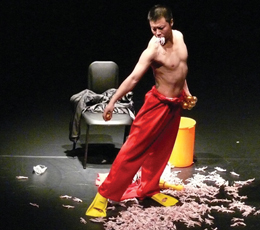
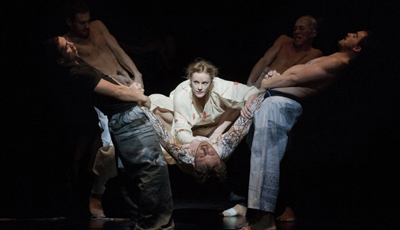
A : After meeting modern dance choreographer Kim Nam-jin, who’d done a lot of work in Belgium and France, I became familiar with his work and eventually became the musical director for one of his projects. While working on a production with Belgian dancers for a Korea-Belgium intercultural relations event, he introduced me to Sidi Larbi Cherkaoui, who was in town and with whom I’ve kept in touch since. After a few schedule conflicts I managed to get a spot as a musician in a production of his called 〈Tezuka〉, a performance that embarked on a world tour thanks to the joint investments of EastMan(Cherkaoui’s company), a Japanese theater called Bunkamura, and an English theater called Sadler’s Wells. I’m also currently involved in Cherkaoui’s new production, 〈Fractus〉. It’s in the works right now, and is scheduled to start its world tour in Belgium next year.
|
|
|
|
▲Production of 〈Crazy Swan Lake〉, a Dance Theater CHANG production, in collaboration with choreographer Kim Nam-jin |
▲ Park Woo-jae, who partook as a musician in the production of 〈Tezuka>ⒸEastMan |
Q : What are the merits of working with a choreographer?
A : Every choreographer has his or her own way of working. My work with Cherkaoui had me collaborating with several other musicians. Production took the form of musicians from various countries crafting music according to each scene, with each musician actively and independently expressing his or her opinion. The production with Kim Nam-jin in Korea was especially inclusive, even permitting me to intervene in stage direction, turning my role into that of a musical director. Although it’s different from what I normally do, witnessing something I want to express musically appear before the audience visually—therein lies the beauty of dance.
Extending Park Woo-jae’s Geomungo
Q : Let’s talk about your own work. Would you mind introducing your concert for this year’s Performing Arts Market in Seoul (PAMS), 〈PARK Woo-jae Geomungo Extension〉 ?
A : I suppose a better way to explain 〈PARK Woo-jae Geomungo Extension> would be to simply describe it as "adding something to Park Woo-jae’s geomungo." That "something" is a new discovery about the geomungo, whether it’s a new sound or technique, even an electronic addition such as looping or overdubbing. Although there’s only one Park Woo-jae playing onstage, techniques like overdubbing or looping can make it sound like there’s four Park Woo-jaes, or even a hundred! For this performance I’m going to play various pieces that I did for the concert I did at the beginning of this year—〈PARK Woo-jae Geomungo Extension : Morphosis〉—such as 〈Passivity〉, 〈Elation〉, 〈Drifting〉, 〈Morphosis〉 and 〈Caress〉.
Q : Your music is different from Korean classical music or that of other professional composers. How do you usually compose your pieces?
A : My music usually begins with one of two things. Sometimes I start with an unseen image, and sometimes I begin with a new sound or technique. During the finishing stages, I picture the image or narrative that I want to create in my listeners’ minds and adjust the pace accordingly. I think my unorthodox approach to composition is both my strength and weakness. Rather than a concert where all the focus is placed on a single soloist’s skill, I want my performances to express a plethora of various colors and textures, one where the music doesn’t communicate just one fixed image or narrative. Through composing and performing I want to give my audiences freedom of imagination.
|
|
|
|
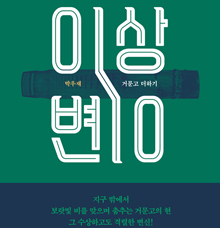
▲ A poster of the concert〈Park Woo-jae Geomungo Extension: Morphosis〉 |
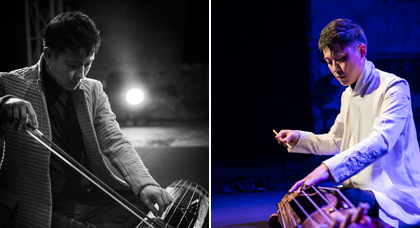
▲〈Park Woo-jae Geomungo Extension〉concert |
Q : The creative new ways in which you play the geomungo—escaping traditional methods by playing with a bow or by using the stroke1) method; even utilizing electronic effects—has always left a great impression on me. Why are you so interested in finding new and different ways to play?
A : I found that I enjoy experimenting. At first, a lot of it was just for kicks or completely coincidental. Eventually, what started as harmless fun developed into the techniques and style that I use today. For example, 〈Morphosis〉, a piece I’m performing in the upcoming show, is the result of an interest in different acoustics and electronic effects, such as sound effectors(an electronic device used to synthesize sounds to alter them), that developed during my days with Park Jae-rok and Baramgot.
1) a technique of playing the guitar in which the performer strikes or strums several strings simultaneously
Q : Was it because you felt certain limitations or boundaries after so many years of playing the geomungo?
A : No, it’s not like that. It didn’t start from a need to expand upon the geomungo’s identity or surpass some kind of boundary—it was just a personal fascination. Instead of just discounting the fun ideas I gathered during my musical trials as invalid, I’d focus on them more and further develop them.
Q : Did you experience any limitations during your new undertakings?
A : Experimenting with a new technique means going through a process of trial and error. Because I was classically trained to play traditional Korean music, stepping out of that box required a lot of effort. Even the techniques I use now need to be further developed and refined, something I need to keep working on.
Park Woo-jae : Using the Geomungo as a Creative Musician
Q : Although you’ve accomplished a lot in your career, I’m willing to bet you have new aspirations. What are your plans for the future?
A : I want to play a few more concerts that expand upon the concept of "geomungo extension." I want to cooperate more aggressively with the energy that sounds carry to create music that is modern, music that expands upon the geomungo’s borders. You could say I’m working on music that redefines what traditional geomungo music is. I want to reinvigorate what’s considered a static musical tradition in my own way, expanding on orthodox inflection techniques known as sigimsae(a technique used by traditional zitherists of inflecting end notes) without imitating those of Western music, creating a new style of play that still stays true to geomungo’s principles. I’d also like to continue working with artists from other genres, starting with choreographers, to develop myself as a musician. I don’t want to just perform musicon the geomungo- I want to use the instrument as a creative musician.
Q : Are these plans currently in the works?
A : Everything that I want to do is in the works. In that sense, I’m a happy person.
Q : What kind of musicians do you want to be in the far future?
A : There’s trend in the Korean music community these days to preserve the tradition while seeking new deviations. Perhaps what I’m doing is just another one of such deviations. However, I want to be remembered purely as someone who sought something new. Don’t you think the Korean music community needs at least one person like that?
|
|
|
| ▲ Park Woo-jae, GeomungoPlayer | |
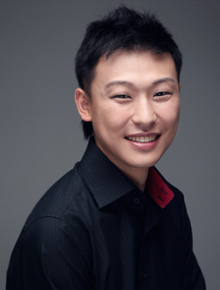
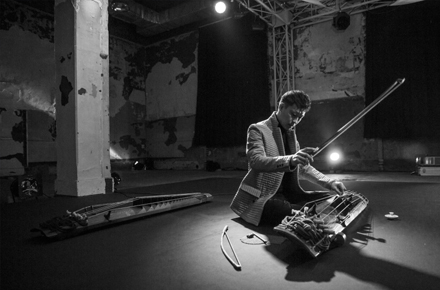
ⒸBeondi
|
2014 PAMS Choice
〈PARK Woo-jae Geomungo Extension〉
〈Park Woo-jae Geomungo Extension〉 is an eclectic concert that’s revolutionized geomungo music and elevated it to the world stage with four songs—〈Passivity〉,〈Elation〉,〈Morphosis〉and〈Caress>—displaying Park’s unique stroke technique and bow utilization that transforms the geomungo from an instrument you pluck into one that reverberates with the strokes of a bow. Park Woo-jae’s geomungo fuses with the sound design of music director Kim Byeong-geuk to form a free-flowing style of play that’s never been witnessed before, where the sounds of a single geomungo onstage intertwine with pre-recorded tunes refined through sound design techniques to deliver several musical layers to the audience: a far cry from the standard performances that simply play a recording—in a class all its own. Offering audiences a chance to experience a brand new world of geomungo music through Park’s manifold techniques and experimental sounds,〈Park Woo-jae Geomungo Extension〉has enthralled musical circles since its launch in February 2014. - Performance Arts Consulting Group Beondi Performances Arts Consulting Group Beondi: Beondi is a professional music agency with a foundation in traditional music that works in the planning and production of concerts in traditional music, world music, and various other genres. From geomungo master Park Woo-jae to Baramgot, Park Soon-a, Kim Hyo-young, Jung Min-a, and several other great talents, Beondi works to uncover skilled musicians and show them to the world. - Park Woo-jae Park Woo-jae is a composer, music director and geomungo artist. He has crafted his musical world by pushing the envelope while subverting tradition and convention. He challenges the limiting definition of the geomungo as a traditional instrument, creating unique techniques such as his stroke method and the his bow utilization. Although the geomungo is known as a traditional instrument, Park Woo-jae cooperates with renowned contemporary dance choreographers, including Belgian artist Sidi Larbi Cherkaoui. Park’s Europe tour is scheduled for 2015. |
 PREV
PREV
.JPG)
.jpg)
.jpg)
.jpg)
.jpg)












(0).jpg','〈PARK Woo-jae Geomungo Extension〉’s protagonist Pa..');)


