





Crispy New Cultural Content
[People] Heo Seong-il, Chairman of Cultural Content Planning-Production Corporation, Toastor
This past winter, Disney’s animated movie 〈Frozen〉 was a sweeping success in theaters worldwide. With over 10 million tickets sold, 〈Frozen〉 fever ran well into spring, and the film now holds the record for all-time highest box office in the animated film category. Its presence spread from the theater into several other areas. Idina Menzel’s performance of the song “Let it go” featured in the movie was a hit, the official soundtrack topped the music charts, and related books became bestsellers, a ground breaking feat for an animated film.
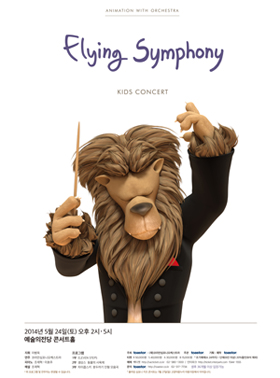 |
Animation has also begun to make its way into the world of classical music performances. At the center of attention is the Toastor production, 〈Flying Symphony: Kids Concert〉. The 〈Flying Symphony〉 is a production featuring musical performances of ’s “The Nutcracker” and Saint-Saëns’ “Carnival of the Animals” accompanied by animated sequences designed especially for each piece. The concert will feature the Korean Symphony Orchestra’s Lee Byeong-wook(Christopher Lee) conducting, as well as pianists Cho Jae-hyeok and Lee Hyo-joo. I met with the chairman of Toastor before the show’s first performance on May 24 at the Concert Hall at Seoul Arts Center. |
|
Poster of 〈Flying Symphony〉 |
Adding to Live Orchestra with 3-D Animation
Q(Ryu Tae-hyeong): I see thatyou studied business administration in the United States. How did you end up working in the film industry after graduating?
A(Heo Seong-il) : I was born in Korea and went to the States with my parents in the sixth grade. My father was a computer science major there. After I graduated, I had a brief stint working in finance for about two years. It was not at all what I had thought it would be, which led me to think I could not do this kind of work for long. I did not immediately go into the film industry after; I travelled a lot. Travelling across Europe and India by myself gave me the courage to try doing what I loved, and what I loved was movies. Even before I started working in film, I never missed out on watching new films opening in theaters.
Full of resolve, I entered Myung Films (“MK Pictures“ at the time). Without any education in film, English was the only thing I knew well. I started out in the overseas business team and learned about film on-site. Then, I was put in charge of production investment of Korean films by 20th Century Fox. We (the company) make Korean films using actors, directors, and scenarios from Korea. One of the recent films 20th Century Fox has participated in is the 2013 work “Running Man,” with Shin Ha-gyun in the lead role.
|
|
|
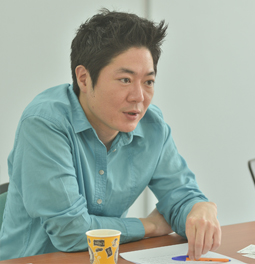

Q : What was it that led you to get into classical music production while in charge of production investment for the Korean film division of 20th Century Fox films?
A : I met Toastor’s CEO, Kim Seung-ju, during my travels in India—we hit it off. I was vthe first to suggest starting a business in classical music performance content. In the beginning, he was the musical director in charge of both the planning and production of the 〈Korean Symphony: Kids Concert〉 from 2012 to 2013.
Q : What kind of work does Toastor do?
A : As you might have guessed, our name comes from the toaster appliance, except the spelling of our company’s name, “Toastor,” is slightly different. We thought of the name to express our desire to create programming that was as fresh and crisp as bread taken straight out of a toaster. We want to make universal cultural products that include classical music. 〈Flying Symphony: Kids Concert〉 is our first project, our first at bat as a fusion of classical music and animation.
Q : 〈The Flying Symphony: Kids Concert〉 opens on May 24 at the Seoul Arts Center. As you said, it is a combination of classical music and animation. Although we have seen this combination before in Disney’s 〈Fantasia(1940)〉, this is the first effort we have seen in Korea. How was this project organized? What unique characteristics does 〈Flying Symphony〉 have?
A : 〈Fantasia〉 is an extraordinary work. It seems there were many similar attempts made following 〈Fantasia〉. After its release, many of the new ideas that came out would somehow involve the application of creative editing to film. We started by first selecting the musical pieces. Then, using our own re-interpretation of the original score we created new characters to fit the music and then produced the animation. Also, while 〈Fantasia〉 was made to play on theater screens, our 〈Flying Symphony〉 does not add a recorded music track to the animation, but instead has a live orchestra performing the pieces.
Bringing Missed Analog Sensibilities into the Digital World
Q : Considering the characteristics of Korean movie audiences and of classical music concert goers, what did “Flying Symphony” place its focus on?
 |
A : The largest demographic of movie audiences in Korea is women in their 20s. With the growth of Korean film, the affection towards it was greater than expected. Unlike in the past where marketing was necessary, [nowadays] if the quality of your product is high people will seek it out through positive word of mouth. In short, the content itself must be good. We have high expectations for classical music in this respect as well. Though there are all kinds of programs and stories out there for children, we wanted to create something that stands out from the rest by combining animation with something we can do well and have confidence in. |
|
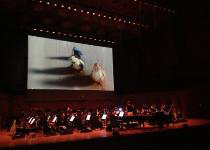
〈Flying Symphony: Kids Concert〉 live in the Concert Hall at the Seoul Arts Center on May 4, 2013, photo Source_Toastor |
First and foremost, the children must like it, and it should be an engaging experience for the entire family. Our aim is to make quality content that children and their families can all enjoy together while experiencing and appreciating music.
Q : What was the reason for selecting “Carnival of the Animals” and “The Nutcracker” to use as the basis for the 〈Flying Symphony〉 score? Also, when using these to create the animation, which parts were emphasized?
A : During the 2012 and 2013 performances of 〈Kids Concert〉, the Korean Symphony Orchestra oversaw the production while Toastor took part in the production of the animation. At that time we dealt with “Carnival of the Animals” and Rimsky-Korsakov’s “Shéhérazade” The reaction was tremendous. It started as a project by the Korean Symphony Orchestra to draw in new audiences and create kid-friendly entertainment, but we worked so well together that our company, Toastor, continued working with them for further development. We put effort into finding music that would fit well when mingling with video. We also wanted to choose pieces that were familiar to both the children and their parents and can be enjoyed by the entire family. It will be a display of unique character establishment and interpretation.
“The Nutcracker” was also used in the 〈Barbie〉 animated film series (2001). That series used motion capture of ballerinas, but we wrote a summary and developed a plan for our production that would use a storytelling format, so the music acts as dialogue as it flows out and stimulates the children’s imaginations. “Carnival of the Animals” does not just lay out the animals one by one, but looks at it as one big picture, and we can use a storytelling approach as the tale unfolds. With nothing to work off of, we made the character design and story with its own universe. Each animated segment is 25 minutes long, for a total runtime of 50 minutes. A lot of time goes into the production of the animation. Short on time and manpower, we had to make it up by working overtime and pulling all-nighters. When making our first piece, we used the know-how we had at that time and the combined efforts of our staff, giving our all to create quality work.
|
|
| 3-D The lion, mule, and pianist characters of Saint-Saëns’ “Carnival of the Animals” reinvented through 3-D animation, photo Source_Toastor |
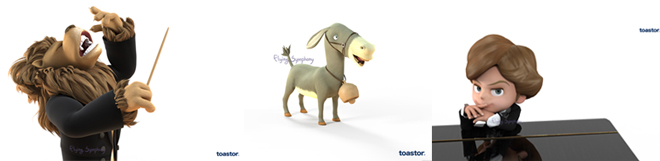
〈Flying Symphony〉 is a type of universal content. Works made with Korean dialogue require the viewer to understand Korean, but this piece has no lines and relies entirelyon the animals’ movements and the accompanying music. It is more accessible because it breaks through language barriers.
Q : What difficulties did you face while bringing “Flying Symphony” to life? When you faced these things, what gave you strength?
A : Since we are in pursuit of creating new kinds of entertainment, it has been difficult to spread the word about our business before anyone actually sees the product. Animation in and of itself is a field that requires heavy investment, so with this package it was not a simple task. It also makes it hard to enter the market without an existing platform. However, this was something I also felt when working in film. As the world progresses to become more and more digitalized, we come to miss analog. Two-way communication is beginning to be hailed as more important than unilateral. Even the recent rise of festival culture in Korea—and its corresponding emphasis on in-person experiences—is related to the demand for analog and this kind of communication.
Q : What was the experience like as you transitioned from the film industry into classical music?
A : That there are audiences out there who love classical music. However, the barrier for entering the market is considerably high for ideas trying to break new ground. It is still quite a conservative world.
Q : How does the marketability for “Flying Symphony” seem? What will Toastor focus on after this?
A : DVD sales have substantially dropped. However, with the invention of great formats like IPTV, the VOD market is growing. If we are able to secure a place in overseas markets as producers of content that overseas orchestras can use in performances for families, then it can be another form of Hallyu. There’s a lot of interest in entering foreign markets. We are both curious and look forward to what kind of reaction we will be met with there. If this business had focused solely on classical music concerts, it would have never begun. Using performances as a starting point, we want to try a variety of things through a one-source, multi-user format. Though it is appealing as a digital offering, for now we want to introduce the 〈Flying Symphony〉 brand, putting on one or two productions each year. By adding up one by one, our aim is that the shows will not be limited as standalone works but as pieces of a larger picture of a
◎ Photographer_Park Chan-hyeon (Chad Park)
 PREV
PREV
.JPG)
.jpg)
.jpg)
.jpg)
.jpg)












.jpg','This past winter, Disney’s animated movie <Frozen>..');)


