





Reality Hidden behind the Numbers –〈100% Gwangju〉 by Rimini Protokoll
[People] Stefan Kaegi and Helgard Haug
Last May, Last May, Rimini Protokoll’s〈100% Gwangju〉, which had been produced by the Asian Arts Theatre to be opened inside the Asian Culture Complex in 2015, premiered in Gwangju and Seoul.〈100% Gwangju〉 is part of the serial project called 〈100% City〉 performed by Rimini Protokoll, a Germany company which is taking the lead in the documentary theater. Gwangju became the 15thcity to be chosen for the company’s project. This work codirected by Helgard Haug and Stefan Kaegi is a large-scale social participation performance. For this, 100 citizens are selected based on the demographic composition of a given city and they tell their own story.〈100% Gwangju〉is no exception; 100 local citizens of Gwangju were chosen based on their age, gender and hometown, to tell the audience what Gwangju City is all about. Since the first performance of〈100% City was presented in 2008 at Hebbel am Ufer Berlin (HAU1), it has travelled to other major cities in the world such as London, Paris, Brussels, Melbourne, Tokyo and Vancouver, drawing great attention. It is the third time for Rimini Protokoll to perform in Korea after〈Call Cutta〉and the semi-documentary play〈Karl Marx: Das Kapital, Erster Band>. The Company has been known as connecting people’s daily lives to Dramaturgie from a socio-scientific perspective, thus reflecting on both drama and life. The title〈100% Gwangju> is composed of a number, which symbolizes statistics, and Gwangju, which symbolizes Korea’s modern history. However, what makes the work impressive is that it actually shows the “present” instead of the “past,” “life” instead of “numbers,” and “us” instead of “anonymity.” Helgard Haug and Stefan Kaegi tell us about the power of their series〈100% City〉, which is being upgraded while traveling around the world, and the unique attractiveness of〈100% Gwangju〉.
Redefine the Theater with Experts from Our Daily Lives
Q(Nam Ji-soo): As Rimini Protokoll presented three performances in Korea, your name is no longer unfamiliar to Korean theatre-goers. Would you explain the meaning of the unique and interesting name of your company “Rimini Protokoll”? We suppose from the word “protokoll” that you aim to go toward the so-called “documentary theatre.”
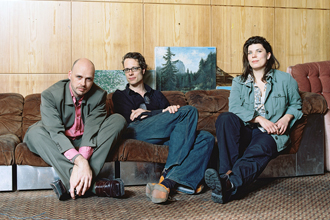
A(Helgard Haug and Stefan Kaegi) : We are three artists that are working in various constellations together – Rimini Protokoll is the label we are using to communicate all projects that one, two or all three of us are creating. Our main common interest is to stretch and re-define the definitions and limits of the theatre. The output can have diverse forms. We often start projects like journalists by studying a certain topic, meeting interesting people to talk to and often find our protagonists through this process. They will finally be on stage to perform. All this is often described as the “documentary theatre” but we also always mix reality and fiction in our plays...
We have been to Rimini only once but the Italian City sounded good when it was combined with protocol: something we write, study and are interested in.
|
|
|
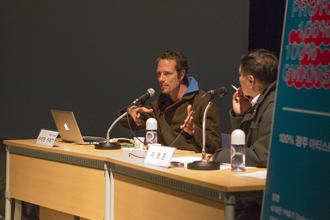
| (Left) Rimini Protokoll gathering together Daniel Wetzel, Helgard Haug and Stefan Kaegi. All three of them studied applied drama at the University of Giessen in Germany | |
Q : The fact that you cast “experts” and you use “verbatim method”1) in your works may be constitute the most interesting theatricality in your works. In particular, it is very interesting that you cast the ones whom we do not usually have chances to meet, let’s say that the ones who work in special a field or who are in a quite unacknowledged status. It seems that casting is not totally easy. Regarding this, would you explain the general process of producing your works?
A : The “casting” is the most important research period for our plays. When we started to make theater, as students, we were bored by what was happening on the conventional stages in Europe at this time. It felt very artificial, based on skills but not on content, it felt as well being detached from reality and the lives of the audience. There was a big distance between what was happening on stage and the people’s life. In reality, there were so many interesting stories to tell and we knew that theater can be a great communication tool for this, if only you take communication with the audience seriously. This is how we started – we realized it is very exciting to also reflect on people’s role – to ask them to perform in reality – the role of a politician, policeman, nurse, elderly persons reflecting on their lives, intellectuals talking about their access to Karl Marx’s The Capital... and so on – the list is long... People are actually very open for a talk with someone who comes to meet them. – I guess it is an unusual way of reflection and most people enjoy it.
The next step in the artistic process is then to see if this person would be a good partner for a theater-production. One of the criteria of a good partner is his or her willingness to take time off for the performance.
1) “Verbatim,” which means “literally,” refers to a style that is about using materials such as interviews and documents to show exactly what has been studied so that the concent can be as close as possible to reality.
Relay Casting Tells Us What Social Networks Are
Q : Your cast is large because you cast 100 people for your project 100% City. I suppose that you need to change some ways, more or less, in your rehearsal with these experts.
A : The 100% city project uses a slightly different method. Here we are looking for 100 people that (in terms of five demographic categories) represent the city. We choose a starting figure, often a person working in the field of statistics – and ask this person to link us to another person that fits the categories.
|
|
|
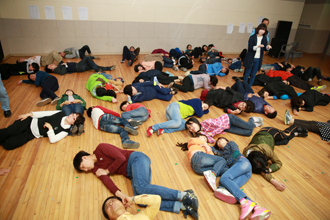
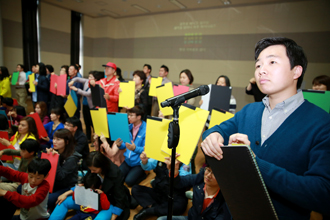
| Rehearsal of 〈100% Gwangju〉 | |
Q: Casting 100 people seems absolutely not easy. Especially as time goes by, it may be hard to find someone who fits your criteria. I heard that you finally found out the 100th person for the performance a week before its premiere. Please tell us some behind stories or difficulties that you have gone through during the casting or rehearsal.
A : It is a very exciting process because it also tells a lot about the social network people are included or excluded... Some people are so connected to others that they do not have any problem when finding someone whose living space, age group and ethnic group are totally different, for example. On the other hand, others stay more with their peer groups... At the end, we have 100 people on stage and play a game with them with which we can mirror the city. It it different from other projects due to the fact that we only had about 4-5 rehearsals whereas we sometimes rehearse six to eight weeks for other shows.
Q : Let’s focus on 100% Gwangju. First of all, I would like to express gratitude for the performance. Gwangju was chosen as the 15th city of your project. When you travel to different cities for this project, what needs to be done would be to adjust the actors’ costume to each city. Do you have any principles that you may consider as the most important for this project?
A : We have a local team that carry out interviews with the 100 participants – we read these interviews to prepare our performance and to understand the people, their thoughts and questions. We then come up with our draft script – basically a set of statements and questions – some general ones that pop up as we travel from city to city, some very special ones focusing on the current situation of the city/country and then a whole lot of personal questions. And then of course there are local conditions that we try to adapt to – maybe you can call this a basic temperature – well, a cultural background.
Q: The way of gathering 100 people is what characterizes your performance. In this way, you want to show the microcosm of the city. They are not randomly chosen. Through “relay casting,” 100 people are connected or have possibilities to be connected in a way. What do you want to tell us by choosing this demographic chain reaction?
A : it is an advantage if a person knows at least two more people in the cast already – often there are whole families involved or a set of friends joining in – I think this makes a difference instead of choosing 100 people through a bird’s-eye view – of course the whole casting process is also framed – so in addition to the 5 categories (age, gender, ethnicity, household composition and district where they are living), we have a list of profiles that we do not want to let out. This is something we develop together with our local team. It makes sure that there are all social and economical classes represented, some special professions, some special constellations, some special opinions and lifestyles.
Q: However, this microcosm based on the strict rules brings some sort of gaps, I think. In fact, the questions are not to aim to shed light on this sort of formula. The questions are more private than public, more intimate than universal. I would like to say, I feel kind of freedom in spite of sticking to the strict statistics. At this point, your unique theatricality occurs, I think. It is based on the statistics outwardly, however, you may intend to show reality hidden behind the numbers. What kind of reality you actually want to show us?
A : We want to show the people behind the numbers – there are so many surprises and it becomes very emotional, too, if you track certain people and their answers throughout the show and write (in your mind) a kind of biography for that person by watching him or her. At the end of the show, we ask people to always stand together like a family portrait answering a statement with yes, for example, “I grew up without a mother,” “I have been in jail” or “I have a family member who is suffering from Alzheimer.” First of all, it takes a lot of guts to answer those questions publicly and then, you’ll find people standing next to each other that have a completely different lifestyle and opinion but they join this very emotional moment and get glued together for this snapshot. I think it is beautiful to see the different layers and potential of a city as well as the missed chances and conflicts which don’t always have a rosy picture – it is an honest and sometimes brutal reflection of a city.
100% Gwangju, Speak up! Do Not Hide!
|
|
|
|
| |
| 〈100% Gwangju〉 presented at the Main Hall Hae at the National Theater of Korea on May 26, 2014 | |
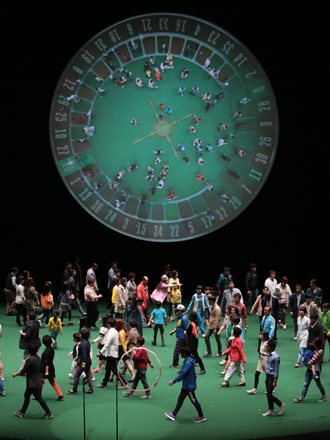
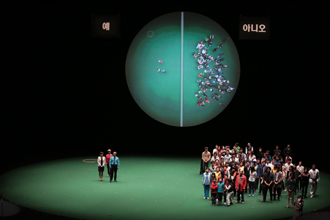
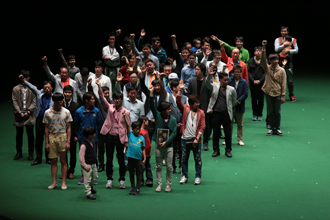
Q : As you may know, the city of Gwangju has a symbolic meaning to many Koreans, making their emotions run high. So we naturally expected that you might bring a certain sociopolitical context regarding the Gwangju Uprising on May 18, 1980 or the ordeals that Korea went through in modern times. But you didn’t do so. In fact, the date of the performance, which is close to May 18, also made us anticipate such historical elements. Is it your intention to make Gwangju deviate from such a sociopolitical context? In fact, I have thought that Rimini Protokoll’s works usually focus on small stories in order to draw a big picture such as a country’s system and structure.
A : Well, I think we did – I think it was the right choice to produce the first Korean 100% City show in Gwangju and not in Korea’s capital, for example but we did not want to reduce Gwangju to the place of the uprising. During our survey, we asked the citizens a couple of questions about the massacre, in an attempt to understand how they want to live with this memory. Surprisingly enough, many of them wanted to forget about the past and carry on. I think that it is not about forgetting but about cultivating democracy so that nobody may be afraid of expressing their thoughts and feelings. I think this is what 100% Gwangju is all about: Speak up! Do not hide! Attempt diversity and the freedom of speech!
Q : Let’s compare two performances in Gwangju and Seoul. Whether you may know or not, the audiences’ reactions are quite different. Hearing from news, I may suppose that the Gwangju performance brings a more social and political context than that in Seoul. Were there any changes? You also told in an interview that you might change some questions for the Seoul performance.
A : It is the first time that we took a 100% City production to another city. An exciting experiment and somehow it seemed to work. The audience in Seoul was very moved – they enjoyed seeing the differences and overcoming clichés and we were able to provoke them a little bit by reminding them of living in the capital and always drawing attention. We added a scene where the audience in Seoul was given a chance to answer exactly the same questions as those for the people of Gwangju on stage and were able to compare the results!
Q : I know that you have stayed in Korea more than one month to produce the performance. I would like to know what you think of Korea and Gwangju, I mean your impression. Plus, during the production and presentation of 100% Gwangju, did you gain anything or were you influenced by something?
A : We enjoyed the people’s humor a lot. Of course there was a cultural gap at first and we can’t speak Korean, unfortunately, but I really felt that they trusted us and that they were eager to take this as an experiment they would all benefit from.
Q : Last question. I would like to know what kind of theatrical value Rimini Protokoll pursues or focuses on most. What kind of theatre do you want to create?
A : Surprising Theater!
◎ Photo provided by_Asian Arts Theatre
 PREV
PREV
.JPG)
.jpg)
.jpg)
.jpg)
.jpg)












.jpg','Last May, Rimini Protokoll’s <100% Gwangju>, which..');)


