





Two Business Cards
[People] Kim Young-il, Director of GURU Visual and CEO of AKDANG
On March 21 and after much controversy, the Dongdaemun Design Plaza (DDP) finally unveiled itself. No less talked about was the Kansong Art Museum, which announced its re-opening after a long shutdown and transferred its exhibits to a new exhibition at the DDP. Titled 《The Treasure of KANSONG》 (Preserving National Identity Through Culture)1), the show is a collection of historical national treasures made open to the public, and is just as foreign in its current setting as the building itself. This article, however, does not intend to further contribute to the abundance of hand-wringing that already exists around this issue. Rather, I aim to look beyond the uneasy meeting of public construction and national treasure and discuss the people involved in the project’s documentation. Humanity has long worked to preserve and proliferate its culture. In this interview, we meet a modern-day Peter Pan, who, rather than seeking the utopia of Neverland, instead tracks down the last physical vestiges of intangible values that are disappearing. He holds the conviction that, in the words of French philosopher Régis Debray, things that are not recorded do not become history.
- 1) Part 1: 《Jeon Hyeong-pil: Kansong’s Founder》, from March 21 thru June 15, 2014.
Part 2: 《Bohwagak: A Look Inside Kangsong’s Treasures》, from July 2 thru September 28, 2014.
Commercial, Too Commercial
Q(Hwangbo Yumi): You’ve been well known since the founding of your record company, AKDANG, but your beginnings really lie in photography.A(Kim Young-il) : This business card is for the record company, but because I’m a photographer at heart, I also have a separate business card for GURU Visual, which is a company that specializes in multimedia. With the latter, I transform into a completely different person, with all the commercial flair in the world. But, really, though they appear different, in essence, the two cards are one and the same. Looking back on why I became a photographer, when I was young, I had the habit of recording things that other people thought unimportant, but I thought important. That led me to photography school, and eventually to form a multimedia company. And then one day, I became enamored by sound. Not that I was never into music, but since I began to appreciate the value of sound, I began to record it, and eventually create a company that turned such things into actual records. It may appear unusual, but whether it is the recording of the visual or the audio, I don’t think that any one outweighs the importance of the other.
Q : What is your role in the transfer of the historical artifacts at the Kangsong Art Museum to the DDP?
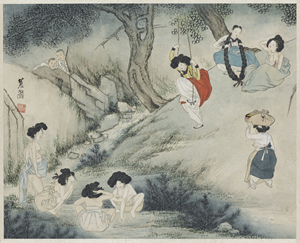
A : Throughout history, the media being used to document the world around us have evolved. In the past, professionals mostly sought to print their works, so their go-to medium was the slide film. But that’s become obsolete more than a decade ago. The LP record has been supplanted by the CD, which in turn has lost its place in the world. And before that was the cassette tape, an antiquity currently produced nowhere in the world. But just because times have changed, it doesn’t mean that anything that ever existed historically is no longer relevant. For example, Beethoven’s Symphonies No. five, seven and nine are no less popular today than when they were initially debuted, but the ways in which they have been recorded have changed over time. The Kansong is the biggest depository of national treasures, and here is the chance for those objects to be recorded in their original form, which would have been shot in slide form. But the is such a delicate material that needs to be controlled for heat and humidity that even wrapped in acid-free paper, its colors become distorted in six years. In the digital age, that job is up to digital instruments. The works of Sin Yun-bok, Chusa (Kim Jeong-hui), and even the original 『Hunminjeongeum Haerye』 will be thus presented to the world.
|
|
| The No. 135 national treasure, |
It is our responsibility to document our own history; there is nobody else who can do this job for us.
Q : Then is it fair to say that these art works are being documented with the newest of technology?A : That’s right. This [our project with the Kansong exhibit]is a form of documentation. The digital single-lens reflex camera, or DSLR, records images at around 20 to 30 megapixels, which is a high degree of quality for most situations. Even phones have such cameras attached to them these days, and I myself use them for Facebook and Twitter. But If I were to take such images of the Namdaemun and Dongdaemun with my phone, it would be impossible to properly blow them up, as they would be pixelated. This is why some professionals choose to use the largest available sensor available, at 120-megapixels. An average Canon or Nikon camera would take images at around 20 to 30 megapixels, which translates to around 100 more megapixels with this top-of-the-line technology. Regular computers can’t even operate the software for such cameras.
When it comes to storing such high resolution audio files, the best available method in the world is the Direct-Stream Digital (DSD), which allows a person to create a copy in their medium of choice, whether that be in CD, Blue-ray, or DVD. It is our responsibility to document our own history; there is nobody else who can do this job for us. My hope was that such a task could be done with the most cutting-edge technology possible, to share with the world such things in the highest definition possible — that is why I do this job.
Q : Does GURU Visual shoot artwork only?
A : Not really. We’ve done projects for textbooks as well. GURU Visual consists of eleven other department heads besides me, each of which has a team of first, second and assistant camera operators. There are approximately fifty of us in total, and together we shoot anywhere between tens of thousands to millions of cuts each month. In addition, we’ve worked on company newsletters, magazines and even posters. In our textbook work, for example, we did a science one where we had to get shots of experiments, and for one on math, shots with students. Every single image is premeditated, based on a synopsis created by the books’ authors, cut by cut. Basically, we do any project that pays, from textbooks to architecture and interior designs. The hard work has paid off, because a tenth of that revenue is used to finance AKDANG, which really does not earn a single dime. It’s a not a matter of profit, but whether we even break even.
|
|
|
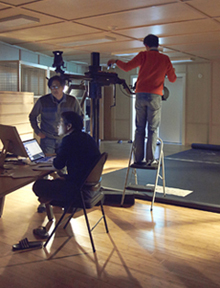
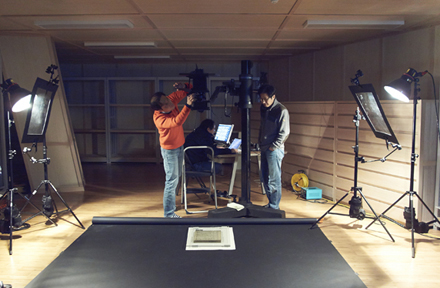
| Working with photos landscape ◎ Photo by GURU Visual | |
Q : How will you document the exhibit of Kansong artifacts at the DDP?
A : The items will be moved tonight and shot for the next three days. But photographing the relics is only part of the challenge. Thousands of people will visit the DDP every day, and even if it was a more modest exhibit, it would be impossible for all the visitors to see everything. As a result, the images of many artifacts are to be projected on screen, at UHD (or ultra-high definition) resolution. HD and Full-HD displays are commonly found these days. UHD is the next level up, and was created together by Samsung and LG. And since the Seoul Metropolitan Government could not afford to fund all the costs of the DDP exhibition, Samsung announced that it would finance all the costs of the video media exhibits. Essentially, it’s our job to hand over the images and for Samsung to show them on a UHD screen, but it’s impossible for regular cameras to shoot such high resolution images. Another company had learned this the hard way, by shooting with its cameras, sending off the data to Kansong and Samsung, only to be rejected, as the images’ resolution was decidedly too low. This company had been using seventy megapixels to shoot its images. Tonight will be our final test run, and afterward, the real work begins.
Q : So, basically, you will have to fine-tune your work to fit the UHD screen. Then what camera are you using?
A : a digital back. This back records images at around 100 megapixels, and is run by not one but two computers operating simultaneously.
Mission as Visual Director
Q : How many curators will work with you throughout the recording of the exhibition?A : Mainly those working with us at the Kansong Art Museum. The truth is, any project should attempt to reduce the number of people it employs, including my team. Behind the scenes at the shoot, we demand that people onlywalk in a single direction so that there is less danger that people pick up the relics, confuse directions, and crash into each other, artwork and everything—it has to be that way. After the set-up, the shoot continues for three days with such rules in place. With this exhibition, the relics of Kansong are to be shown at the DDP for the next three years, after which, they will have to make way for the newer exhibits, and be photographed again for that occasion. What’s important to note is that when they are being shot for the second time, the images must replicate the conditions of the first photos exactly, duplicating things such as the aperture setting, strength of lighting, color balance, and grey scale for every single one that they are photographed.
Q : So, the curators are responsible for the artifacts, and the GURU Visual staff members oversee the shooting and the many conditions that influence the shoot. How many GURU staff members are there, and how do their roles differ?
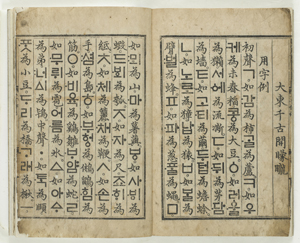
A : The team of staff consists of four people: the first and second cameramen as well as both their assistants. My responsibility here, as visual director, is to take care of the things invisible to the first and second camera staff on account of their busy international shooting schedule. Then, it is the visual director who must decide how the shot must take place. The visual director, for example, has to decide whether each page of the 『Hunminjeongeum』 should be photographed individually or as two pages per shot. That is the job of the visual director.
|
|
|
| The No. 70 national treasure, 『Hunminjeongeum』 | The No. 65 national treasure, 『Cheongagirinyugaehyangno』 |
Q : Does that involve a certain amount of discussion with curators?
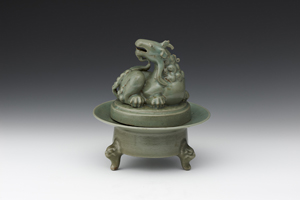
A : Absolutely. This is my general rule of thumb. The celadon [a common type of artifact in the collection] displays countless patterns that resemble a cracked surface, but it is in not in any way broken. In fact, the more intricate the cracks appear, the higher the quality of the celadon. It is also important that the cracked surface of the celadon is permeable. The surface of celadon can be made to gleam, and when enough light is shone, the area gets whited out and its natural texture becomes invisible. Therefore, in order to avoid a direct glare, light is diffused over the object instead. With diffused light, celadon’s texture can be seen much more evenly and accurately. How to use light, how transmissive it should be, and at what angle are all things to consider. Photographs of historical relics generally have backgrounds that are lighter below and darker above. This is a method that was used 30 to 40 years ago in Japan, which is still being duplicated in Korea. British, French, and overall European photographs do not employ this technique.
Q : What was the reason for such a background?
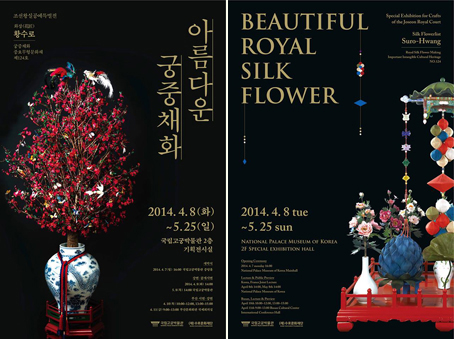
A : This technique, called the "gradation back," or in Japanese, "bokashi (shading off)," highlights the object’s sense of volume and mystery. Another explanation is that lightening the lower half prevents a shadow being formed at the bottom because of light shone from above, and reflects the light from below to evenly show the object. That might apply to a limited number of cases, and not for cubic objects or bottom-heavy bottles. In fact, the real reason for the persistence of the method is simply the fact that it was the way things were done by curators and archaeologists, and no one objected to it. It’s much like the law that stated people keep to the left, when one day, it really turned out that the reverse is actually more convenient. Whether it is white or gray, I will use a single color background. Last time I was photographing royal flower paintings, I used an all-black background for some of the works. These are the kind of decisions made by the visual director - to return things to their rightful place, and to let the future generations witness them. These are the things I intend to fix.
|
| |
| 《2014 BEAUTIFUL ROYAL SILK FLOWER》 Poster ◎Photo sources_The National Palace Museum of Korea | |
Digital and Analogue: Not Enemies, But Close Neighbors
Q : Does sound recording encounter the same issues, besides the problem of profitability?A : As much as video companies are lacking in Korea, the same applies all the more to music companies. So my decision to own these two things contributes greatly on a national level, in that I provide a national standard for music. The Ministry of Science and Technology ruled that length be measured by the metric system, and weight not by pounds and ounces but kilograms, and these are the rules for technical standardization. With music, the designated government standard is the 16-bit, 44kHz CD, but a popular trend today is to listen to high-resolution music files on one’s personal computer. As for the next generation technology to replace that, the websites for the German record company Deutsche Grammophon and the Berlin Philharmonic and their use of a Direct-Stream Digital (DSD) service is telling. The DSD is an algorithm jointly developed by Japan’s Sony and the Dutch company Phillips, and is currently the best available method with which to record sound. A regular CD uses around 800 megabytes of memory, whereas the same music in DSD would take up around 18 gigabytes of storage. Listen to a CD after being exposed to DSD and the sound quality is unbearable. This is the way technology and the world is headed; just as with the evolution from black and white television to color to UHD. The West is already way ahead in the high resolution game.
Q : If the initial recording is done in DSD, everything that follows must be in a higher resolution format.
A : Right. Going back to sound recording, let’s say I were to record Hwang Byungki’s gayageum. Hwang is one of a kind, and I believe it necessary to record him with the best technology that is available. In music, that is the DSD format, which can be encoded to a lower file when making a CD. However, the reverse—of turning CD material in DSD—is limited. This is why the first stage should be in high resolution, which is how I ended up researching and discovering the DSD method. I thought, it shouldn’t be too difficult to do, and so I imported the machine from Switzerland into Korea, but it turns out there were only three engineers in the country who knew how to operate it, all of whom had studied overseas, which was beyond ridiculous. And then an engineer with a graduate degree came to work for us. I told him we will be recording, not in PCM, but in DSD format, so he should go study it up. After which he went straight over to his professors to ask about using DSD at AKDANG. This was an engineer with a graduate degree, and yet he had never heard of DSD. To the question of what literature he should study, his teachers told him, "That will never make money." A nation’s culture needs to be recorded and documented, and yet it comes down to the same issue again and again. There is nothing to stop this from being done in the best way possible. Someone out there was able to invent the technology itself; it’s hardly difficult to press a few buttons.
 |
Q : Isn’t it possible that such technological sharpness may actually distort an object from when it’s viewed with the naked eye? A : Of course. People talk of drowning in a digital swamp, but the digital is merely a binary code, and exists as a range of degrees. In the spectrum of the darkest dark to the lightest light, the analogue human eye cannot distinguish things at either extreme. With digital technology, however, one may open a page and see information that doesn’t actually physically exist. Therein lies the danger of the digital, but this is something that the medium knows about itself very well. Thus, ironically, the digital aims to be analogue at its very best. It reminds me of stories of the cyborg who wants to be human, who wants to love and feel as humans do. It’s the age of the robotic vacuum cleaners, and concurrently a time that the digital and analogue vie to be and offset the other. An example of this is the LP record, which at one time was the best analogue method available. Today, with the abundance of digital technology, people are turning back to the LP, now created in digital format. |
|
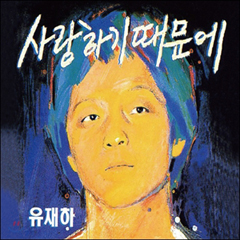
Suh Do-ho drew the album jacket of Yoo Jae-ha, ◎ Photo sources_YES24 |
Q : This was drawn by Suh during his early years as a student. Here, I’m learning something new retrospectively. So this project was done by AKDANG, then?
A : As you’re aware, Yoo Jae-ha has only ever made one album. The master tape for this album was in the possession of a friend of mine, who is not in the best of health. One day he told me that he wants to make a good record [of it], unlike the hastily copied versions created by Seoul Records in the past, and so this project was born. The LP record was pressed and cut in Germany, in 180-gram virgin vinyl.
Q : Is the record currently available for sale?
A : It was, but sold out immediately after announcement. I first made 500, then 1,000 copies, but have none left. In answer to the previous comment about the digital medium, I say that this would not have been possible had the record been made in any old digital format, such as mp3 or CD. In the DSD format, yes, this is more than possible. In the end, digital and analogue are not enemies, but rather close neighbors, really.
Q : Essentially, you deal in all mediums of documentation.
A : Yes. I’ve just wanted to, throughout the years. Whether that be books, texts, images or sounds.
◎ Photo sources_ KanSong Art And Culture Foundation
|
Kim Young-il Kim Young-il founded the in 1993, and has since published some 40 photography collections. In 2003, he founded GURU Visual, a video media corporation, and served as its director. After seven years of preparation through traditional musical performance, recording and construction of performance halls, he created AKDANG as a record/media company in 2005. Since then he has produced approximately 1,400 master files for Korean traditional musicians and 78 records of the same genre, which are currently being sold domestically and internationally. |
 PREV
PREV
.JPG)
.jpg)
.jpg)
.jpg)
.jpg)












.jpg','On March 21 and after much controversy, the Dongda..');)


