





Slowly Embracing All Things Varied
[People] Suh Do-Ho_ Installation Artist
In the latest poll for the Top 5 News Arts Management Stories of 2013, installation artist Suh Do-Ho was selected as Person of the Year for the category of Art and Creation. Suh, who has made more of his career overseas than in Korea, has been making quite a domestic splash recently. His solo exhibition at the Leeum Samsung Museum of Art was the first of its kind for a living Korean artist, and received great public attention, gathering the most number of visitors to the museum since the institution’s opening.
Artwork as Universe
|
|
| L) Home Within Home Within Home Within Home Within Home, at the MMCA, Seoul R) Home With in Home, at the Leeum, Samsung Museum of Art |
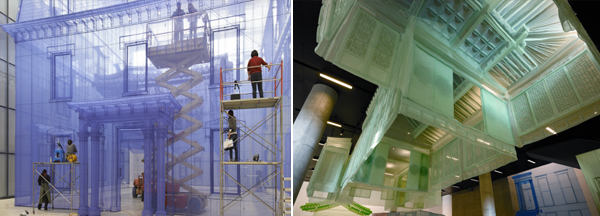
“I’ve had to consider several things: that the exhibit is located in Seoul, that it is situated on the site of Jongchinbu, which sat atop of the site of the Gyeongbokgung Palace, and finally, that it is within the MMCA building. It was important that I created the work without losing sight of the historical, political and cultural significance of the exhibition space. Though those elements are not visually noticeable in the final artwork, they informed the work in its initial stage of conception. Perhaps the visitors may vicariously experience this, at various angles: the point from which my work overlaps the view of Jongchinbu, visible from the back window of the Seoul Box; the point from which the different spaces of MMCA Seoul is visible through the work; in the gaps between one piece and another; and the areas between the work and the Seoul Box itself. As the title suggests, I wanted to emphasize the convergent nature of the Seoul Box’s site.”
Suh’s earlier works on homes, such as
"This latest piece is an extension of my exploration of personal space, for which the mobility of space is a relevant question. My previous works were titled after the cities in which they were exhibited to highlight their mobility, and here the idea of the "home within the home" is pertinent, because a space cannot exist outside of its context. Hence, this is reason for the works being named after their cities, and in this way, they were naturally homes within the larger home of the city. I think it’s necessary to highlight these themes, for viewers tend to focus only on what is immediately displayed before them."
|
|
| ▶ Fart in the Wind, 2010 |
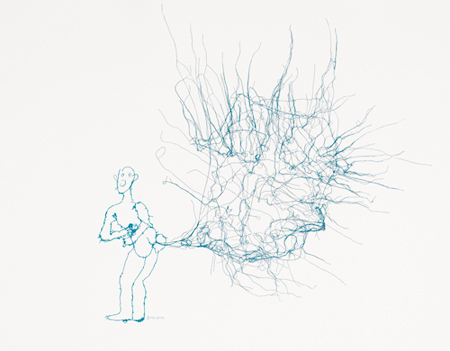
One of your works which I found particularly interesting at the Leeum, was the drawing Fart in the Wind, and the idea that to eat a meal in New York, digest it over the flight to Seoul, and then fart, thus transporting the food and air of one city to another, was quite amusing. What’s more, the shape of the fart appeared to resemble the form of a house. So in that respect, what does a home mean to the artist, Suh Do-Ho?
"For me, the home is a thing not rooted in one place, but moveable and changeable at any point in time. Thus, it is similar to a fart, impossible to capture but always reappearing in new form."
Your works tend to be understood intuitively by the audience, being simple and clear, such as your home recreated to scale, or a western building clashing with the traditional hanok. Belying the simplicity of concept, the scale and details of your work are overpowering - which suggests the effort involved in their creation. Do you feel a pressure to create works that will impress (create a spectacle)?
"Your comment on simplicity sounds like a compliment as well as a criticism, but either way is fine. Scale and size are two distinct concepts, and in my work, I consider the former over the latter. Details are influenced by the scale of a work, and therefore very important to me. Furthermore, I take effort to realize small and large scales within the same work, because I think that is how our universe works. This is not to say that I prefer to create larger works as opposed to smaller ones, and the same applies to the spectacle, or lack thereof, that I make. The larger size of a work does not translate to its greater impact, and vice versa. Even at the smallest of scales, an artwork may impress and resonate. I think the same applies to life in general. Thus, I never think of the need to make waves while preparing a work. The audience may take away from it what they will, and some of them may think my work inspiring."
Seeking Universality with a Basis in Specificity
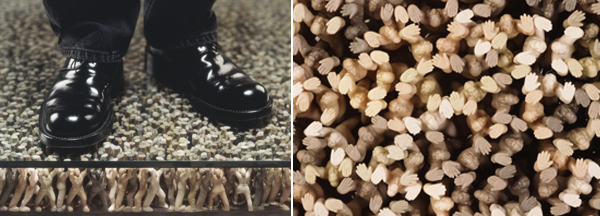
Suh Do-Ho is well known for his"It is correct to say that my earlier works depicting human masses were critical of standardized institutions. But considering the time period when they were introduced, it’s worth noting that they were made in times when Korean society had already become more liberalized. I think resistance, in its true sense, can stand if the political climate of the works’ birth period truly justifies its meaning, and in this sense, this dilutes the rebellious meaning of those works. All my works were created with an amount of distant observation, and thus, they are retrospective. Some may say that they lack a sense of desperation and urgency that characterizes grass-roots art, but as mentioned, this ties into my approach to creation, and is thus intentional. Though my work starts from a point of specificity, I desire to achieve a level of universality in all my pieces. Also, because my recent people sculptures are not founded in the specific periodical, political and social conditions of the times, but start from a spiritual, religious and philosophical question, they do not contain a visual reference found in reality."
|
|
| ▲ Floor 1997-2000 |
Continuing his busy streak from last year, Suh will enjoy a packed schedule for 2014. After his solo exhibition finishes in January 25, he will continue the same show in New York and Austin. In particular, the exhibition to be held in New York will be presented at two spaces owned by the Lehmann Maupin Gallery simultaneously, with a broad theme of "drawing." A book made of a collection of the very same work will also be published. In 2010, Suh moved from New York to London, and he is doing his best with his limited time to be with his family as well - working on his “Home” in the ultimate sense. "My children are still young, and it’s still a process, but looking at my growing children allows me to feel at a level previously inconceivable to me."
◎ Photo sources _ SUH ART
|
Suh Do-Ho Suh was born in Seoul, Korea in 1962. After earning his Bachelor of Fine Arts and Master of Fine Arts in Oriental Painting from Seoul National University, he continued his studies in painting at the Rhode Island School of Design and Sculpture at Yale University. He has held solo exhibitions at New York’s Lehman Maupin Gallery, the Whitney Museum of American Art at Philip Morris, the London Serpentine Gallery, the Seattle Art Museum, the Artsonje Center in Seoul, the Maison Hermès Tokyo, the DAAD Gallery Berlin, the Leeum Samsung Museum of Art, the 21st Century Museum of Contemporary Art at Kanazawa, and the Hiroshima City Museum of Contemporary Art. He was invited to international biennales such as the Venice Biennale, the Instanbul Biennale, and the Liverpool Biennale. He currently resides and works in London. |
 PREV
PREV
.JPG)
.jpg)
.jpg)
.jpg)
.jpg)












.jpg','In the latest poll for the Top 5 News Arts Managem..');)


