





A Gift Given by Strikingly Beautiful, Elegant, Intriguing, Cool Woman to New York
[People] RoseLee Goldberg_Director and Curator of PERFORMA
In 1972 when she was director at the Royal Art College Gallery, Ms. Goldberg set precedents for a new curatorial approach which is multi layered and integrates several disciplines. A few years later at The Kitchen, she created and curated the performance space, the visual arts gallery and the video room presenting groundbreaking artists including Laurie Anderson, Phillip Glass, Peter Gordon, Meredith Monk, and Robert Wilson and curated the first solo exhibitions of Jack Goldstein, Sherri Levine, Robert Longo, David Salle, and Cindy Sherman, among others. Her innovative programming helped established The Kitchen as one of the foremost multi-media institutions worldwide.
|
| |
|
Cindy Sherman and RoseLee Goldberg |
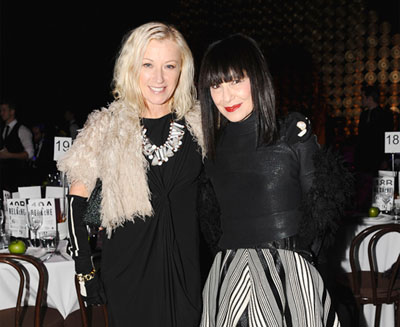
Ms. Goldberg is the powerhouse behind PERFORMA, the first biennial of performance by visual artists, which she founded in 2004. Collaborating with more than 60 spaces city wide, every other year in November, PERFORMA takes New York City by storm with more than 100 live performances, screenings, exhibitions, lectures, and symposia by U.S. and international artists. Dedicated to exploring the critical role of live performance in the history of twentieth century art and to encouraging new directions in performance for the twenty-first century, PERFORMA has triggered a new trend in museum and exhibition planning around the world. Important exhibitions at institutions such as the Museum of Modern Art (MoMA), the Guggenheim and the Whitney in New York, the Centre Pompidou in Paris, and the Garage Center for Contemporary Art in Moscow, have mounted major new performance art exhibitions and presentations in response to PERFORMA’s efforts over the past years. PERFORMA was described by Jerry Saltz in New York Magazine as "…a gift to New York".
Ms. Goldberg is known for breaking conventions and encouraging artists to push their boundaries and experiment with new language. Through commissioning visual artists to create performances and performance artists to work with new technologies she brokers the creation of new theater and performance for the 21st century.
Breaking Conventions and Encouraging Artists to Push their Boundaries
Renata Petroni (hereafter called as "Petroni") : You have been involved with performance art all your life. You have been teaching and lecturing about performance, you have written "Performance Art: From Futurism to the Present", and you have started PERFORMA in 2004. Why this passion for performance art?RoseLee Goldberg (hereafter called as "Goldberg") : I started out as a dancer from a young age but I was also interested in the visual arts. I received a degree in fine arts as an undergraduate and a graduate degree in Art History from the Courtauld Institute. Visual art and dance had equal billing for me, but also their relationship to architecture, film, music, photography. The connections between disciplines became even more clear when I chose to do my graduate research on Oskar Schlemmer, painter and dancer at the Bauhaus, where indeed students could move in and out several disciplines as part of their studies. In 1972, fresh out of college, I was hired as Director of the Royal College of Art Gallery in London where I organized exhibitions and events by visual artists and musicians as well as architects and designers, such as Giulio Paolini, the Kipper Kids, Brian Eno, Marina Abramovic, Christian Boltanski, Anthony McCall, and Gaetano Pesce. In 1972, I came to New York for the first time and over the next few years I would become friends with Laurie Anderson, Steve Reich, Trisha Brown, Lucinda Childs, Julia Heyward, Cindy Sherman, Robert Longo and many others. I moved to New York permanently in 1975, and wrote "Performance Art: From Futurism to the Present" in 1979 which I am pleased to say is still in print 35 years later, and now in many languages.
Petroni : Historically, the role of performance art in the 20th Century has been to break away from codified art, from the establishment and the politics of the art market. It was about making strong social and political statements. I feel that today many artists seem more preoccupied with achieving success, with posterity, with sensationalism than with content. How has performance art shifted? What is its message today?
Goldberg : The period you are referring to, the 60s and 70s, were highly politicized times in general, not only in the art world. It was a period of social and political upheaval with the civil rights movement and feminism being highly visible and effective. Artists responded to, and articulated those times; choreographers such as Yvonne Rainer and Steve Paxton in performances at Judson Church or the work of Italian Arte Povera artists; or architects such as Super Studio all created work that was pointedly political and was aggressively democratic and against the commodification of art. Our times are quite different; we have different concerns, but performance is still hard to tame. It still surprises and provokes. It is still outside the art market, and artists can still use performance to express a complex layering of ideas. For example, a performance in a bathhouse which we presented during PERFORMA 13 ("Dutchman" by Rashid Johnson), raised a host of political and social questions but did so with an entirely different aesthetic than might have occurred in the sixties. Performance is always changing, but it remains a platform for experimentation without limits.
|
| |
|
L) Joan Jonas with Jason Moran, Reanimation, 2013. Paula Court, courtesy of Performa |
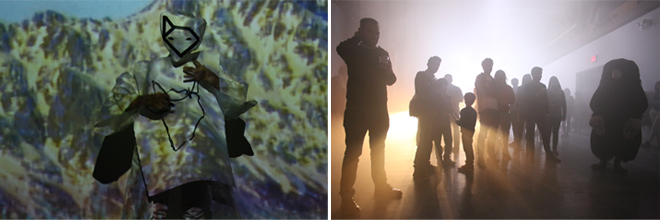
Goldberg : It is a contradiction, but not surprising given the popularity of performance right now. Museums have had ’performance art collections’ for years; just under another name. Works by Yves Klein are paintings made during performances, so are films and objects by Matthew Barney or photographs by Cindy Sherman. For me the more exciting possibilities for collectors, is inviting them to work with us to commission new performances, and to get involved with the artist and with the process of making the work itself. A much more exciting and enriching approach than waiting for the end product.
Petroni : Is influencing museums to present performance one of PERFORMA’s functions?
Goldberg: That is one of them, especially in relation to their historical holdings, where the role of performance in shaping art history needs to be explained. But PERFORMA has many functions; to make the extensive history of performance widely known, to commission new work and find funds to fully support the artist’s vision, to provide the expertise necessary for producing this material. As interest in performance is growing, and with museums taking steps to build performance art collections and spaces to show performance, they will discover the complexities of presenting this material and we can advise and support these new developments as well.
Petroni : Does access to money and collectors distort the way artists approach their work?
Goldberg : It can but the same could be said of the entire history of art, given the critical role of patronage throughout the ages
PERFORMA is about Taking Risks and Trusting the Artists’ Imagination
Petroni : Through PERFORMA, you commission and present many international artists – many of whom work in countries ravaged by political conflict. How is their work different from the Western world artists?Goldberg : Performance made in countries outside the market and biennial circuit – "the Western world" -- is often more about humanity, citizenship, ritual, society, local custom or politics., whereas inside the art world, it is often about institutional critique, relational aesthetics, art about the art world. In South Africa, India, or China, the work is about life and the reality of those countries. For artists living in non-Western countries, performance, rather than painting or sculpture, can often be the passport to entering the Western art market. Artists such as Tania Bruguera (Cuba) or Zhang Huan (China) become known through their actions, and the art that documents those actions.
Petroni : Is providing non-Western artists with a passport to the Western art market the reason why you commission visual artists to create performances even though they have never done performances before?
Goldberg : No. My reason for inviting visual artists to create performance was to open entirely new possibilities for performance. It all started with my commission of "Logic of the Birds", by Shirin Neshat which was presented in 2001. In the late 90’s I was seeing so many interesting performance installations and films and was at the same time very tired of the repetitive monologue performances that were being performed around New York. I started by asking myself "what would happen if an artist whose work I liked in one medium would agree to work in another medium, in performance?" Shirin’s work seemed to have all the qualities that I felt could translate from film to live performance: Her work is theatrical, emotional, elegant, evocative; it contains both beauty and meaning, She took up the challenge and Logic of the Birds was indeed a stunning performance. Next, I commissioned a work by Isaac Julien, followed by Jesper Just, Candice Breitz, Omar Fast, Nathalie Djurberg, Yeondoo Jung, and many others. These are artists who use visual seduction to reach into your mind, and who have each taken performance in a new direction with their Performa Commissions. It is full of risk, but PERFORMA is about taking risks and trusting the artists’ imagination.
Petroni : When you commission work, do you follow the artists through the creative process or do take the hands off approach?
Goldberg : We are there for the artists every step of the way. We discuss their ideas from the very beginning, and throughout the process of development, and gently move the work forward. We assist with creating budgets, a time line to include rehearsals, residencies, expertise in terms of lighting design or sound and in general, we help them structure the piece by asking a lot of questions such as "what do you want to happen when I walk into the space?" or "what do you want me to feel by the end?".
|
| |
|
Queen Mother, Pawel Althamer, 2013. Paula Court, courtesy of Performa |
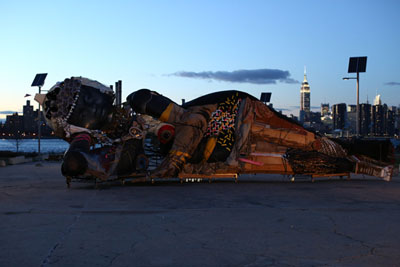
Goldberg : The intention for "Pavilions Without Walls", is to develop a cooperation with other countries involving in-depth research and extensive exchange of ideas about cultures and curatorial vision, and not just present a single project by an international artist as is more typically the way the Pavilion’s work at the Venice Biennial for example.Our curators and producers traveled to Poland and to Norway on several separate visits. We met artists, curators, museum directors, and government led cultural organizations in each country and were given significant access to contemporary artists and an overview of the culture, history and politics in that country. As a consequence of these trips, we decided to invite curators from these countries to work with us at PERFORMA which turned out to be a very exciting exchange for those curators who spent the six months leading up to the biennial, working with us in New York. The firstPavilions Without Walls program has been profoundly illuminating — politically, culturally, socially — and has proved to be very successful for everyone involved.
Petroni : I know that a Korean delegation of visual arts curators supported by Korea Arts Management Services (KAMS) has come to New York last November to do some research, attend the events of PERFORMA 13 and meet with you. KAMS has recently created a new exchange program for the visual arts and partnering with PERFORMA on "Pavilions Without Walls" would be a fantastic opportunity. Is this idea being explored?
Goldberg : The relationship with KAMS is moving along very well. We had a terrific delegation here during November, who were able to experience the Pavilions Without Walls and the biennial directly. We showed them materials from the Norway and Poland Pavilions and we sent them a proposal for a two-year project that will include workshops for curators, seminars with students in both countries, sending our curators to Korea and reciprocally, hosting Korean curators in New York.
Petroni : In conclusion, can you share a few words of wisdom as to the direction of visual arts performance in the next ten years?
Goldberg : Performance is going to be very important in the 21st century because it allows artists to use the many different media that surround us today and for them to explore a complex range of ideas that reflect the complex global connections and expanse of the art world. For audiences, the live aspect is an exciting antidote to the highly mediated and internet driven world in which we live, and it provides a high energy conduit for absorbing questions about culture and the future. Performance is accessible, yet complex, and asks a lot of questions of the viewer. It is an exciting way to confront contemporary culture.
|
| |
|
RoseLee Goldberg, Photo by Patrick McMullan |
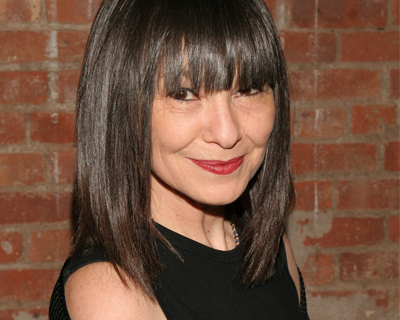
Born in Durban, South Africa, RoseLee Goldberg studied Political Science and Fine Arts at Wits University, Johannesburg, and Art History at the Courtauld Institute in London. As director of the Royal College of Art Gallery, London, Goldberg set important precedents for exhibiting modern and contemporary performance and organized exhibitions, performance series, and symposia on a broad range of multi-disciplinary artists including Marina Abramovic, Bernd and Hilla Becher, Christian Boltanski, Brian Eno, the Kipper Kids, Piero Manzoni, Anthony McCall, and Christo and Jeanne Claude. While in London she also taught at the Architecture Association School of Architecture.
Goldberg’s curatorial commitment to new media and contemporary visual arts continued during her tenure as curator at The Kitchen, New York in the late 70’s. Since then, Goldberg has curated several performance series including Six Evenings of Performance, as part of the acclaimed High and Low: Modern Art and Popular Culture (1990), exhibition at the Museum of Modern Art, New York and Couleurs Superposees: Acte VII (2005), a performance by Daniel Buren, (in association with Works & Process), at the Guggenheim, New York.
In 2001 as part of her visionary goal to create significant new theater and performance for the 21st Century, Goldberg commissioned and produced Logic of the Birds, a multi-media performance by Shirin Neshat in collaboration with composer and singer Sussan Deyhiem. Developed in residency at Mass MOCA, Logic of the Birds was presented in workshop at the Kitchen in 2001, and premiered at the 2002 Lincoln Center Festival. It also toured to the Walker Arts Center, Minneapolis, and Artangel, London.
In 2004, Goldberg founded Performa, a non-profit multi-disciplinary arts organization for the research, development, and presentation of 21st Century visual art performance. As Director and Curator of Performa, she launched New York’s first performance biennial, Performa 05, to tremendous critical and popular acclaim. Performa 05 offered an exciting three-week program of live performances, exhibitions, installations, film screenings, and symposia by more than ninety international artists at leading cultural venues throughout the city. Over 25,000 people attended and both Roberta Smith of The New York Times and Time Out New York selected Performa 05 as one of the best events of 2005. The fifth edition of the biennial, Performa 13, took place from Nov. to Nov. 2013.
Goldberg has taught at New York University since 1987 and has lectured at Columbia University, the Guggenheim Museum, New York, Kyoto University of Art and Design, the Mori Museum, Tokyo, the Tate Modern, London, the Whitney Museum of American Art, and Yale University, among other institutions. She is a frequent contributor to Artforum, and her publications include Performa (2007), Performance Since 1960 (1998), Laurie Anderson (2000) and Shirin Neshat (2002). Recent awards and grants include two awards from the International Association of Art Critics (2011), the Agnes Gund Curatorial Award from Independent Curators International (2010), Curatorial Research Fellowship from the Warhol Foundation (2008), and Chevalier of the Order of Arts and Letters from the French Government (2006).
 PREV
PREV
.JPG)
.jpg)
.jpg)
.jpg)
.jpg)












.jpg','Strikingly beautiful, elegant, intriguing, cool. T..');)


