





Transferring the soul of the deceased and transcending sadness of the living
[PAMS Choice interview] Ensemble SINAWI, Singing Korean Sentiment
The grass is ever so green along the five-li long paths of Mt. Buyongsan.
Riding on the whirlwind
That blows through the pine grove,
You are gone forever
Without even the words of farewell
Withered is the sick rose
The sky is ever so blue over the peaks of Mt. Buyongsan.
- Excerpt from “Mt. Buyongsan”
Poet Park Gi-dong wrote this poem after he returned from burying his sister in Mt. Buyong, who died of tuberculosis. This elegy for his sister was banned after the Korean War. The fact that Ahn Sung-hyun, the composer who composed music for this poem and turned it into a song, defected to North Korea, and that the song became a popular repertoire among the partisans was enough to have it banned. Almost six decades after the original song was written, Ensemble SINAWI put on a new melody to this poem. SINAWI’s keyboardist Jeong Songhee says, “This song still resonates with the audience, for we all have experience with partings and reunions, a sense of longing, families separated by borders, and loved ones who are far away.” As Lee Bonggeun’s heartrending vocal, Shin Hyunsik’s ajaeng (strings), Ha Sera’s ,gayageum (strings), Kim Jinhyuck’s percussions, and Jeong Song-hee’s piano and yanggeum (strings) intertwine with and blend into one another, the rusty old door creaks open to the locked-away memories. And the forgotten mournful memories slowly come back. Ensemble SINAWI, though grounded on traditional music, does not linger in a distant, bygone past but instead reaches out to the contemporary audiences. This is what makes SINAWI unique.
This year, Ensemble SINAWI was chosen to showcase their work as one of the PAMS Choice selections for the second year in a row. They will be performing Cadenza for Soul at Sejong Center for the Performing Arts on October 7 at 2 P.M. Cadenza for Soul is a piece that uses Jindo ssitgimgut — a shamanistic ritual that transfers the soul of the deceased and transcends sadness of the living—as its motif. They revealed the piece for the first time in 2010 on their debut album of the same title, then they performed an orchestrated version in collaboration with the Prime Philharmonic Orchestra at Chungmu Art Hall last year.
Q. This is your second time being showcased at the PAMS Choice.
Shin Hyunsik (SHIN hereafter) : At last year’s PAMS Choice showcase, some gentleman, I think he was Dutch, rushed to me right after the show, hugged me, and burst into tears. He must have experienced some overwhelming surge of catharsis. He wanted to invite us to his country really badly but he couldn’t due to budget problems. It seemed he was very frustrated by that. We wish we could go this year.
I believe the professionals participating in PAMS Choice can provide the most objective perspective about our performance. When we attended PAMS Choice last year, we had a lot of talks with the organizers and received a lot of valuable advice that shed light on our direction. I feel that we have found a way to get onto the international stage and have also gained confidence. PAMS Choice is a festival where the artists and organizers can interact and communicate with one another and have fun. I am excited and grateful that such an event exists. Watching other teams’ showcases, we learn something new and are also inspired to want to collaborate with them.
Q. You have chosen Cadenza for Soul as this year’s PAMS Choice showcase piece from SINAWI’s repertoire. I am curious to know what compelled you to make this choice.
SHIN : Within the standardized structure of Western classical music, cadenza is the part that allows freedom and improvisation to the musicians. We can draw similarities between that and the music of gut in traditional Korean performance. When I say Cadenza for Soul, it may sound grandiose (laughs), but when it comes down to it, it’s just another name for Korean ssitgimgut, you know, the shamanistic rite to cleanse the spirit of the deceased. Gut music may sound chaotic and disarrayed, but what it does is provide catharsis. What we are trying to do is package this in a form that is suitable for a stage performance.
By participating in PAMS Choice, we would like to express and deliver Korean sentiment. We want to go beyond the boundaries of both Korean music and Western music and just show people what our sentiment is. Performing at PAMS Choice, where professional organizers from overseas are in attendance, we hope to create an opportunity to spread this sentiment to wider audiences all over the world. The reason we chose a Western orchestra to collaborate with is not because it is familiar to the Western audience. We could have tried to work with a traditional Korean orchestra, but we just felt that a Western orchestra was a more fitting choice in terms of harmony and structure.
 | |
| Ensemble SINAWI | |
 | |
| Ensemble SINAWI performing with the orchestra | |
Q. How did you approach and undertake the recomposition for an orchestral version?
SHIN : Jeong Songhee was in charge of the orchestration process. She has had quite an interesting career path. She graduated from Handong University with a degree in law and then studied composition and interactive media at Korea National University of Arts and KAIST, respectively. Although Songhee would take on the central role in our composition or arrangement, Sera and I and Bonggeun would jump in at any time to make suggestions and write music for our own parts. We have always worked collaboratively in our creative process, and this time was no exception.
Q. A collaborative creative process among five artists, that sounds like quite a challenge.
SHIN : Let me paint you a picture of how our creative process goes. For instance, Sera would say, “Hyunsik, what do you think of this melody?” and play eight bars on the gayageum. I hear it and I actually like it. Then I might suggest, “The byeolsingut rhythm of east coast regions should go well with that.” We talk to each other, play, record something about half an hour long, and then listen to it together. Then we work on it to shorten it to twenty minutes, then to ten minutes, and finally, we come up with the main theme.
We think of this as a process of creating an imaginary mountain. It could amount to the Himalayas, Mt. Baekdusan, Mt. Fuji, or anything else. But essentially, it has to have valleys and peaks. In other words, if it was intense at first, then we follow it with soft rhythm; if it was fast, then we slow down afterwards. This is the rule of “big three, small three” (daesam sosam), a.k.a. yin and yang. Mastering the art of pulling in and letting go represented by the rule of “daesam sosam” is the key to our improvisational performance. Our director, Park Geun-hyung, often tells us this joke when this subject comes up: “You’ll understand it when you get married. You’ll understand it better when you have kids. You’ll understand it even better when you are divorced.”
Q. Ensemble SINAWI evolved from a study group among students at the Korea National University of Arts who were curious to explore “what true traditional music is.” Is this study still going on?
SHIN : Of course. When we decide on a topic, we dig deep. We take teamwork and harmony among our members very seriously. Every January or February, we go on a training camp and share our thoughts and daily lives. Last year we went to India and Nepal, and this year, we went to Hwasun-gun in Jeollanam-do.
This winter, we focused on studying pansori in a small house near Mt. Mudeungsan. I’m not talking about the modified form of pansori these days but the original form. We examined it by listening to old records, and we contemplated what it meant back then. Director Bak Geun-hyeong went with us as well. When we studied sanjo, we checked and played every scale and searched and read as many related articles as possible. By deconstructing and analyzing existing theories and performances, we struggled with and developed ideas about how to perform sanjo that is our own. To that end, we also invited the masters of sanjo and had in-depth discussions with them.
Q. Ensemble SINAWI has developed a number of different performances in an attempt to merge their performances with other artistic genres like theater and dance.
SHIN : We are grappling with the question of how to create synergy by such consilience and fusion. We do occasionally get the advice from people who say, “You should create and show something that was made just by yourselves. That’s how you grow.” But we are confident that we can develop by forging new attempts. What we focus on is finding the best way to convey Korean sentiment. When we thought we could be achieve that through movements and gestures, we collaborated with dancers, and the distinctions between ballet, traditional Korean dance, and contemporary dance didn’t matter. When we felt like music was limiting us, we reached out and willingly collaborated with stage actors. We received grants to finance those projects and invested everything for the projects. Isn’t it time we had a revolution that could demonstrate an evolving tradition?
Q. What do you think the role of SINAWI is in the traditional Korean music (gugak) scene?
SHIN : What I keep telling myself as a musician is, “Don’t do gugak,” “Don’t become a traditional Korean musician. Become an artist.” I am not out to make a name for myself or to stand out in the ensemble. I believe our role and purpose as an ensemble is to express and convey Korean sentiment.
In fact, I hate solo recitals, because it is all about exhibiting “oneself.” We have agreed among ourselves not to hold seasonal concerts but to perform whenever we have something we want to say to people. We would like to perform in a theater with great sound equipment. But we would also like to perform on the streets. We want to perform the kind of music that could make people tear up or could comfort them, even if they don’t know whether that music is good or bad.
Q. What are your plans for after PAMS Choice?
SHIN : We are planning to produce our third album, which will be a collaboration between SINAWI and orchestra. We are trying to work with a European orchestra, possibly one from Croatia or Slovenia. We have contacted a few but haven’t had much luck. I am frustrated, because our tight budget puts a great strain on our choice. We will include Lunar Eclipse, Cadenza for Soul, Chanbiga, and Dirt Road on this album. The scores have all been prepared.
There is a recording of a collaboration between Deep Purple and London Symphony Orchestra. The marriage between orchestra and hard rock music is simply fantastic. I believe we can do that too. The orchestra can open up with the harmony, and we can add our own dynamic vibe and provocative touch to it. That is how we want to record it. Anyone out there interested in funding this project?
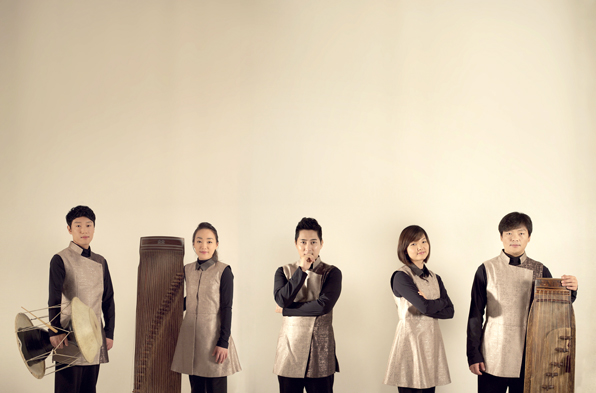 | |
| Ensemble SINAWI members | |
 PREV
PREV
.JPG)
.jpg)
.jpg)
.jpg)
.jpg)












.jpg','Poet Park Gi-dong wrote this poem after he returne..');)


