





Pansori Woven into Children’s Musical
[PAMS Choice Interview] Korean Musical Group TAROO: The Tiger with the White Eyebrows
“Once upon a time, when the tiger used to smoke . . .”
“Give me a rice cake, or I will gobble you up!”
If you grew up listening to or reading Korean folktales, these are some of the familiar phrases you encounter in stories about tigers. Tigers are in fact a popular character in Korean folktales. Sometimes it is portrayed as an animal that is strong and fast but a bit dense and easily tricked by a hare, fox, or magpie. Or, quite contrarily, it may appear as a mystic creature with supernatural powers that enable it to shift its form into that of a human or other animal or to look into the future. At times, it appears in moral tales as a sacred creature that helps the weak, the righteous, or the dutiful son in need and drives away evil.
It is said that there were many tigers inhabiting the mountains of Korea since early times, since much of Korea’s area is mountainous. For that reason, Korea was often referred to as the country of tiger. It is perhaps no coincidence that Hodori (an amicable character taken after Amur Tiger) was chosen as the mascot for 1988 Seoul Olympics. Tiger was the king of the animal kingdom and was adorned with many nicknames, such as san-gunja (noble man in the mountain), san-sinnyeong (mountain god) or sanjung yeong-ung (hero in the mountain). In Korean Musical Group TAROO’s Tiger with the White Eyebrows, one of the works selected for 2013 PAMS Choice, a tiger that possesses supernatural powers appears.
Grr! Still Not Afraid of Me?
The tiger with the white eyebrows is a mystic creature that has lived for not a hundred years, not a thousand years, but far longer than that. The story of this tiger opens with a line about its unusual ability. When it wiggles its eyebrows, its supernatural power awakens, and it can read people’s mind. When the tiger sees someone with an evil mind, it swallows him or her without mercy. Saddened and enraged by the fact that there is no one who does not deserve to be eaten up by him, the tiger decides to go down to a nearby village. There he meets a child with a beautiful, innocent heart, who eventually transforms what he thinks of humans.
Tiger with the White Eyebrows is a pansori musical performance that bestows the audience with the entertainment of four silver-tongued sorikkun (narrative singer) accompanied by a vibrant live performance of Korean traditional instruments. It is a product of a successful collaboration between the devoted professionals in youth theatre and traditional Korean musicals. It is based on a storybook of the same title whose narrative strengths were recognized both domestically and internationally and that was selected as Book of the Year by the Korean Ministry of Culture, Sports and Tourism and translated into French and Japanese. This intriguing story about a thousand-year-old tiger with a mysterious white eyebrows that allows him to look into people’s mind draws children into old Korean folktales and pansori, provides them with a rich artistic experience, and cultivates their imagination. Children who watch the show come out of the theater mimicking the actors’ performance and singing along to their songs. It is a children’s musical that is perfectly tailored to meet the interests and curiosity of children.
In 2013, Tiger with the White Eyebrows won the Seoul Children’s Theatre Award at the Seoul Performing Arts Festival for Young Audiences hosted by ASSITEJ Korea, which rewards the best original children’s musical of the year for its contributions to the field and for encouraging children’s dreams in musical theater. It was also invited to the Jeju Haevichi Arts Festival in June, and TAROO plans to submit this work to the ASSITEJ International Festival of Theatres for Children and Young People this winter.
After receiving grants from the Seoul Foundation for Arts and Culture and completing production at the end of 2011, Tiger with the White Eyebrows premiered at the Eunpyeong Culture and Arts Center and was performed at numerous other locations, including Jayu Theater at the Seoul Arts Center and Seoul Namsan Traditional Theater. Ever since then, the show has been invited by dozens of elementary schools and touring all over the country. You could say it was quite an exceptional success, even for an extraordinary tiger.
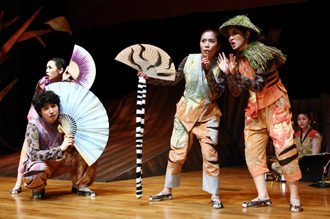 |
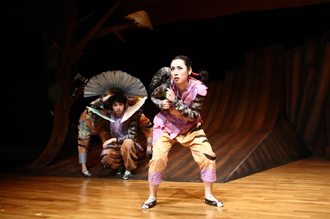 |
| Tiger with the White Eyebrows, a children’s gugak musical |
Doubling the Fun with the Arts Education Director
This traditional Korean musical starts in an unusual manner. Before the actual performance begins, Arts Education Director Park Yeong-ju enters the stage. She first communicates with the young audience by asking them, in the form of riddles, about how actors enter the stage and what kinds of instruments are used as accompaniments.
“Children, do any of you know what that gentleman is called, the one sitting over there and tapping out rhythms with his instrument to support the sorikkun’s (singer) narrative singing?”
“Me, me, me!!”
“Yes, young man in the back. Please speak up.”
“He’s called gosu (drummer).”
“Wow. Gosu is correct. Let’s give a round of applause to that very smart young man.”
“Well, then this time, who can tell me what the short verbal sounds or words of encouragement like eolssu or eoheo that are inserted between the gosu’s drumbeats and the sorikkun’s singing are called?”
“Me, me!”
“Yes, young lady in the middle. Can you tell me what it is?”
“It’s chu-imsae.”
“Wow. Right again. That was excellent. Please give the little lady a great big hand.”
Park Yeong-ju gives a more detailed explanation of the accompanying instruments onstage: how the gayageum in the show has twenty-five strings instead of twelve, which is typical of the original instrument; also, how plastic water barrels or metal pots can be turned into excellent instruments. All of these instruments play their roles perfectly during the musical while the audience is immersed in the performance.
Korean Musical Group TAROO
Korean Musical Group TAROO is an artists’ collective that creates musicals based on traditional Korean music. It was first conceived of by actors who majored in pansori in college. The pan in pansori refers to the place where people gather in traditional Korean performing arts, as in the case of gutpan (shamanistic ritual) or chumpan (open dance stage). Pansori is a traditional popular art form performed at the noripan (performance venue, or literally, playground) that brings together the sorikkun, gosu (lone drummer), and audience. Traditionally, a sorrikkun delivers dramatically composed narrative to the spectators not through typical “songs” but through “stylized narration” (aniri) and “gestures” (ballim) to the accompaniment of drumbeats by the gosu. In November 2003, its unique artistic value was recognized by the global community, and pansori was registered on the Representative List of the Intangible Cultural Heritage of Humanity by UNESCO. With a folding screen and a straw mat, the stage can be set indoors or outdoors for the performers to showcase a lengthy narrative, which can last between three to eight hours. This interesting art of pan, pansori, was a popular art form produced in late Joseon Dynasty and reflected the realities of common people’s life. Masters of pansori were artists in traditional Korean society that played the role of troubadour, composer, singer, and stage actor.
The members of TAROO write their own lyrics. The scripts they have worked on are expressive and characterful. The creative process varies by occasion, but the members make a concerted effort with every piece and create songs befitting each performer. Once the melodies are complete, the composition of the accompanying music follows. Through the hands of the music director, Jeong Jong-im, the music is completed, and then with the touch of the director, Kim Mi-jeong, every work is shaped into a performance piece. This process is repeated every time.
The perfection of the gugak (traditional Korean music) musical as an independent musical genre in Korea is the product of Korean Musical Group TAROO’s unrelenting efforts over the past decade. Although TAROO is currently focusing on children’s plays, they have consistently created and performed works that reflect the questions and issues of the young generation living in this period. Current members playing a pivotal role are the actors Song Bora, Jo Ella, Yi Won-kyoung, Kim Yong-hwa, and the accompanying musicians, which number to the size of a chamber orchestra. But among the former members is Lee Jaram, who won the Best Actress Award in the International Theater Festival Kontakt in Poland in 2010 for her modernized pansori piece, Sacheon-ga. The list of works by TAROO includes some outstanding pieces: Guji-ga; The Story of Cookies; PANSORY, Eats the Applegreen; The Time Seller; Unhyeon-gung Romance; and My Sweet Orange Tree, which is based on the famous book by J.M. Vasconcelos of the same title and was selected as PAMS Choice 2005.
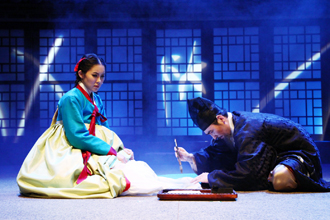 |
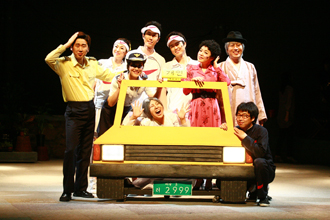 |
| Unhyeon-gung Romance | PANSORY, Eats the Applegreen |
Tiger with the White Eyebrows Maximizes the Appeal of Pansori
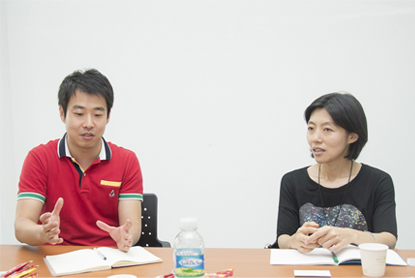
In addition to the ones mentioned earlier, behind the success of this traditional Korean musical for children are Jeong Jong-im (music director) and Kim Mi-jeong (librettist and director) to thank for. Jeong Jong-im is the executive and the final decision maker who overlooks and ultimately has the final say in the musical aspects of the musical.
Kim Mi-jeong studied playwriting in college and majored in youth theatre in graduate school. The Tiger with the White Eyebrows was her first creative work that involved pansori. Prior to that, she worked on writing, codirecting, and acting in children’s plays and made quite an accomplishment in youth theatre. She created Happy Prince with the Theater Company Play BST and won the Best Playwright Award at the ASSITEJ Korea Children’s Theatre Award. She directed Miru’s Sound Box, which was performed by Sookmyung Gayageum Orchestra. She was also chosen to participate in a global collaboration project, Looking for Yoghurt, — which was performed at Daehangno Arts Theater—with other leading theater producers and artists from Korea, Japan, and the UK,.
Kim Mi-jeong has always been interested in pansori. She was fascinated by its dramatic power to take the audience on a mysterious journey through the colorfully painted landscapes and verisimilitude of the characters’ lives just by listening to the stylized narratives of a sorikkun performing in a stripped-down stage setting. She effectively integrated and expressed the elements that she felt were interesting about pansori in Tiger with the White Eyebrows and vividly delivered them to her audience. And that is the strength of the Tiger with the White Eyebrows.
 |
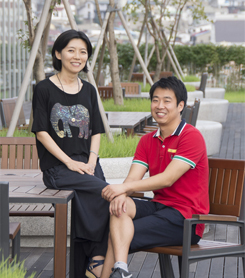 |
| Music Director Jeong Jong-im and Director Kim Mi-jeong | |
 PREV
PREV
.JPG)
.jpg)
.jpg)
.jpg)
.jpg)












;)


