





"I’m a designer who crosses divisions and boundaries to connect with real life"
[PAMS Choice Interview] Pizzas for the People’s Kim Hwang
Viewers never see the artist, only the art. Yet I’ve always wondered about Kim Hwang. This is how his profile reads: “Kim graduated from the metal design department of Hongik University, went to Britain and received a master’s degree in design products from the Royal College of Art. He lives in the Netherlands, where he works as an interaction designer.” Obviously, there were a lot of other details about the artist, but it was strange – I wanted to know the connection between the “designer” title he attaches to his name and the work he has presented to date.
Connecting with Real Life through Design
Q : You talk a lot about “critical design.” Could you explain briefly what you mean by that?
A : Critical design involves a very contradictory approach of trying to get away from the traditional frames of design while remaining within design in a new kind of way. You do have the matter of technique, but what’s typically most essential in design is materiality. So if traditional design is about projecting ideas on that substance, that materiality, then critical design is about taking away all the materiality and communicating only the ideas.
Q : What do you mean by “taking away the materiality”? Are you trying to take design away from its close ties to the capitalist production and distribution system and create art that connects with society in a more practical way?
A : Yes. Art is inseparable from the society in which it is produced. What interests me is the dynamics between the individual and the group. These are not questions any designer could hope to solve on his own. Thanks to my parents, I’ve been interested in the capitalist system and its underside ever since I was a child. Ultimately, I thought my work should start in the here and now, right where I’m standing, and that’s how I work today, too. That’s what enabled me to do things like Cocoon and CCTV.
|
|
|
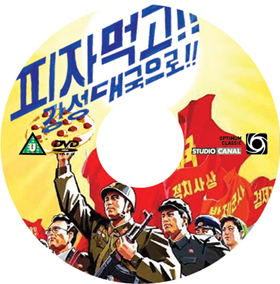
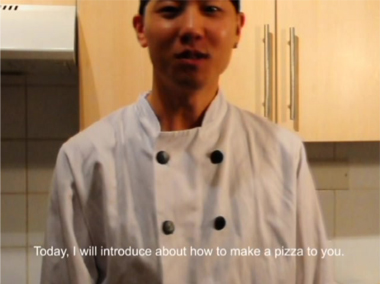
| DVD Title of Pizza recipe | Film clip of Pizza recipe |
Encountering the Theater, Opening Up New Possibilities for Communication
Q : Pizzas for the People drew a lot of attention here and abroad. It was also unusual in how it was produced. Could you talk a bit about the process behind its development?
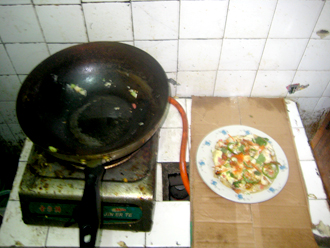
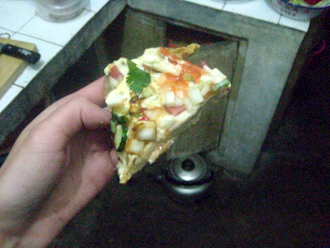
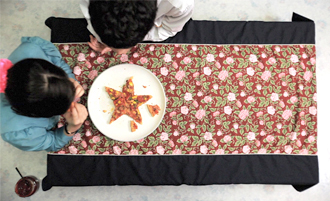
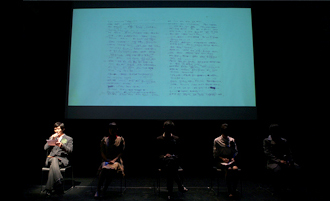
A : I was never very interested in North Korea. But living abroad, I was constantly exposed to the same set of questions: “Where are you from?” “I’m from Korea.” “North or South?” And so I became interested in the issue of the country’s division. So I made 20 videos about making pizza and sent them to North Korea. Then I made another 500, and those were the videos that were shown at Festival Bo:m. But I didn’t start out working with the festival. When I got the performance request from Festival Bo:m, it was after I had already sent the videos to North Korea and was waiting for feedback from the residents there. I had no way of knowing when I would get it. So right up until just a few days before the performance, I had no sense of what I was going to show the viewers or how. I was even thinking about making a follow-up to Pizza and showing that to them. But then I got work from the broker that I had received letters from North Koreans. I think it was about a week before the performance.
Q : Pizzas is offbeat even for you. To begin with, there’s the way in which this design, which you brought into this social horizon as an artist, is now entering the concrete space of the theater and encountering actual viewers who are watching it.
A : To be honest, with exhibitions I’ve been able to package myself to some degree. That wasn’t a possibility with Pizzas. I felt utterly naked. There hadn’t been cases in design where it’s time, rather than space, that’s coming in there in that compressed form. I honestly knew nothing about “site-specificity” or the concrete space. So my biggest questions were, How am I going to make this into theater? How am I going to communicate with the viewer? But when I actually staged the performance, the theater of it was shocking and fascinating. I felt like it was a case where the theme of the nexus between design and society was practiced in the most intensive and artistic of ways. I was starting to feel a bit dismayed about established design methodologies and methods of communications – exhibitions, for example – and this performance ended up giving me a kind of fascination with theater.
Q : The communication that happens in Pizza is bidirectional rather than unidirectional, and extremely multi-layered. The stage isn’t a preformed space, but one that is neutral, fluid. So the message isn’t being communicated by the stage; it only comes across as it encounters the viewer. And there are a lot of different themes, things you could never address in terms of pure political ideology. They trigger an emotional response in the viewer, and the viewer is able to see the stage in a multi-faceted way. If that’s not the “performativity” that people are always talking about in modern performing arts, then I don’t know what is. And it occurred to me that that’s where everything – the videos, the documentary, even the actor’s reading – functions in a very theatrical way within the space of the theater. Of course, by “theatrical” I’m referring to communication that takes place directly between the body of the stage and the body of the viewer. In that sense, this performance was trying something very new both in terms of design and in terms of theater. Did the themes that you got from Pizza lead to the piece you had shown at Festival Bo:m this year, X: I Liked B Better. Y: I Am 29 Too?
A : They did. With X/Y, I was actually trying deliberately to make something more theatrical. I had originally wanted to do something in Tumen, a Chinese village that’s close to the North Korean border. But things were very touch and go politically between North and South, so I had no choice but to do it in Yanbian in China. For the performance, I used Skype, which is a very simple form of online technology, and the captions were done simultaneously by a translator. For that performance, I just made a very basic framework, and then left everything else up to the actors and chance. It’s a very “designer” thing to do. The most important thing for me was to create a technically perfect communication channel, and then cripple it theatrically. So I’ve creating a situation where two groups that are politically and culturally unable to even communicate are suddenly able to do that through various technological means, and then perpetuating it in a theatrical way and making the communication imperfect.
Q : With X/Y, the communication isn’t only between stage and viewer. There’s also a different form of communication within the stage, between stages. In that sense, I thought that the themes you showed in Pizzas – transcending boundaries, crossing borders, communicating – took on a more complex, more theatrical form in X/Y. Two spaces that are completely separate geographically attempt to communicate under these periodic, constrained conditions, yet within that you see another form of communication, other situations that are constructed. The attempts at communication are continually thwarted, but that created a completely different, completely unintended form of communication. It was very ironic, but also very authentic.
A : In reality, the actors on both sides were interpreting it whichever way they felt and responding to that. But those interpretations were actually the result of the actors responding alertly to the given situation and attempting to understand each other. Ultimately, what the actors are exchanging both is and isn’t their own willful interpretation. In that way, I hoped to create a sense of irony that was characteristic of the work itself. It’s all things that are possible but ultimately impossible, utterly impossible yet ultimately possible.
|
|
|
| Feedback from North Korean people | |
Crossing Borders, Crossing Boundaries
Q : Pizza and X/Y helped to artistically enable a dialogue that has been completely impossible politically in Korea in recent years. In that sense, the two performances seemed to embody the kind of “political” described by Jacques Rancière, where you produce a new performance through an aesthetic repartitioning of partitioned senses, things that are distributed by the powerful. The viewer comes away from them with a new perspective that breaks away from the established discourses on “reunification” and “national division.” But I’m sure you encountered a lot of practical constraints in making a performance out of such sensitive topics. . . .
A : With Pizza, you had both sides, the [conservative] government and progressives, promoting it as being linked to their own activities. The government seemed to think it would be helpful in criticizing the North Korean regime and hastening its downfall – the Ministry of Unification promoted it on its homepage. Meanwhile, I think the progressives saw its significance as an attempt to connect with North Koreans. But not long ago, I was scheduled to appear at the invitation of the International Youth Arts Festival in Beijing, and all of a sudden I received word that the Chinese government wasn’t going to allow it to be staged. There are actually a lot of people who are worried about me doing this kind of work. Still, my feeling is, it may be difficult, but I want to take it on. I’d also like to show X/Y again, this time using a real spy camera in Tumen. The National Security Act [Ed.: A South Korean law enacted to restrict activities that threaten the security of the country] is very sticky when it comes to cultural products. But if there’s none of that, if there’s no dialogue or any kind of exchange, I don’t understand how they could condemn the performance. I mean, with X/Y, the actors don’t end up exchanging anything. Of course, that’s just what I think. I thought about talking to a lawyer or an expert, but I never had the chance. I’ve also read the National Security Act backwards and forwards – some of its classifications are really vague. To begin with, it’s vague about what “a North Korean” is. There are too many North Koreans who aren’t North Koreans.
Q : What are your future plans?
A : They involve linking design and performance. I’d like to make my next work more theatrical. Still, at the end of the day my work is about design. That’s what I studied, after all. I may continue working with inter-Korean issues, but I’m more interested in the direction that contemporary East Asian art is headed. Not long ago, a bunch of Korean curators tried to define multidisciplinary art as a genre that emerged in Korea (or East Asia), and I think that was kind of a significant act.
Kim was very sincere throughout the interview. He seemed very enthusiastic when he spoke about his design work. In regard to his new explorations with theater, he spoke cautiously but was full of unlimited curiosity. I asked a very vague question about what he thought theater was. His first response was “the form of art in which spaces and time are most compressed.” He then immediately changed it: “It’s right here, right now.” The question may have been vague, but the answer was quite simple. Still, there may be no more honest or sincere answer to expect from a young designer who has just started expanding his artistic horizons into theater.
|
|
|
| Film work of Pizzas for the People | Performance at Festival Bo:m |
 PREV
PREV
.JPG)
.jpg)
.jpg)
.jpg)
.jpg)












;)


