





Poetry, I, Dream, Body (詩, 我, 夢, 身.)
[PAMS Choice Interview] Park Min-hee’s No Longer Gagok: Four Nights
Gagok: a UNESCO intangible cultural heritage
Have you heard of gagok before? The term refers to traditional Korean vocal music. It has been registered by UNESCO on its Representative List of the Intangible Cultural Heritage of Humanity. However, gagok is not very well-known yet, either in Korea or overseas. As a result, people who do gagok are extremely touchy about two issues, which are introduced below. The gagok performer that I interviewed—Park Min-hee—was no exception. Park shared her thoughts about these two kinds of misunderstandings.
First of all, it is disappointing for practitioners of gagok to hear people refer to modern Korean vocal music as gagok, since gagok in fact is a specific genre of traditional Korean vocal music. However, as Korea was being modernized, the term also came to mean lyrical songs imported from the West such as the German lieder as well as pieces composed by Koreans that take a similar approach. Indeed, the majority of Koreans think of this secondary meaning when they hear the word gagok. As a result, people who sing traditional gagok feel as if their musical term had been appropriated by a genre that came from the West.
Second, these singers are very sensitive about being lumped together with pansori singers despite the fact that they actually sing gagok. While it is true that they both are genres of traditional Korean vocal music, gagok and pansori are extremely different. But pansori is what the general public is familiar with, so they mistakenly assume that gagok performers are just the same as pansori performers. gagok performers get very offended when this happens. gagok has now been registered as an intangible cultural heritage, just like pansori. But despite this, even today gagok remains an unfamiliar genre even to Koreans.
There are not very many practitioners of gagok. While precise statistics are not available, it would not be inaccurate to say that there is only one practitioner of gagok for every ninety-nine performers of pansori, the other traditional Korean vocal music genre. This is why gagok is a precious asset, and also unfortunately why its influence is so weak.
What Park likes is the genre of gagok itself
When I met Park, I found her in one sense to be just like any other practitioner of gagok. As soon as the topic came up, an excitement came into her voice that derived from an embarrassment about how the genre is a “minority inside a minority.” But in another sense, she was very different from anyone else involved in gagok, or indeed in gugak, the larger category of traditional Korean music that includes gagok, pansori, and other genres. I have met dozens of people who are doing gugak, and during the interview, each of them needed no prompting to start talking about their teachers. They began by speaking of their teachers in terms of respect and love, but I could see that deep down they dreamed of being viewed as the equals of their teachers someday. It is typical for practitioners of Korean traditional vocal music to emphasize the artistic school of which they are a part while on the stage, asserting with modesty that they are not nearly so good as their teacher. But there is one artist who does not hide behind her artistic ‘pedigree’ but focuses on her story—and that is Park Min-hee. “I just like gagok,” Park told. “I’m not interested in the tradition of gagok, or in people who do gagok. I don’t see any point in talking about that.”
|
|
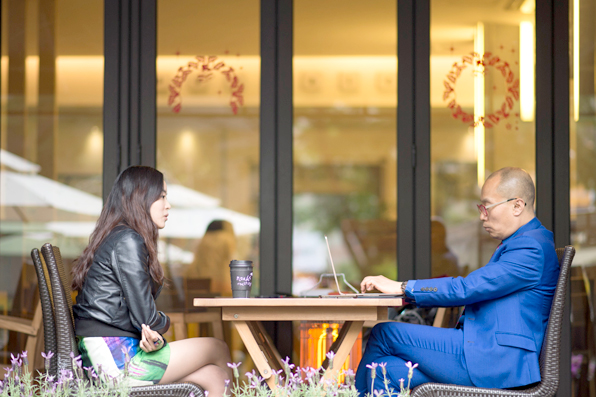
| Park Min-hee and Yoon Jung-gang during the interview |
As Park understands it, gagok is poetry
What was it that drew Park to gagok? How does she bring gagok to other people? She says that gagok equals poetry. In that case, what does she understand poetry to be? It appears that, Park regards the feeling contained in poetry as being more important than whatever form poetry may assume. While she is no doubt also interested in the rhythm of poetry, she seems to pay more attention to the emotion found in poetry. Poetry, as she sees it, is the most confidential form of art, the art that bares its soul. And she has preferred to express that confidential emotion through the fantastic method of gagok (fantastic in the sense that her works began as dreams). No Longer Gagok, the work by Park that was selected for the PAMS Choice, started from poetry in the same way. Park considers poetry to be appropriate for a confidential revelation of herself. She portrays that kind of poetry in the form of four days of diary entries, and those diary entries came out of her dreams. Park has chosen this method of creating a “fantastic” atmosphere and then ultimately using that to reveal what is inside the ego known as Park Min-hee. As part of that process, she naturally offers up the genre of gagok, and she hopes that the audience will also naturally accept that kind of gagok.
During the course of interview with Park, I realized that the same four words were occurring repeatedly. In addition to “poetry,” these were “I,” “dream,” and “body.” The central character in Park’s performances is Park herself. She is very direct about putting “I” at the center. This is radically different from the standard approach among gugak practitioners of putting forward a teacher, an artistic school, or gagok itself. The Park Min-hee that exists inside of Park’s performance—that is to say, “I,”—is a typical young woman of the current generation. She is a woman without any particular distinguishing characteristics: a woman who gets caught up in fads, loses sleep worrying about men, and deals with nightmares.
The unusual thing is that she is portraying such an “I” through the medium of gagok.
Each time that gagok makes an appearance, it is taken for granted that one is taking a trip back in time, 100, 200, or 300 years ago. People tend to think that gagok was the vocal music sung during the Joseon Dynasty. Gagok brings to mind people who lived back then: Hwang Jin-i, the femme fatale, or Shin Saimdang, model of the virtuous mother and loving wife, whose son was the illustrious scholar Yi I. This is true both in terms of time period and also in terms of personality. However, the feminine vision that Park portrays is completely divorced from the past, both in terms of time period and in terms of personality. Park’s performances present a universal woman of the current age.
Park is attached to dreams, and this is especially true in the work to which PAMS Choice introduces us. There are two words that are connected with her dreams: dreams are hope, and dreams are fantasy. Park uses dreams in this way both to twist everyday life around and to examine things that are in actuality impossible. Looking at her obsession with dreams, one can ascertain with clarity that both gagok, and Park herself, are located between the fantasy and the hope of dreams.
Park stands out most in connection with the word “body.” In extreme terms, gagok could be defined as an art form in which there is a mouth but no body. The woman who is singing gagok is rather like a snapshot or a screenshot. In extreme terms, the best way to sing gagok, traditionally speaking, may well have been to offer the sound without ever revealing how that sound was produced through the motion or the appearance of the body. But Park is different. She attempts to use her body to show the melody and rhythm of gagok to the greatest possible extent. This is exactly why I pay attention to Park as an artist. Sometimes, Park’s emphasis on “I” and dreams makes her seem to be no more or less than someone wavering between feelings of superiority and inferiority, and sometimes the sense that she seems to have imprisoned reality inside the dream and be indulging in worry for its own sake causes disappointment and frustration. Nevertheless, my point is that, when I see her using her body to give gagok a concrete form, I feel that there is something great about this young artist.
It appears that Park has used this method to transform the traditional artform of gagok into a fusion genre we might call “no longer gagok.”
This is especially valuable because Park’s thoughts and actions related to the body contrast with the traditional (and, in particular, feminine) understanding of the body in Korea. In the traditional (and Confucian) Korean way of thinking, the body is viewed as being separate from the mind. Using an extreme dichotomy, the body could be called the eruption of desire, and the mind the thing that controls that eruption. People often say that people sing gagok in order to “develop character.” To be sure, gagok is music (and thus, by definition, pleasurable), but because the emphasis is placed on finding a justification for that music, the pleasure that gagok can offer is less important than the morality it can inculcate. Perhaps this could be expressed by saying that, traditionally, gagok has served as an “oral” way to achieve a “moral” purpose. Park expresses gagok, which she views as poetry, through the medium of her own body. First, she brings a journal in which she had jotted down her dreams and then converts the text of the journal into the text of a song. And ultimately, she tries to realize this in the text of her body. Thus, for Park, gagok in the end serves as an important text (book), for a bodily performance.
|
|
|
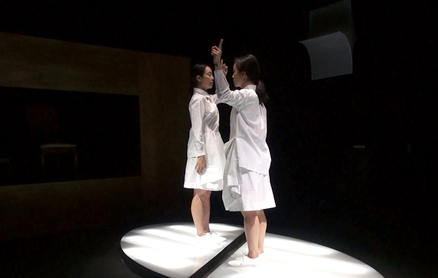
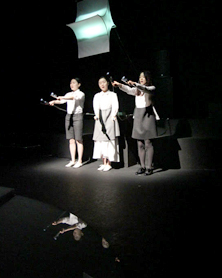
| No Longer Gagok : Four Nights | |
Not modernization, but translation, of gagok
Despite this, Park shudders when she hears anyone talk about the “modernization” or the “popularization” of gagok. She is also skeptical about talk of helping gagok change or develop. She thinks of her own artistic work as a kind of “translation” of gagok. It occurs to me that what Park hopes to accomplish through her gagok (that is “no longer gagok”) is offering people today who don’t know much about the genre a translation of gagok into a more contemporary language that is easy to understand.
Park’s performances are always worth seeing—wherever or whenever they may take place. First, they teach us about the unfamiliar genre known as gagok. And she is not teaching us gagok by dressing it up in Western chords and instruments, but she is rather showing us the fundamental possibility of gagok itself—through a method that presents itspure, unadulterated sound. Second, these concerts emphatically present “I,” that is, the artist herself. That sometimes manifests as a feeling of superiority, and sometimes as a feeling of inferiority. As we view this side of Park, it ultimately becomes clear that this image is in the end not very different from “I.” While Park shows off “I” more than anything else, we know that this showing off is, in the final analysis, a howl filled with the desire to communicate with the world. Even if this approach sometimes seems a little clumsy, it is only by using such a method that Park can advance to the next level. This applies not only to Park, but is in fact the reality in which the genre of gagok finds itself.
Thus, through Park’s concerts, we see Park, and we see gagok. Beyond that, we find ourselves seeing “I” and seeing all of our dreams, our attempts to find our own unique path through trial and error. This is developed through Park’s modest yet vigorous physical presence. And undergirding the base of these concerts is the vocal music of gagok, which has been sung in Korea for many long years. Here we have gagok, the value of which is recognized all the more because of its scarcity, and Park, who is singing it! Her music is an attempt to escape from the scarcity of gagok by using it as a medium, which also reflects the dilemma faced by contemporary art and fusion genres, thus giving it a curious resonance.
|
|
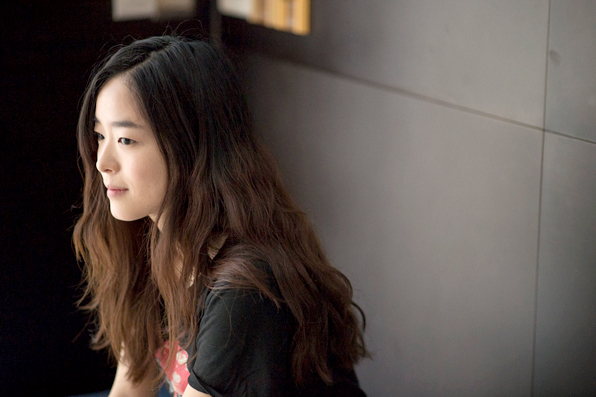
| Park Min-hee, singer |
 PREV
PREV
.JPG)
.jpg)
.jpg)
.jpg)
.jpg)












','http://www.theapro.kr/eng/now/now_view.asp?idx=1198','http://www.theapro.kr/DATA/BBS1/upload20130708_simg01_001.jpg','Have you heard of gagok before? The term refers to..');)


